

Quick Answer: How Did a Chinese Incense Clock Work?
A Chinese incense clock used the progress of burning incense to mark elapsed time. A trail of powder could be laid in a pattern of known duration. A stick could also serve as a measure when its burn time was familiar.[1][3][4]
- A powder trail: A stencil helped define the path the glowing edge would follow.[1][2]
- A stick: A familiar length and preparation could mark an approximate interval.[1][3]
- A signal: Some designs gave a signal through sound or a change of scent.[1][4]
The burn measured an interval. Its length depended on the preparation and the conditions in which the incense burned.[1][3][4]
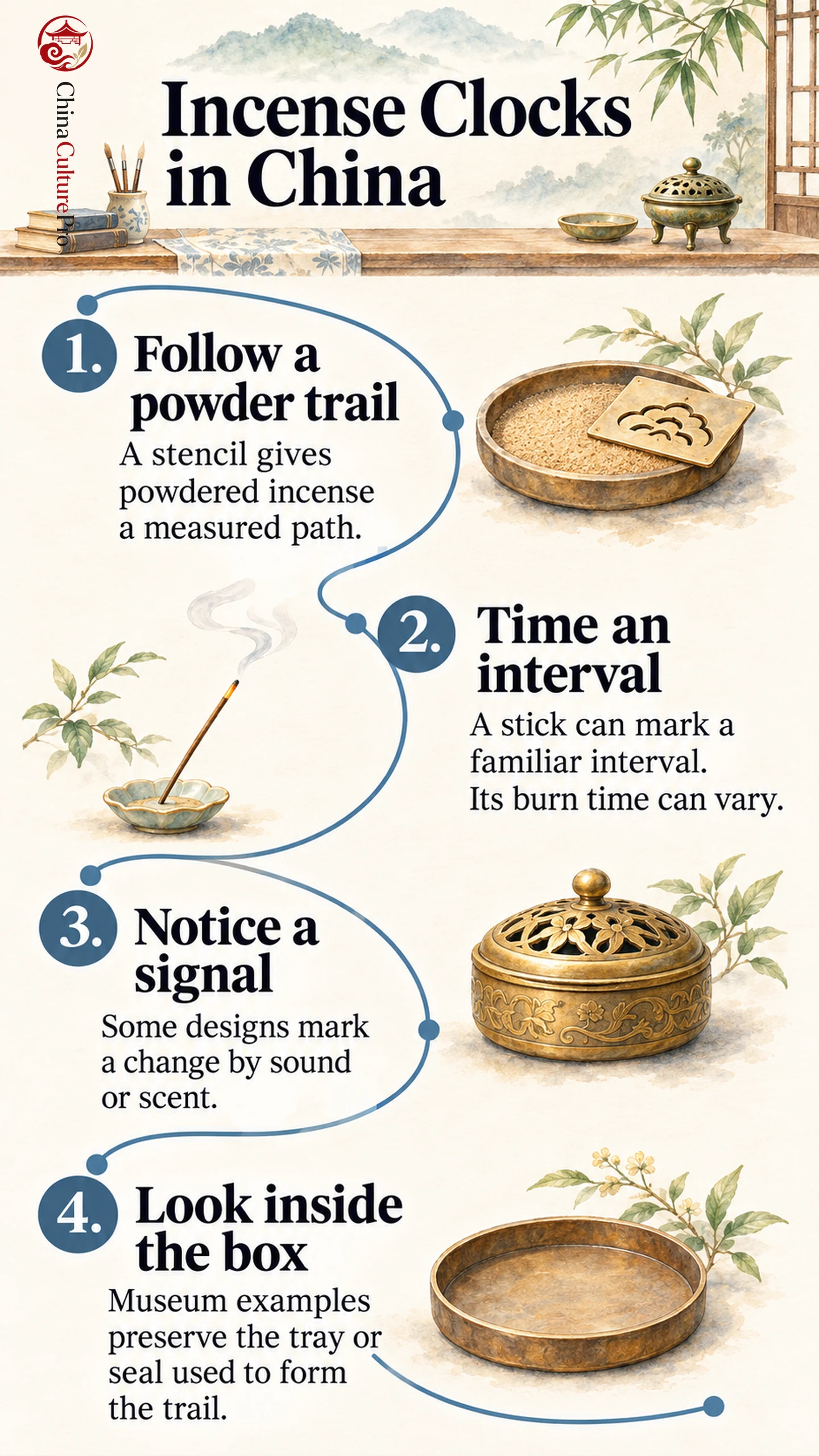
A lidded metal box can look like an ordinary incense burner until you find the stencil. The stencil shows how the maker fitted a timed trail inside the box. The path or length of the incense gives the burning material a way to mark elapsed time.[1][2]
What a Powdered Incense Clock Measures
In one kind of clock, a stencil guides powdered incense into a continuous pattern. The Chinese incense seal (香篆, xiāngzhuàn) takes its name from the way the powder trail forms a patterned or character-like design. When one end is lit, the glow moves along the trail. Under comparable burning conditions, a longer path can mark a longer interval.[1][2][3]
The length of the path matters more than the width of the box. A compact case can hold a winding trail that fits into a small area. A museum clock may preserve more than one pattern or tray, allowing different intervals to be represented within the same case.[1][2]
How a Stick Could Mark an Interval
Incense sticks offered a simpler reference. Chinese writing sometimes measures an interval as “the time of one incense stick.” Its practical length depends on the stick and the burning conditions. A familiar local form could be understood in context even when the text does not give a modern minute equivalent.[1][3]
Some incense timekeepers offered a second kind of cue. A sound could announce that the burn had reached a particular point. Some preparations used different scents to distinguish stages. These features let a person notice a change without continuously watching the glowing end.[1][4]
The method also contrasts with Chinese water clocks, which used flowing water to mark elapsed time. Both methods turn a gradual change into a measure that can be observed or signaled.[3][4]
What Two Museum Clocks Show
Science Museum Group object 1952-184 preserves a metal incense clock with a patterned lid and additional parts used to form a trail. In this type of clock, the lid can be decorative, while the interior stencil identifies where the incense lay. A visitor looking at the exterior alone may miss the part relevant to timing.[1]
A Horniman Museum clock preserves a seal that forms a longevity character. Its upper tier held fine ash beneath the powder. The character gives the object a visual subject as well as a burning path. The meaning of the shou character helps explain that decorative choice. The museum account also records later associations with meditation and aesthetic use.[2]
FAQs About Chinese Incense Clocks
How long is the time of one incense stick?
There is no fixed conversion for every historical use of the expression. An interval depends on the stick’s length, preparation and burning conditions.[1][3]
Was every incense burner a clock?
A burner can hold incense without using it to mark time. A timing path, a familiar burn duration or a dedicated signal gives a timekeeper its particular function.[1][2][4]
Did incense clocks have dials?
The examples described here use a length or trail of incense as the timing element. A patterned container can give a visible indication of progress without a dial and moving hands.[1][2]
Источники
[1] Science Museum Group. Chinese Incense Clock, Object 1952-184
[2] Horniman Museum and Gardens. Incense Clock With a Longevity Seal
[3] Silvio A. Bedini. The Trail of Time: Time Measurement With Incense in East Asia
[4] Science Museum. No Smoke Without Fire