

Quick Answer: How Do Century Eggs and Salted Eggs Differ?
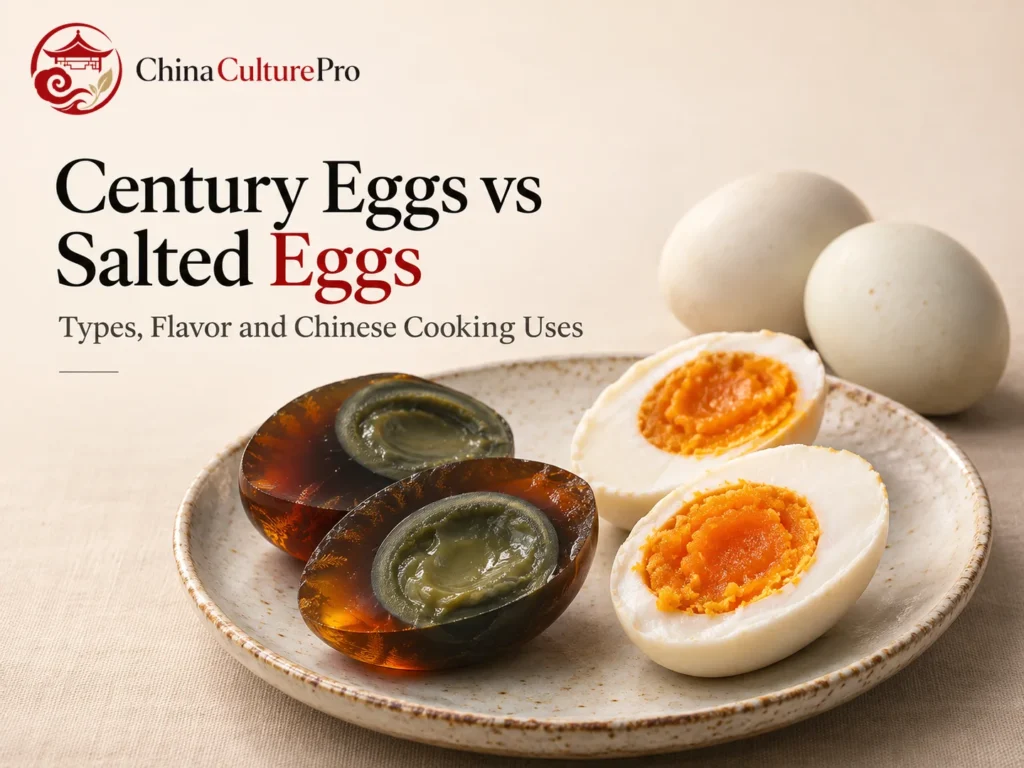
Century eggs (皮蛋, pídàn) are alkaline-cured eggs with dark, jelly-like whites and greenish-gray yolks. Salted eggs (咸蛋, xiándàn) are salt-cured eggs; after cooking, they usually have opaque white albumen and golden-orange yolks. Duck eggs are common starting materials for both, but the processing and finished eating qualities differ.[1][3]
- Century eggs: Known for a springy gel, creamy yolk and pronounced alkaline-cured flavor.
- Salted eggs: Known for saltiness and a rich, often grainy cooked yolk.
- Shopping check: Salted eggs may be sold raw or already cooked; curing alone does not tell you which.
Both can accompany porridge, but they are not interchangeable ingredients for a filling or sauce.
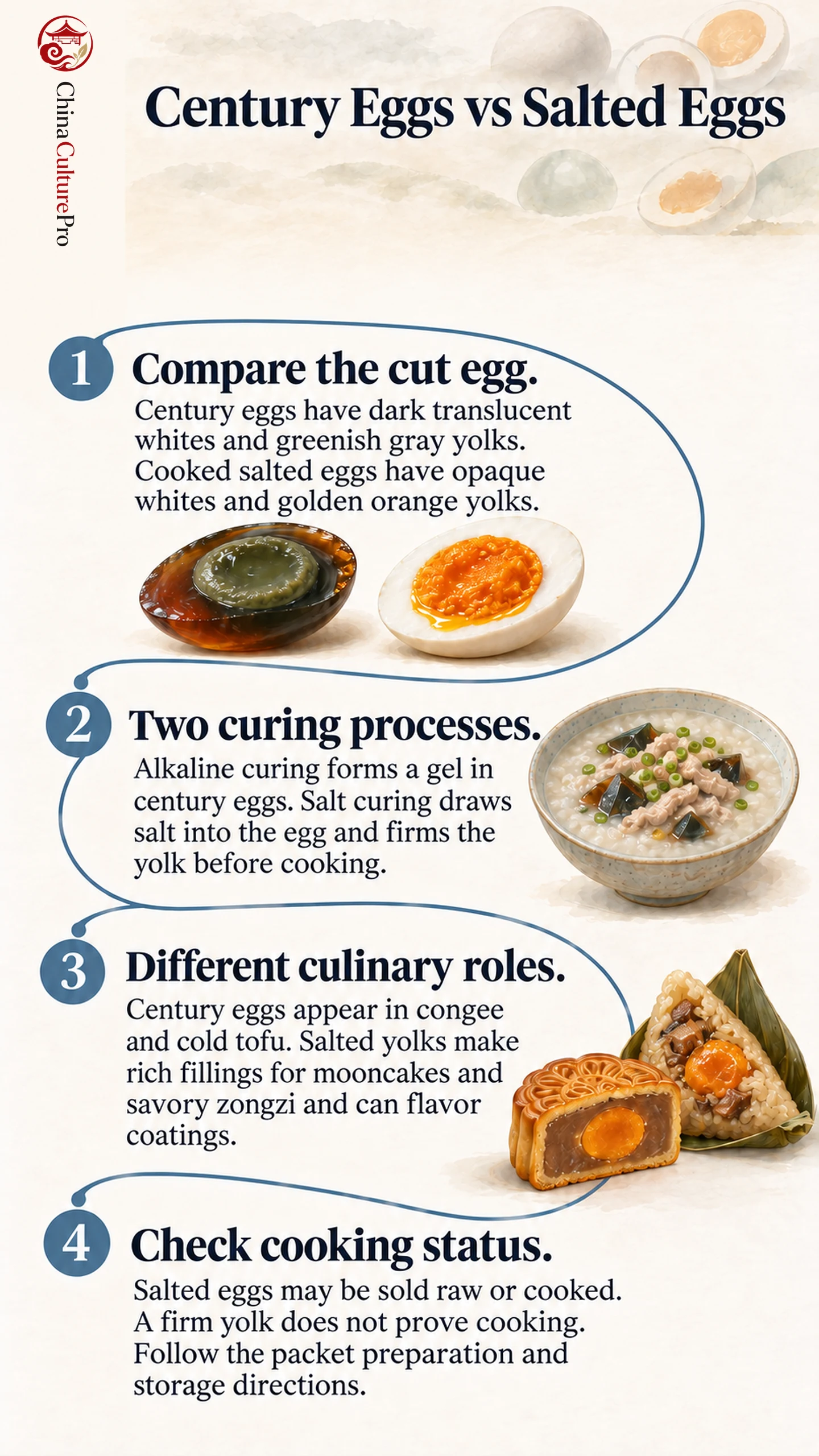
A dark wedge in congee and an orange yolk inside a pastry come from different kinds of preserved egg. Compare the treatment, the cut surface and the intended dish, then check the packet’s cooking status before deciding how to use it.
A Side-by-Side Look at the Egg Inside
The peeled interior gives a clearer comparison than the shell. For more on the first ingredient alone, see century eggs.
| Характеристика | Яйцо пидан | Cooked salted egg |
|---|---|---|
| Preserving treatment | Щелочная выдержка | Salt curing, followed by cooking |
| Белый | Translucent amber-brown and jelly-like | Opaque white and set |
| Yolk | Greenish-gray to dark, with a soft or firmer center | Golden-orange, rich and often grainy or oily |
| Главный акцент вкуса | Savory, mineral and distinctly aromatic | Salty and rich, especially in the yolk |
Century-egg centers range from creamy to more firmly set; salted yolks vary in color and oiliness.[5][6]
Alkaline Curing and Salt Curing Do Different Jobs
Alkaline curing raises the egg’s pH and changes its proteins, which aggregate into a gel. It also produces the characteristic brown egg white and greenish-dark yolk. Sulfur-containing compounds contribute to the distinctive aroma. The altered appearance comes from curing rather than ordinary aging.[1]
Salted eggs follow a different route. Salt enters through the shell during curing in brine or a salted coating. In experimental duck and chicken eggs, salt increased in the white while the yolk lost water and became firmer. That firming happens during curing, before the later cooking stage.[2][4]
Heating a raw salted egg then sets its white. A well-cured cooked yolk can have a sandy, granular bite and release some oil. This granular texture is distinct from a century egg’s gel.[2][3]
Congee, Cold Tofu and Salted-Yolk Fillings
Century egg and pork congee (皮蛋瘦肉粥, pídàn shòuròu zhōu) combines chopped preserved egg, pork and rice porridge. Century egg tofu (皮蛋豆腐, pídàn dòufu) pairs the egg with silken tofu and a dressing. These dishes showcase the egg’s flavor and texture alongside a milder base.[5][10]
Salted egg yolks (咸蛋黄, xiándànhuáng) have a different filling role. They appear inside mooncakes (月饼, yuèbǐng) and savory zongzi (粽子, zòngzi), contributing a rich, salty center. These are optional fillings.[3]
Cooked salted eggs can also accompany plain congee. Salted yolk is used beyond whole fillings, including coatings for pumpkin or seafood. Its salty richness is the point; substituting century egg changes the dish.[6]
Buying, Cooking Status and Storage
Read the product name and preparation directions. Raw salted eggs have not been cooked, even when their yolks already feel solid; their whites can remain liquid. Cook raw salted eggs thoroughly before eating. Already-boiled products are a separate retail option.[2][8]
Century eggs are commonly sold ready to eat, and they can also enter cooked dishes. Follow the packet’s directions. For menu wording, see Chinese food names.[5]
Choose clearly labeled products with intact packaging and unbroken shells. Follow their storage directions: one already-boiled salted-egg product specifies a cool, dry place unopened and refrigeration after opening.[7][9]
Use clean hands and utensils when handling eggs, and keep prepared cold egg dishes refrigerated.[8]
FAQs About Century Eggs vs Salted Eggs
Правда ли яйцам пидан сто лет?
No. The English name is figurative; alkaline curing creates their characteristic appearance, rather than a century of storage.
Are century eggs and salted eggs always duck eggs?
Duck eggs are common, but not compulsory. Century eggs can use chicken or quail eggs, and chicken eggs can also be salt-cured.
Can century eggs replace salted egg yolks in mooncakes?
They would make a different filling. The dark gel and creamy center do not reproduce a salted yolk’s rich, grainy texture.
Does a solid salted egg yolk mean the egg is cooked?
No. Curing can firm the yolk while leaving the white liquid. Check whether the product is raw or cooked and follow its preparation directions.
Источники
[1] Hong Kong Science Museum. How Do Duck Eggs Become Century Eggs?
[2] Taiwan Food and Drug Administration. Salted Eggs: Raw and Cooked Products
[3] Lin Rongxin, Ministry of Agriculture knowledge portal. Making Salted Eggs: Ingredients, Texture and Uses
[4] Fukunaga and colleagues, Japanese Society for Food Science and Technology. Changes in Duck and Chicken Eggs in Sodium Chloride Solution
[5] Sarah Leung, The Woks of Life. Century Eggs: Flavor, Texture and Culinary Uses
[6] Judy Leung, The Woks of Life. Salted Duck Eggs: Flavor and Culinary Applications
[7] Doshee. Boiled Salted Duck Eggs: Product Type and Storage
[8] Hong Kong Centre for Food Safety. Food Safety of Eggs and Egg Products
[9] Changhua County Public Health Bureau. Choosing Preserved Eggs
[10] Judy Leung, The Woks of Life. Congee with Pork and Century Egg