


Quick Answer: What Are Buddhist Vegetarian Fasting Days?
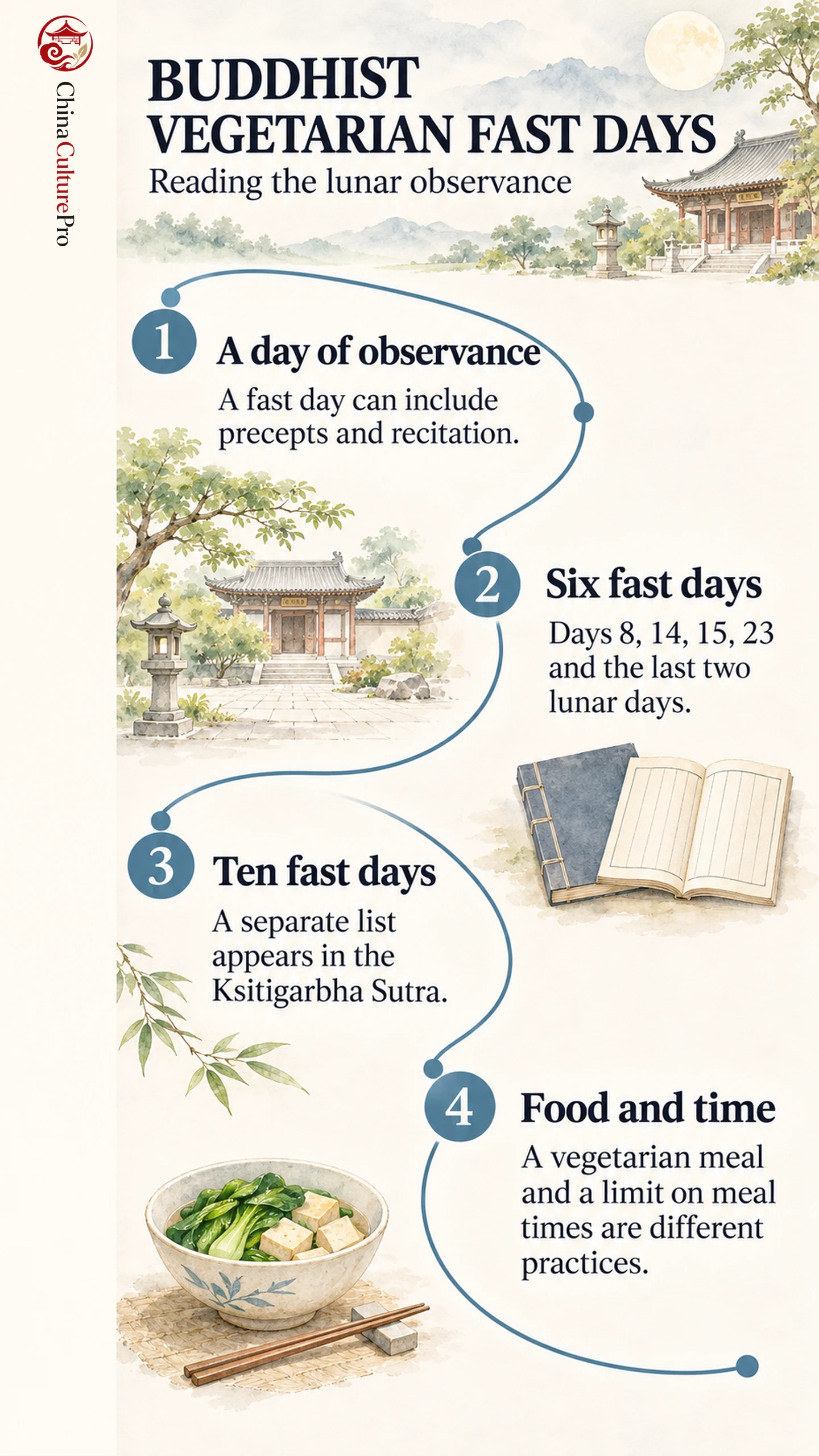
In Chinese Buddhist practice, a fast day (斋日, zhāirì) is a day set aside for religious observance. Some lay Buddhists keep a vegetarian diet on these days. An observance can also involve precepts, recitation or restrictions on when food is eaten.[1][3]
- Six fast days (六斋日, liù zhāirì): A common pattern includes days 8, 14, 15 and 23 and the last two days of the lunar month.[3][4]
- Ten fast days (十斋日, shí zhāirì): A list of ten dates appears in the Sutra of Ksitigarbha’s Fundamental Vows.[2]
- Calendar: The dates use lunar months. The closing dates in a 29-day month can be adjusted by a temple or calendar publisher.[3][4]
These patterns help interpret a notice or calendar. A specific temple’s dates and practices come from its own schedule.
A notice mentioning zhai can refer to the day, a discipline associated with it or a meal. The word’s range helps explain why a vegetarian feast and a day of restraint can both be described in related terms.
What Zhai Meant in Buddhist Practice
Eric Greene discusses a fourth-century Chinese text by Xi Chao that called on lay people to abstain from meat and fish on fast days and eat before noon. These are two separate conditions: one concerns the food and the other the time. Buddhist sources on the eight precepts also describe a wider period of restraint. Lay fast days are periodic observances. Monks and nuns follow the longer-term rules of Chinese Buddhist monastic discipline.[1]
Six and Ten Fast Days on the Lunar Calendar
The dates are numbered within Chinese lunar months. The standard lists below are easiest to compare in a month that has 30 days.[2][3][4]
| Observance | Dates in a 30-day lunar month |
|---|---|
| Six fast days | 8, 14, 15, 23, 29, 30 |
| Ten fast days | 1, 8, 14, 15, 18, 23, 24, 28, 29, 30 |
Some calendars use days 28 and 29 for the final two entries of the six-day list when the month ends on day 29. One published ten-day calendar also moves its last three entries to days 27 through 29 in a short month. Check the specific calendar before carrying the final numbers from one month into the next.[3][4]
How to Read a Vegetarian Meal in Context
Historical descriptions use zhai for vegetarian food (素食, sùshí) served at some midday feasts. A meal might be offered on a recurring observance or for a special event such as Buddha’s Birthday. In a painting or photograph, a food offering can show the practice of giving. An accompanying notice or inscription can establish the occasion.[5]
FAQs About Buddhist Vegetarian Fasting Days
Are these dates on the Gregorian calendar?
They are lunar day numbers. The Gregorian dates move from month to month and year to year.
Does a fast day always mean going without food all day?
Historical descriptions include meals at or before midday. Some observances combine a limit on meal times with vegetarian food and other precepts.
Do the six-day and ten-day patterns overlap?
Yes. The ten-day list includes the six dates in a 30-day month and adds the 1st, 18th, 24th and 28th.
Источники
[1] Eric M. Greene. A Reassessment of the Early History of Chinese Buddhist Vegetarianism
[2] Dharma Drum Institute of Liberal Arts. Buddhist Glossary: The Ten Fasts
[3] Waken Temple. The Temple: The Fast Days
[4] American Buddhist Citizens’ League. Mahayana Buddhist Vegetarian Observances
[5] Kenneth K. S. Ch’en. Buddhism in China: A Historical Survey