
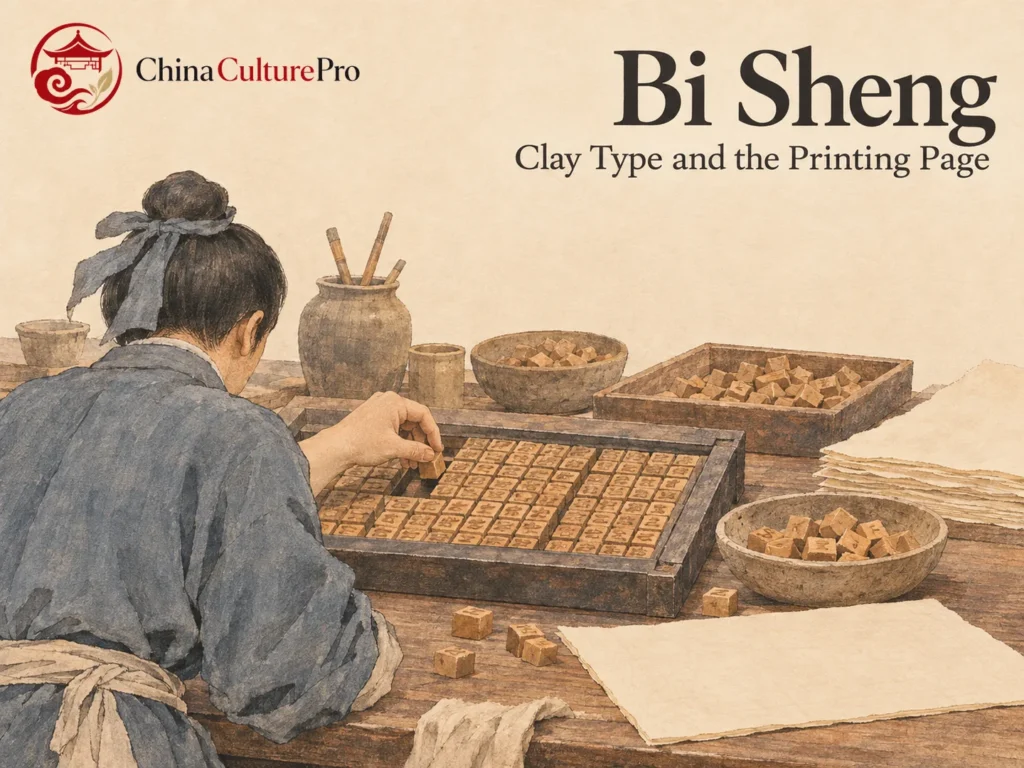

Quick Answer: Who Was Bi Sheng?
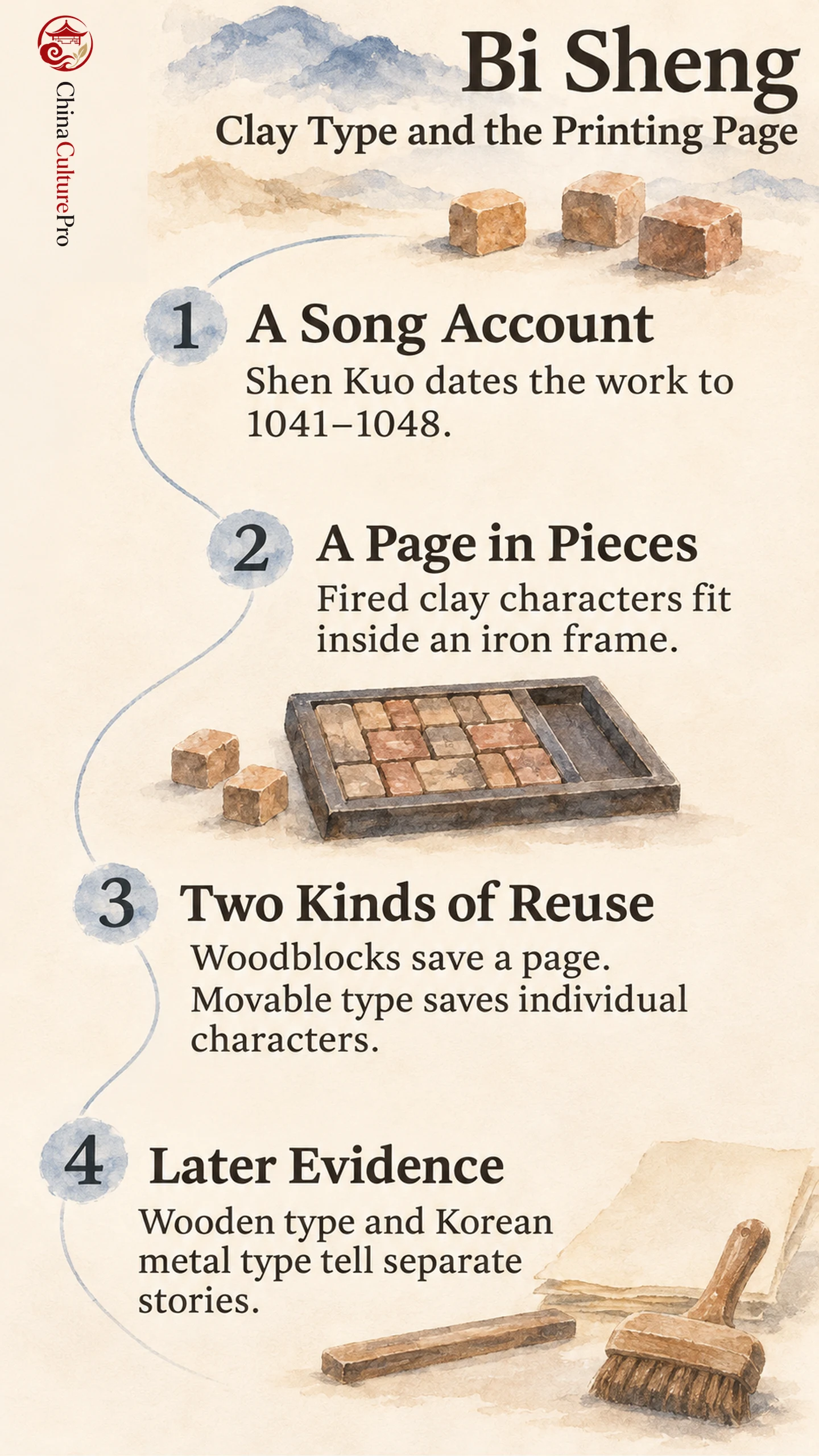
Bi Sheng (毕昇, Bì Shēng) was a commoner of the Northern Song (北宋, Běi Sòng) credited with making reusable clay printing type. Shen Kuo (沈括, Shěn Kuò) recorded his method in the Dream Pool Essays (梦溪笔谈, Mèngxī Bǐtán) and placed it in the Qingli era (庆历, Qìnglì), 1041–1048.[1][2]
- The change: Movable type (活字, huózì) let a printer assemble a page from separate characters and take the page apart afterward.[1]
- The material: The account specifies fired clay characters held in an iron frame.[1]
- The evidence: Shen Kuo records both the procedure and what he says happened to the type after Bi Sheng’s death.[1]
Shen Kuo gives a fuller account of the printing method than of the inventor’s life.
With a carved woodblock, a single page stays intact from one printing to the next. Bi Sheng’s page could be taken apart. Its characters could then appear on different pages in a different order. The idea is familiar today, but the Song account is worth reading for the problems it sets out to solve. Getting the characters level, finding the right pieces and keeping a page ready while another was printing all took separate decisions.
What Shen Kuo Tells Us About Bi Sheng
The relevant passage is in the technical arts chapter of the Dream Pool Essays. Shen Kuo identifies Bi Sheng as a commoner and dates his work to an era within Emperor Renzong’s reign. He says that relatives of his obtained the pieces after Bi Sheng died and kept them. The era name locates the work within the 1040s. The statement about custody tells us that the author knew where the pieces went after the inventor’s death.[1][2]
The author gives no extended biography. Many familiar questions about Bi Sheng, including how he learned his craft or what project first led him to try separate pieces, lie beyond the passage. A precise life story would require evidence besides this account.
What Shen Kuo does provide is a sequence of choices. He tells readers what the pieces were made of, how they were aligned and why wood behaved poorly in this particular setup. That level of detail makes the text useful for understanding technical work in the Song dynasty. It still leaves historians without an identified edition from which to study Bi Sheng’s page design directly.[1]
How Clay Movable Type Made a Page
The printer cut individual characters in clay and fired them until hard. For a page, the pieces were arranged inside an iron frame on a plate coated with a mix of resin, wax and paper ash that softened with heat. Pressing the assembled type against a flat surface brought its faces to an even height. With the page printed, the bed could be warmed again and the characters released.[1]
A type stock needed duplicates as well as a wide range of characters. If a common character appeared many times on one page, the printer needed enough copies to set every occurrence at once. Shen Kuo mentions multiple copies for common characters, storage indexed by rhyme and the option of making a missing piece when needed.[1]
The account also describes two plates in use. One could carry a page that was already printing while the other was being set. Alternating them overlapped two tasks that otherwise would have followed each other. The arrangement helps explain why Shen Kuo describes the system as most useful for runs larger than a few copies.[1]
Readers familiar with Chinese characters can look at one line of a printed page and count both how many distinct signs it uses and how many times the most common one recurs. Both numbers matter to the person retrieving type from storage.
Why Printers Kept Using Woodblocks
The British Library’s Diamond Sutra (金刚经, Jīngāng Jīng) scroll from Dunhuang is dated 868. It was printed from woodblocks more than a century before the Qingli period. The scroll offers direct evidence of the older process. The account of clay type comes from a different kind of source.[3]
A printer with an intact block could reuse the same page layout for a later run. Type became available for other pages after a forme was disassembled, and the original layout would then have to be set again. The choice depended partly on what a printer expected to do with the material after the first printing.[1][4]
Chinese publishers continued to print with woodblocks even when movable type was available. The reuse of individual characters was one advantage among others, including the initial cost of the type stock, the work of finding and setting pieces, and the ability to store a carved page. A wider history of printing in China helps explain why the two methods continued alongside each other.[4]
What Later Movable Type Can Tell Us
In China, the Yuan official Wang Zhen (王祯, Wáng Zhēn) is associated with a documented wooden-type system around the end of the thirteenth century.[4] The career of Bayan of the Yuan helps place Wang Zhen’s era after the change of dynasty.
Wood’s performance depended on how the characters were made and held. Shen Kuo’s objection to wood in a heated adhesive bed belongs to the specific method he described.[1]
A second comparison comes from Korea. UNESCO records the surviving second volume of Jikji as printed at a temple in Cheongju in 1377 using movable metal type. Its date is the date of a particular surviving printed object. Bi Sheng’s earlier date comes from a written account of clay type, so the two dates answer different historical questions.[5]
In Rui’an, Zhejiang, a documented tradition of wooden movable type has been used to print family genealogies. That work gives readers a way to picture sorting, setting and storing individual pieces. Bi Sheng’s place among the Four Great Inventions is easier to understand when the broader label “printing” is broken down into specific materials and processes.[6]
FAQs About Bi Sheng
Did Bi Sheng invent printing?
Bi Sheng is credited with developing clay movable type. Woodblock printing was already established, as the dated 868 Diamond Sutra shows.[1][3]
Did Bi Sheng use metal movable type?
Shen Kuo describes characters made of fired clay. The plate and the frame holding them were iron.[1]
Does a book printed by Bi Sheng survive?
There is no securely identified surviving book attributed to his own clay type. The principal evidence for his method is Shen Kuo’s description.[1][4]
Источники
[1] Shen Kuo. Dream Pool Essays, Volume 18, Movable Type
[2] Academy of Chinese Studies. Bi Sheng and Movable-Type Printing
[3] British Library, International Dunhuang Programme. Diamond Sutra, Or.8210/P.2
[4] Columbia University, Asia for Educators. Song Dynasty China: Printing
[5] UNESCO Memory of the World. Jikji, Volume II
[6] UNESCO. Wooden Movable-Type Printing of China