

Quick Answer: What Are the Four Great Inventions of China?
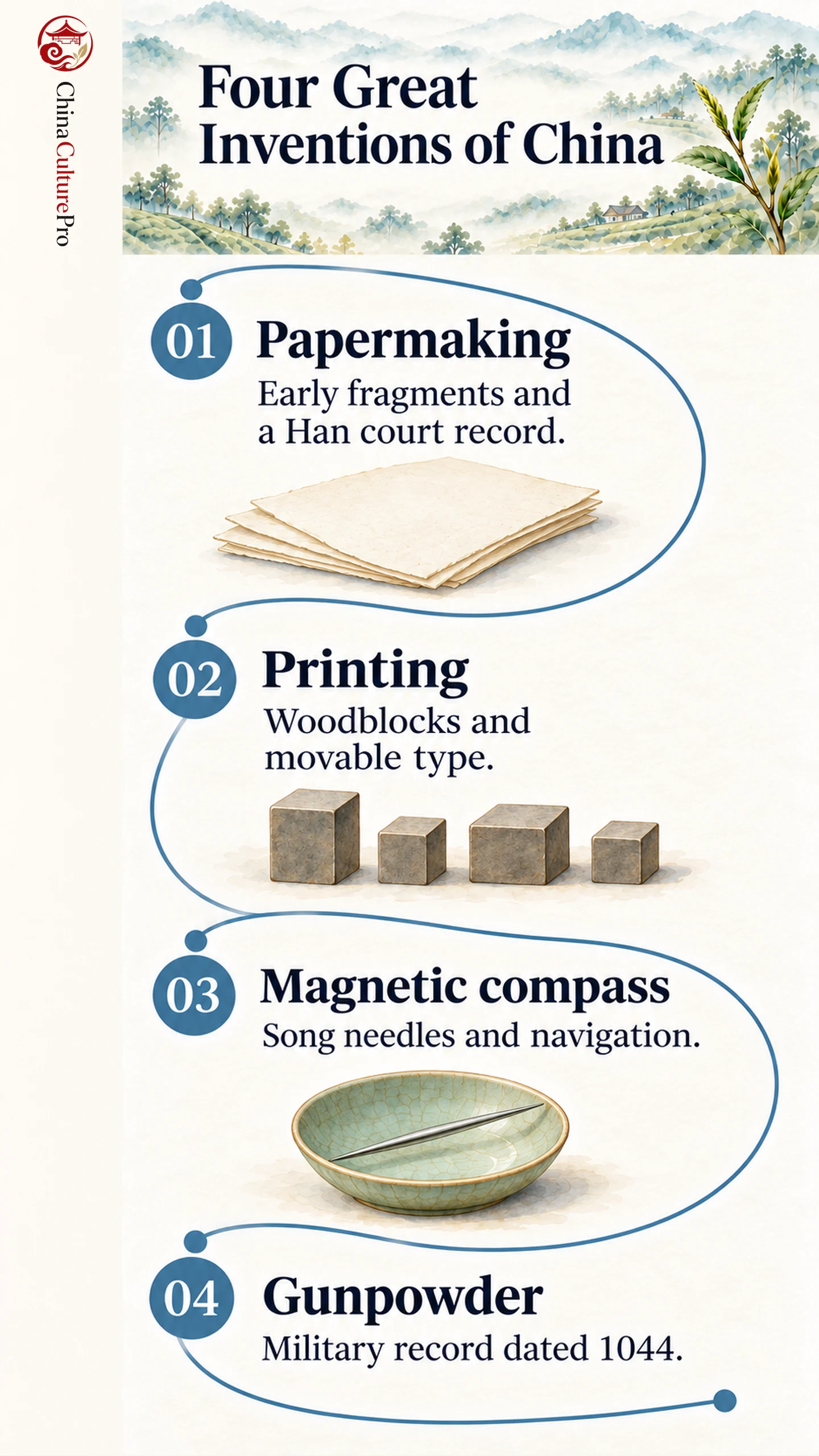
The Four Great Inventions (四大发明, sì dà fāmíng) are papermaking, printing, the magnetic compass and gunpowder. They changed how people recorded information, made copies, found directions and used combustion.
- Papermaking: Surviving early fragments predate the Han court account that credits Cai Lun (蔡伦, Cài Lún) in 105 CE.
- Printing: An 868 woodblock scroll and a Song description of movable type document different methods.
- Magnetic compass: Song texts describe magnetic needles and their usefulness to navigators.
- Gunpowder: A military compilation completed in 1044 records its use as a material of warfare.
The names form a later grouping. Each technology has its own chronology and history of adoption.
A piece of paper could carry one handwritten message. A printing block could put the same message onto many sheets. The two techniques worked together, but each solved a different problem. The compass and gunpowder have different histories again. This comparison of four well-known Chinese inventions starts from what can actually be dated. [1][2][3][4][5][8][9][10]
The Four Great Inventions at a Glance
These milestones date the object or record in each row. An early fragment, a description of use and a finished book are different kinds of evidence. [2][4][5][8][9][10]
| Technology | Early evidence | Main practical change |
|---|---|---|
| Papermaking | Western Han fragments and an account of a Han court presentation in 105 CE | A fibrous surface for writing and other uses |
| Printing | Woodblock scroll dated 868 and Song movable-type descriptions | Repeated copies from prepared blocks or set type |
| Magnetic compass | Song accounts of magnetized needles and navigation | A direction reference independent of the visible sky |
| Gunpowder | Song military compilation completed in 1044 | New incendiary and later projectile technologies |
Paper: Early Fragments and a Han Court Record
The official history of the Later Han credits Cai Lun with presenting a papermaking process to the court in 105 CE. Excavations in Gansu have yielded a paper fragment attributed to the Western Han, earlier than the court presentation. The fragment is interpreted as part of a map. Taken together, the sources show a material in use and a later moment when a process became associated with a named official. [2]
The history of papermaking also includes its use outside China. Central Asian workshops such as those in Samarkand became important centers. In parts of the Islamic world, makers used rags as raw material for paper. The skill traveled through contacts across regions, and its implementation changed with local materials and practice. [3]
Printing: Woodblocks and Movable Type
The Diamond Sutra preserved at the British Library is a woodblock-printed scroll. Seven printed sheets were joined into one scroll. Its colophon, a note at the end, dates the production of that copy to 868. The object gives firm evidence that printers could use the method by then. [4]
In the eleventh century, Bi Sheng (毕昇, Bì Shēng) devised a method with individual pieces of fired clay type. Unlike a block carrying a fixed page, separate type could be rearranged. Both techniques belong to Chinese printing history, and woodblock printing remained important after movable type appeared. [4][5]
Movable type also developed in other settings. The Korean Buddhist book known as Jikji survives in an edition printed with movable metal type. The Gutenberg Bible was completed around 1455 in Mainz and is evidence of a Western European system of printing with movable metal type. The Library of Congress copy of the Bible was printed on vellum. The same broad category of printing can therefore involve different supports, as well as differences in type and presses. [6][7]
Compass: From Magnetic Needles to Sea Navigation
In the late eleventh century, Shen Kuo (沈括, Shěn Kuò) described magnetized needles and observed that their direction could differ slightly from true south. A later maritime account associated with Zhu Yu describes ship pilots using a compass. The records support two related claims. One documents magnetic behavior. The other puts direction finding in a seafaring setting. [8][9]
The Chinese compass could help sailors when clouds obscured the sun or stars. A compass supplied a heading. Sailors still needed other information to work out a vessel’s position and check its course. Later European examples added forms such as a pivoted needle and direction card suited to use aboard ship. [8][9]
Gunpowder: Written Evidence and Changing Uses
The Wujing Zongyao (武经总要, Wǔjīng Zǒngyào), completed in 1044 during the Song dynasty, documents gunpowder in a military compendium. The record gives a firm date for written descriptions. The experiments behind those descriptions could be older than the surviving text. [10]
The early history of gunpowder includes incendiary weapons and, over time, forms of firearms. Different applications called for different techniques and equipment. Fireworks show a separate branch of this history in which craft created sound and spectacle for audiences. [10][11]
Why Their Histories Follow Different Routes
Papermaking can be followed through materials and production centers along parts of the Silk Roads. Printing can be followed through dated objects, type materials and methods used in particular workshops. Compasses became part of practices shared among sailors and later took different physical forms. A finished sheet can travel in a shipment. Establishing a paper workshop in another region also requires people who can work with local fibers and equipment. The circulation of goods and the transfer of techniques leave different records. [3][4][5][6][7][9][10]
Francis Bacon singled out printing, gunpowder and the compass in 1620 for their effects on letters, warfare and navigation. The now familiar four-part grouping includes paper. The list links several changes across long periods, and their connection is clearest when each is tied to the evidence for its own development. [1]
FAQs About the Four Great Inventions of China
Were the Four Great Inventions made in the same dynasty?
The evidence comes from several dynasties. Surviving paper predates the Han court record of 105 CE, the Diamond Sutra is Tang and important records of movable type, magnetic needles and gunpowder are Song.
Are printing and papermaking the same invention?
Papermaking produces a sheet from fibers. Printing transfers text or an image from a prepared surface. The techniques can work together and have separate histories.
Did all four inventions reach Europe along one route?
The evidence points to different timelines and forms of transmission. Paper can be tracked through manufacturing centers, while the records of printing and navigation often document particular methods or uses.
Источники
[1] Dieter Kuhn. Reflections on the Current State and Significance of the History of East Asian Technology
[2] University of Oxford. Origins of Paper
[3] UNESCO. History of Civilizations of Central Asia: Arts and Crafts
[4] British Library International Dunhuang Programme. Cave 17: The Library Cave
[5] Columbia University Asia for Educators. Technological Advances During the Song: Printing
[6] UNESCO. Jikji Memory of the World Prize
[7] Library of Congress. The Gutenberg Bible
[8] Chinese Text Project (проект Chinese Text Project). Shen Kuo: Magnetic Needle Compass
[9] Smithsonian Institution. Time and Navigation: Magnetic Compass
[10] Peter A. Lorge. The Asian Military Revolution: China Through the Yuan
[11] Smithsonian Science Education Center. The Evolution of Fireworks