


Quick Answer: How Did Iron and Steel Develop in China?
Chinese workshops made cast iron (铸铁, zhùtiě) and learned to change its properties by controlling carbon. Finds from the Warring States and Han periods show that artisans used several methods alongside one another.
- Material: Cast iron can be poured into molds. Low-carbon wrought iron is shaped by forging. Steel covers alloys whose properties depend on composition and treatment.
- Production: Han blast furnaces produced liquid iron. Other operations could lower its carbon content for different uses.
- Evidence: Furnaces, workshop debris and the structure of finished objects answer different questions.
- Trade: Iron-production sites around a Song–Yuan port show how metalworking fit into a wider economy.
A single artifact can reveal how it was shaped or treated. A history of the industry also needs evidence about workshops, distribution and customers.
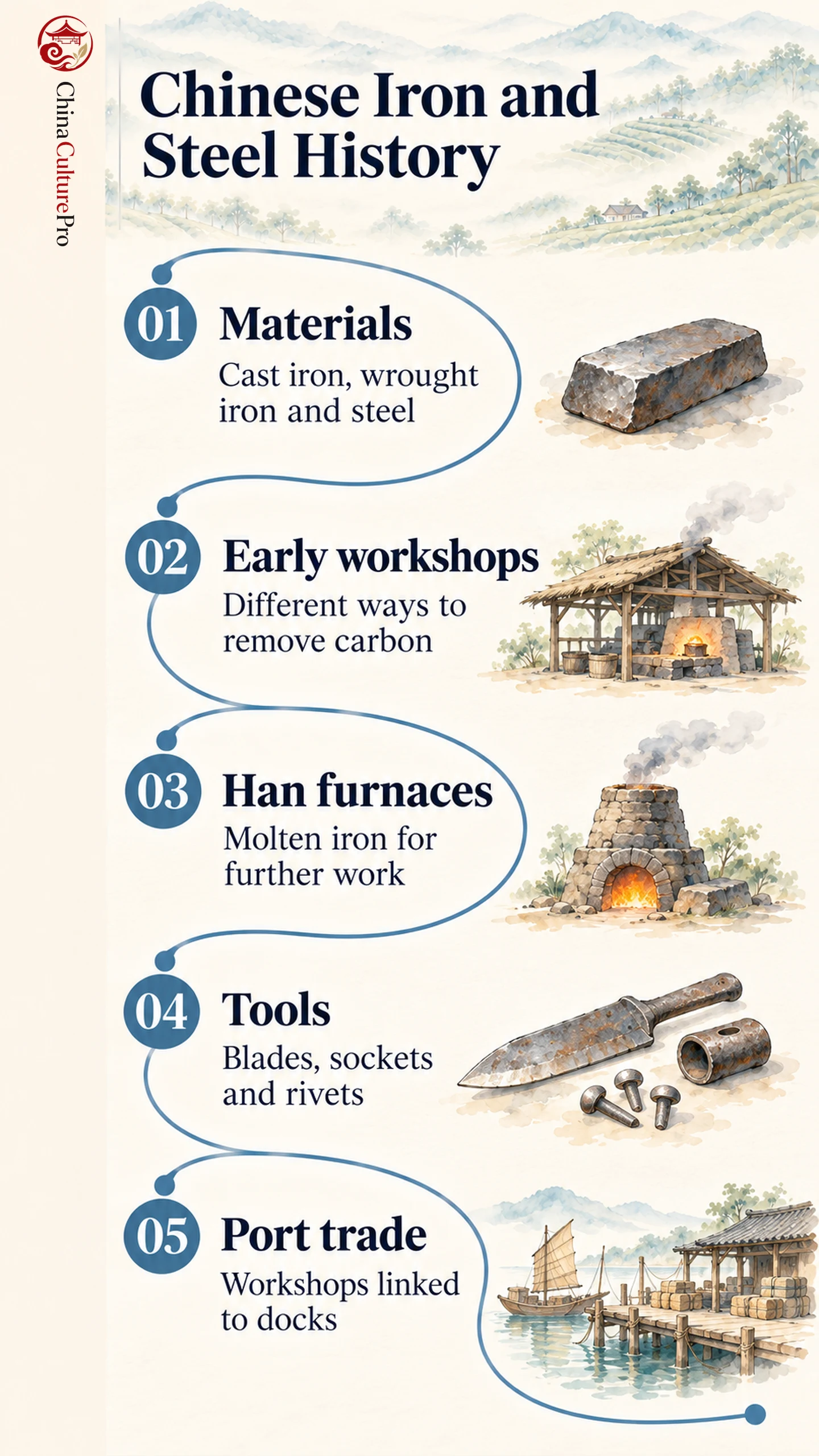
A metal blade might reach a farmer, a worker maintaining a road or an official storing tools for a garrison. Little of that journey is apparent from the surface of the blade. A seam can reveal how pieces were joined. A furnace site can tell a different story, about the making of metal before anyone shaped a tool. Ironworking belongs to the history of Chinese technologies because it connects changes in material to everyday tasks, public works and trade. [1][2][3][4]
Cast Iron, Wrought Iron and Steel
Cast iron contains more carbon than wrought iron or most steels and can be poured while liquid into a mold. A mold makes it possible to repeat a shape, but some cast irons are brittle. Wrought iron has very little carbon and can be hammered or forged. Steels occupy a range of compositions. Their behavior depends on how much carbon they contain and how they were worked or heated. An ancient object may even combine parts made of different ferrous materials. [1][2]
Removing carbon is called decarburization. The Zhengzhou study identifies two approaches in its samples. One lowered carbon through prolonged heating while the metal remained solid. Another refined the material under conditions involving a liquid state. Such processes explain why a community making cast iron could also produce objects with properties more suited to working or shaping. [2]
From Warring States Workshops to Han Furnaces
At Houduanwan, a Warring States workshop in the Zhengzhou region of present-day Henan, researchers identified evidence of both solid-state and liquid-state decarburization. Their comparison with objects from Eastern Han tombs found both paths represented, with solid-state processing dominant in the sampled burial objects. These samples show continuity and change in one region across the transition to empire. The relative frequency of the techniques is specific to the assemblages examined. [2]
Donald Wagner’s overview highlights the development of blast furnaces during the Han dynasty. An air blast allowed a furnace to support high-temperature production of molten iron. That output could be cast or taken through further operations. A furnace site helps establish production capacity and method. Workshop remains and finished objects are also needed to track what happened to the metal once it left the furnace. [1][2]
What an Iron Tool Can Tell Us
A blade found at the Dunhuang frontier and cataloged by the International Dunhuang Programme dates to around 100 BCE. The catalog identifies it as an iron spade or mattock blade. Two sheets of iron were welded together partway down, leaving an opening above to take a wooden shaft. A surviving rivet helps show how the parts were secured. The construction makes the blade a useful example of welding and fitting a handle. [3]
The find illustrates a challenge in reconstructing daily life in ancient China. An iron edge can survive when its shaft does not. Its shape and context can suggest work involving soil, yet the catalog’s two possible identifications leave room for uncertainty about the exact use. Histories of agriculture и engineering can use tools alongside texts and site evidence to reconstruct how work was done. [3]
Ironworking and the Song–Yuan Port of Quanzhou
In Quanzhou (泉州, Quánzhōu), UNESCO identifies iron and ceramic production sites as part of an interconnected system of settlements, docks, roads and waterways. The port linked its hinterland to maritime trade during the Сун и Юань periods. Comparing metalworking and ceramic production within the same network shows how different crafts depended on links between producers, transport and merchants. [4]
UNESCO’s grouping of sites helps explain the layout of that economy. A production site locates work in the hinterland, while a dock shows where cargo could change hands. To identify the destination of a particular piece of iron, historians would look for other evidence, such as a recorded consignment or a securely identified cargo. [4]
What a Ming Technical Book Records
Song Yingxing’s Tiangong Kaiwu (天工开物, Tiāngōng Kāiwù), first published in 1637 under the Ming dynasty, gathers descriptions of agriculture and handicrafts. The Library of Congress holds a digitized edition. A work of this kind helps historians see how a writer divided material production into activities and recorded connections between raw materials, tools and skilled work. Its existence also depends on the circulation of printed technical knowledge. [5]
A technical book describes practices selected by its author. Archaeological samples can answer finer questions about one site or one object, including choices that a printed account leaves out. Read together, the sources show ironworking at several scales, from the grain structure in a sample to the roads, workshops and docks of a regional economy. [2][4][5]
FAQs About Chinese Iron and Steel History
Was all early Chinese iron cast?
Ancient workshops used several ways of making and shaping iron. Casting was important, and excavated material from Zhengzhou also shows different ways of lowering the carbon content of cast iron.
What did a Han blast furnace produce?
A blast furnace could produce liquid, carbon-rich iron. That material could go into molds or undergo further processing for other applications.
How do researchers identify ancient ironworking methods?
They compare material from furnaces, slag, tool marks and the microscopic structure of metal samples. Archaeological context helps establish how and when the material was used or deposited.
Источники
[1] Jesus College, University of Cambridge. Iron and Steel in Chinese History
[2] Jin Zhu and colleagues. From Warring States Workshops to Han Tomb Burials
[3] International Dunhuang Programme. Iron Spade or Mattock Blade, MAS.790
[4] UNESCO World Heritage Centre. Quanzhou: Emporium of the World in Song–Yuan China
[5] Library of Congress. Tian Gong Kai Wu