

Quick Answer: What Makes Qiu Ying’s Mountains Celestial?
Buildings and Pavilions on the Celestial Mountains (仙山楼阁图, Xiān Shān Lóu Gé Tú), by Qiu Ying (仇英, Qiú Yīng), combines extraordinary peaks, cloud-wrapped buildings and a literary vision of immortality.
- Collection: National Palace Museum, Taipei; identifier 中畫000033.
- Medium and size: Ink and color on paper, 110.5 × 42.1 cm.
- Text: A long inscription dated 1550 stands above the landscape.
- Look first: Compare the precise architecture with the improbably steep mountains around it.
Read the painted scenery and upper text together, while keeping their makers distinct.
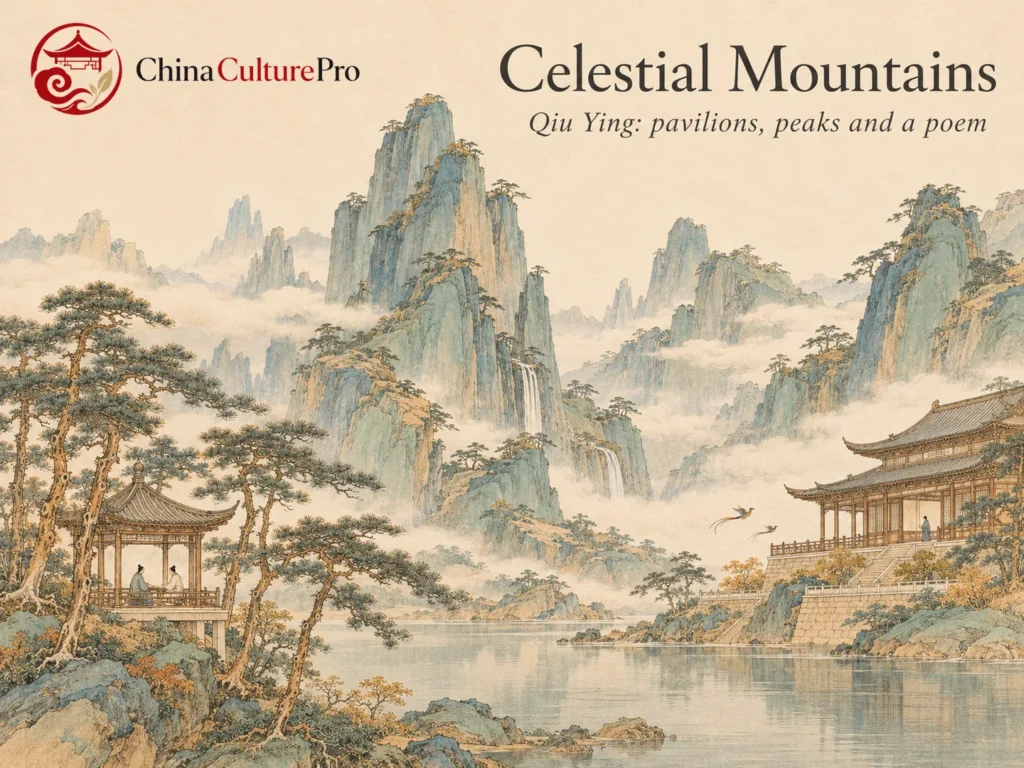
Pines rise from a low foreground bank. Beyond them, buildings occupy separate positions across the water, while narrow peaks climb into a much taller, cloud-filled distance. Above that landscape, a dense rectangle of writing changes the rhythm of the surface.
The scene offers recognizable things—roofs, railings, trees and waterfalls—but joins them into an extraordinary environment. Its celestial character emerges from both that arrangement and the accompanying poem.
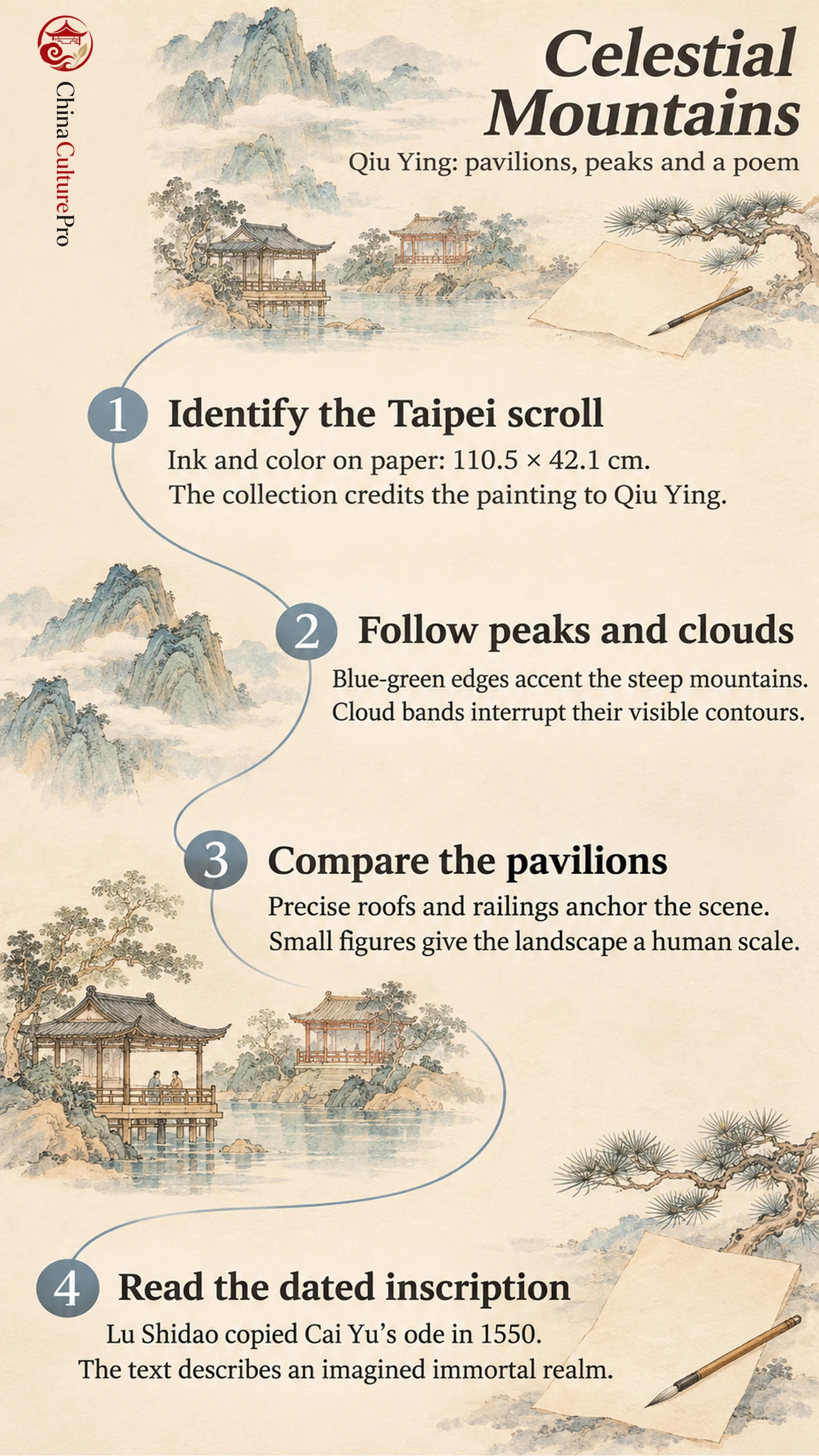
Identify the Taipei Hanging Scroll
The museum catalogs a paper hanging scroll with a painted field of 110.5 × 42.1 cm and Qiu Ying’s signature. It records the long inscription separately under its calligrapher, with a date corresponding to spring 1550. The catalog’s English title is Towers and Pavilions in Mountains of the Immortals. [1]
Keep that title together with the collection identifier when checking reproductions. Other works carry similar celestial-mountain names; the Taipei dimensions and paper support provide a firmer identification than an English title alone.
The Ming dynasty guide places the work in its wider period. For this scroll, begin with the relationship between a professional painter’s landscape and the substantial literary text above it.
The upper writing is visually important even before its words are translated. Its closely spaced columns make a relatively regular field, unlike the broken mountain contours and drifting cloud bands below. Compare their different kinds of density.
Follow the Peaks, Clouds and Blue-Green Color
The museum describes the peaks as improbably shaped and interprets their clouds, waterfalls and blue-green coloration within an imagined realm of Daoist immortals. It connects that coloring with an atmosphere of distant antiquity. [2]
Start with the tall central group. The cliff faces are not uniform columns: some widen near a summit, others narrow abruptly, and projecting ledges interrupt the sides. Neighboring peaks appear at different degrees of clarity.
Follow a blue-green edge downward. Its color may stay strong along one side while a wider face remains warmer or paler. This difference keeps the mountain from becoming a single flat silhouette.
Now compare those colored boundaries with the cloud bands. The clouds move across and between the peaks, interrupting their continuity. Some forms seem anchored below; others are harder to connect to a visible base.
A small building partway up the scene can be easy to overlook. Once located, compare it with the cliff immediately beside it. The tiny architectural scale makes the surrounding rock feel even more remote and difficult to reach.
The landscape-painting guide explores how peaks, water and open areas organize a picture. Here, trace where a contour remains visible and where a cloud temporarily takes its place.
Compare the Pavilions with Their Mountain Setting
The larger building complex at the lower right has multiple roof planes and a projecting terrace. Across the water, a smaller pavilion sits among trees. Their fine lines contrast with the irregular pines in front and the sheer cliffs behind.
The heritage record identifies two scholars facing one another in the left pavilion, a figure looking outward from the right building and two mythic birds on its terrace. These details place human and marvelous inhabitants within the same architectural setting. [3]
Look at one roof corner, then at a railing below it. Repeated straight edges and small structural divisions make these buildings legible even though their setting is fantastic.
Compare the two sides of the water. Each building has a local relationship with a bank, tree or rock face, but the entire scene does not open into an easily surveyed plan. Look for each building’s immediate surroundings before trying to connect it with a route farther into the peaks.
The Chinese architecture guide explains common structural ideas. Use it to notice roofs, terraces and enclosing lines here; a painted view alone does not supply all the dimensions needed to reconstruct a building.
Compare the definite roof and railing lines with the cloud-obscured terrain behind them. A railing can be carefully described while the clouds obscure the base of the very mountain above it.
Read the Ode above the Landscape
Lu Shidao (陆师道, Lù Shī Dào) transcribed a text by Cai Yu (蔡羽, Cài Yǔ): the Ode to the Mountains of the Immortals (仙山赋, Xiān Shān Fù). His small regular-script inscription is dated 1550. The catalog distinguishes this written contribution from Qiu Ying’s painter’s signature. [1]
The heritage account explains that the ode imagines inexhaustible mountains, enduring greenery, undying birds and passage into an immortal realm. It also relates that realm to the imagery of palaces and gardens. The painting’s celestial subject is therefore supported by a specific literary text, not just by unusually steep peaks. [3]
Compare the poem’s promise of enduring life with the abundance of trees and the inaccessible-looking architecture. The text supplies ideas extending beyond what any one painted feature could prove by itself.
The guide to Daoism as a religion provides broader context for immortal traditions. This image presents a literary and artistic vision; it does not establish a surveyed destination that a traveler could locate from the peaks alone.
The inscriptions-and-seals guide helps distinguish painting, transcription and later collecting marks. Here, return from the writing to the lower pines and buildings. The dense upper text and the broken mountain forms organize two very different parts of the same scroll.
FAQs About Qiu Ying’s Celestial Mountains
Does 1550 date the painting or the inscription?
The explicit date belongs to Lu Shidao’s inscription. It is evidence for that written contribution; the cataloged painter’s signature does not itself give the same date.
Does the scene show a documented mountain destination?
The museum interprets it as the imagined mountains of Daoist immortals. It does not identify the composition as a surveyed view of a single visitable site.
Did Qiu Ying write the long text?
The museum credits Lu Shidao with the calligraphy and Cai Yu with the ode. Qiu Ying is the painter credited for the landscape.
Нет. Некоторые источники описывают практики, различавшиеся в зависимости от пола ребёнка, но это не означает, что такие ограничения действуют во всех семьях. Красные яйца могут использоваться для встречи любого ребёнка и также появляются на других днях рождения.
[1] National Palace Museum. Towers and Pavilions in Mountains of the Immortals: digital collection record
[2] National Palace Museum. A Keen Eye: Towers and Pavilions in the Mountains of the Immortals
[3] Bureau of Cultural Heritage, via National Cultural Memory Bank. Qiu Ying: Towers and Pavilions in the Mountains of the Immortals