

Quick Answer
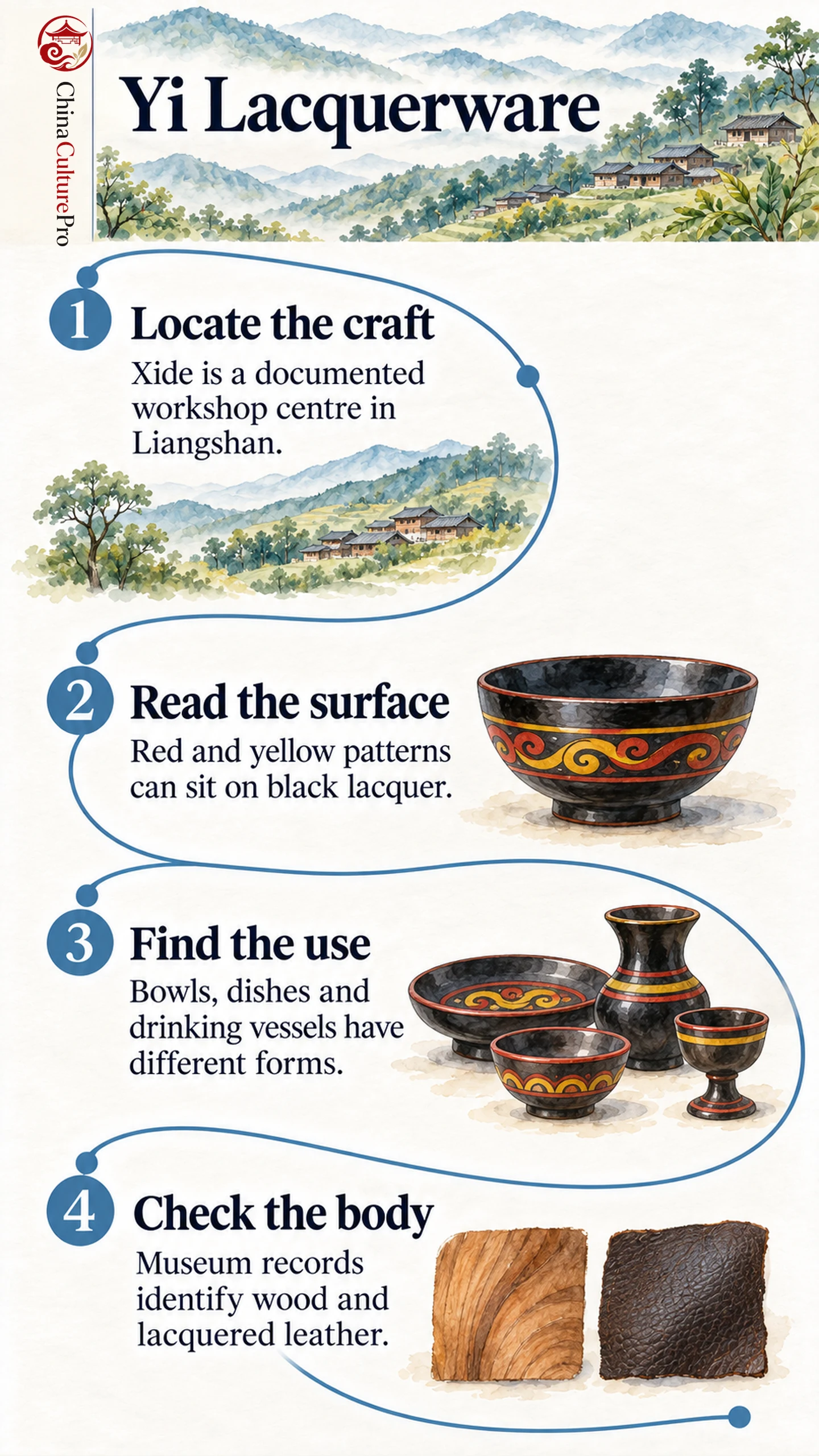
Yi lacquerware (彝族漆器, Yízú qīqì) includes vessels and other objects finished with lacquer. The national craft record for Xide in Liangshan, Sichuan, describes a black ground painted with red and yellow patterns. Museum records include both wooden objects and lacquered leather, so colour gives only one clue to what a piece is.[1][2][4]
- Workshop context: Xide is a documented centre for Liangshan lacquer work.[1]
- Surface: Red and yellow designs can stand out against a smooth black ground.[1][4]
- Object: A bowl, a plate and a drinking vessel can share colours while having different shapes and uses.[2][3]
Look for the material of the body and the shape and origin of the object alongside its colours.[1][2][4]
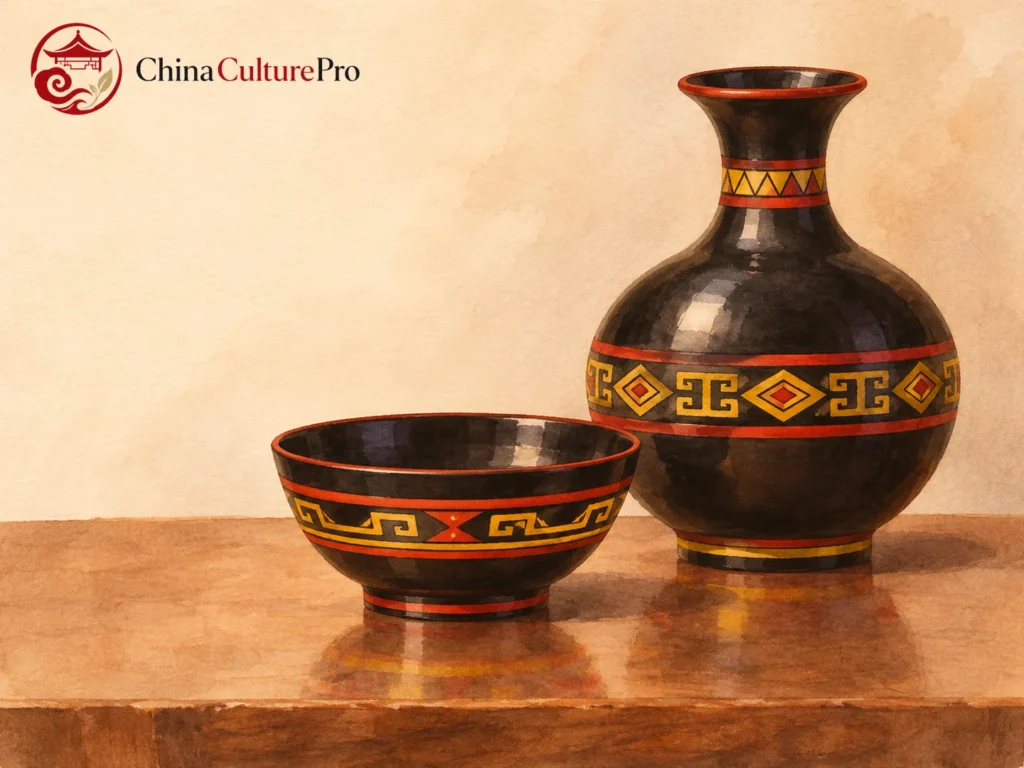
A bowl and a wine vessel can have closely related painted designs. Their rims, bodies and openings tell different stories about how each piece was handled. Looking at form as well as decoration gives a way into Yi lacquerware that starts with the object itself.[2][3][4]
The Workshop Tradition in Xide
China added the Xide lacquer tradition to its national intangible heritage inventory in 2008. The record names Yiluo Village and the Jiwu family, which it identifies with the transmission of lacquer work. It documents several woods and describes the work of preparing a base, coating it and painting the surface.[1]
The wooden body gives the object its shape. A smooth lacquer ground and the painted pattern are the visible finish. The Xide entry records the preparation and decoration as part of a single workshop tradition. A collection label for an individual object can give a specific material or maker where that information survives.[1][2]
How to Read the Black, Red and Yellow Surface
The Xide account describes a black lacquer ground with red and yellow patterns. Follow the edge of a pattern and see whether it repeats around a rim, follows the shape of a curved body or fills a flatter area.[1][4]
A study published by UNESCO includes a wooden object with yellow and red stylised petals on one surface and a geometric repeat on the back. The example shows how the same palette can support different designs on different faces of one object. An image of only one side leaves part of that design out.[4]
What the Vessels Were Made For
An account of Liangshan lacquerware describes bowls and dishes for food and cups and vessels for drink. It also places some objects at festive meals, in hospitality and in offerings to ancestors. The context can help distinguish an object brought out for an occasion from a similar vessel shown as a household example.[3]
At home, the vessels belong to a larger set of objects for preparing and serving food. The guide to fire in Yi traditions discusses the household hearth in an upland Liangshan account. A hearth and a finished bowl describe different points in the life of a meal.
What a Museum Label Can Confirm
The Cultural Palace of Nationalities Museum shows a painted lacquered leather bowl and a painted round-bodied wine vessel among its Yi objects. The bowl illustrates how lacquer can cover a material other than wood. The vessel’s round body and narrow opening give clues to a different use.[2]
For a particular object, check what the label calls it and whether it names the body material, place of collection or maker. Those details can connect the finish to an individual object’s purpose and origin. For a recent object, a maker’s label can establish how it relates to the earlier examples.[1][2][4]
FAQs About Yi Lacquerware
Is All Yi Lacquerware Made of Wood?
Wood is documented in the Xide tradition. The Cultural Palace of Nationalities Museum also records a lacquered leather bowl in its Yi collection.[1][2]
Do the Three Colours Identify Every Piece?
Black, red and yellow are characteristic of the Xide work described in the national inventory. Use the object type, material and provenance to identify an individual piece.[1][2][4]
Sumber
[1] China Intangible Cultural Heritage Network. Yi lacquer finishing in Xide
[2] Cultural Palace of Nationalities Museum. Yi lacquerware collection
[3] China Intangible Cultural Heritage Network. Liangshan Yi lacquerware and its uses
[4] UNESCO Publishing. Lacquerware in Asia, Today and Yesterday