
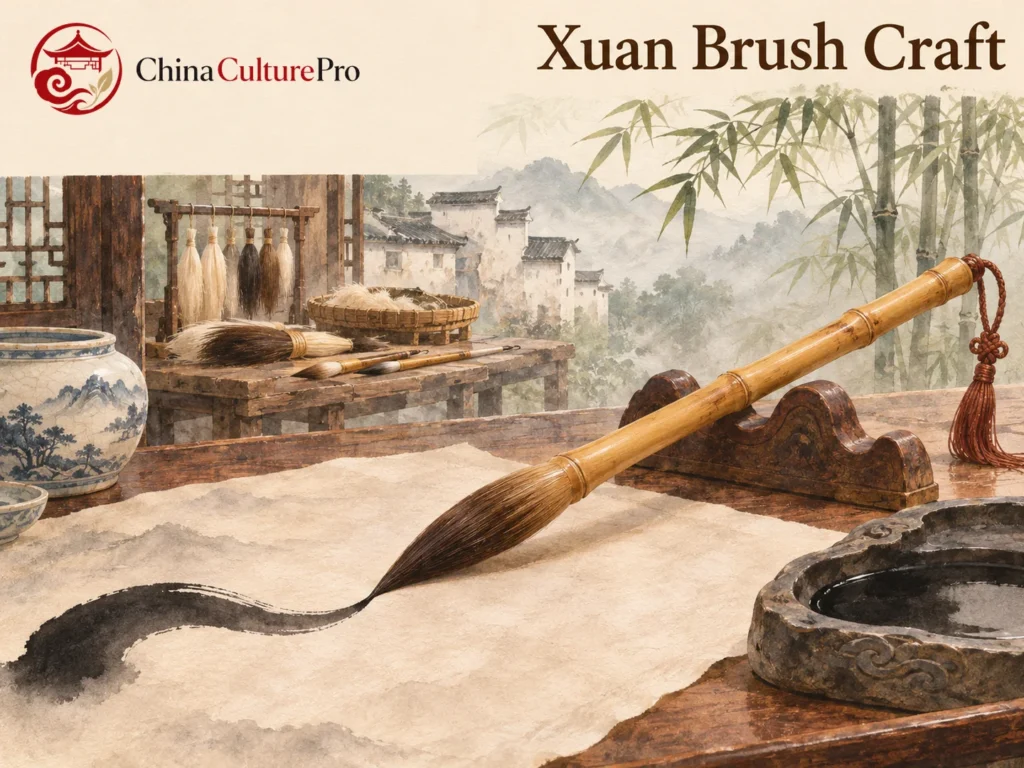

Quick Answer: What Is a Xuan Brush?
A Xuan brush (宣笔, xuānbǐ) is a Chinese writing and painting brush associated with historical Xuanzhou and made in places including Jing County, Anhui. Brushmakers select and align hairs, shape them into a head and fit the head to a handle.[1][2][3]
- Hair: Rabbit hair has a prominent place in historical records. Makers also use other hairs, depending on the brush.[1][3][4]
- Head: Water-basin work (水盆, shuǐpén) helps the maker comb and align the hairs.[2][3]
- Performance: Brushmakers look for a point, aligned tips, a rounded head and recovery after bending.[4][6]
China listed Xuan brush making nationally in 2008.[1][6]
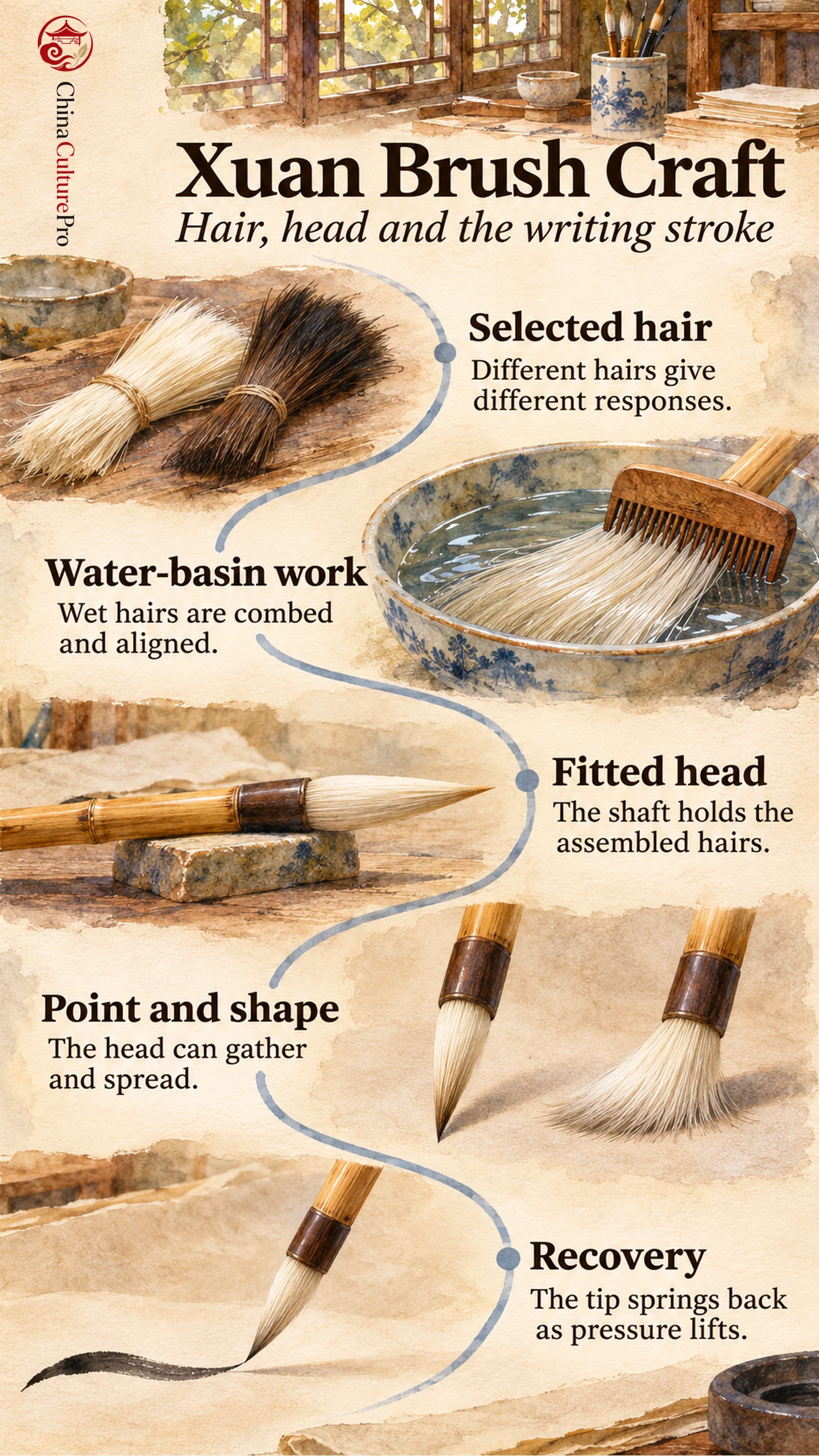
The handle may catch your eye first when you see a brush on a desk. The shape that matters when it touches paper is at the opposite end. A well-formed head can gather into a point and spread as the writer changes pressure.[3][4]
What Gives the Brush Head Its Shape?
The handle gives the writer a grip. The head must gather and release ink while moving with the hand. The historical record associates Xuan brushes with selected rabbit hairs, and field documentation in Jing County describes several types of hair used for different heads. The choice and arrangement of hair affect how easily the tip bends and gathers again.[1][3][4]
At the water basin, a maker combs the wetted hair and aligns the tips. This is one part of a longer sequence. Jing County describes eight major groups of work and 108 operations in its traditional account, including selection, shaft making, fitting, finishing and inspection. The number counts individual operations within those broad groups. The basin stage is especially helpful for understanding how individual hairs become an even head.[2][3]
Different hairs give the maker a range of choices. A calligraphy textbook describes rabbit and weasel hairs as generally springier than goat hair. That helps explain why two brushes with similar silhouettes may feel different at the desk. The brush’s response also depends on the finished bundle, including how the maker fits and shapes the hairs.[3][4]
Four Qualities of a Writing Brush
The traditional four brush qualities (尖齐圆健, jiān qí yuán jiàn) help separate what you see from how the head feels in use. They describe the wet head and its response when a writer spreads it or presses down.[4][6]
| Aspek Mutu | Ciri yang perlu diperhatikan |
|---|---|
| Pointed | The gathered hairs come to a narrow tip |
| Even | The tips lie evenly when the head is gently spread |
| Rounded | The head is full and balanced around its center |
| Resilient | The tip recovers its shape after pressure eases |
Point and evenness can both be present because they refer to different views of the head. A head can gather to a narrow tip and reveal an even edge when spread. A painter or calligrapher changes that shape with pressure and movement, one of the practical concerns of Chinese calligraphy.[4][6]
Xuanzhou, Jing County and a Living Workshop Tradition
The name refers to historical Xuanzhou. The national project records brushes made with local rabbit hair as Tang tribute in 743 and describes specialist brushmakers in the Song. Jing County is a documented modern center. It is also associated with Xuan paper (宣纸, xuānzhǐ), a separate material with its own history and properties. The Xuan paper guide explains what the paper label means.[1][2][3]
She Zhengjun, a representative maker in the national record, entered the Jing County Xuan Brush Factory as an apprentice in 1982. His profile names several teachers and describes his own later work training apprentices. His record links family knowledge with organized factory training and later teaching.[5]
FAQs About Xuan Brushes
Is a Xuan brush the same as Xuan paper?
A Xuan brush is a writing or painting tool. Xuan paper is a writing or painting surface. The similar names reflect a regional association.[1][2][3]
Does every Xuan brush use rabbit hair?
Rabbit hair is prominent in historical accounts of Xuan brushes. Documented brushmaking also uses other hairs with different degrees of softness and spring.[1][3][4]
What happens in the water-basin stage?
The maker works the hair in water so it can be combed and aligned before the head is assembled and fitted to the shaft.[2][3]
Sumber
[1] Museum Digital Warisan Budaya Takbenda Tiongkok. Xuan Brush Making
[2] Jing County People’s Government. Why Are Jing County Brushes Called Xuan Brushes?
[3] Southern Anhui Intangible Heritage and Historic Architecture Field Archive. Xuan Brush
[4] Tsinghua University Press. A Calligraphy Textbook: Four Standards for Choosing a Brush
[5] China Intangible Cultural Heritage Digital Museum. She Zhengjun
[6] People’s Daily Online. Xuan Brush Making in Huangcun, Jing County