
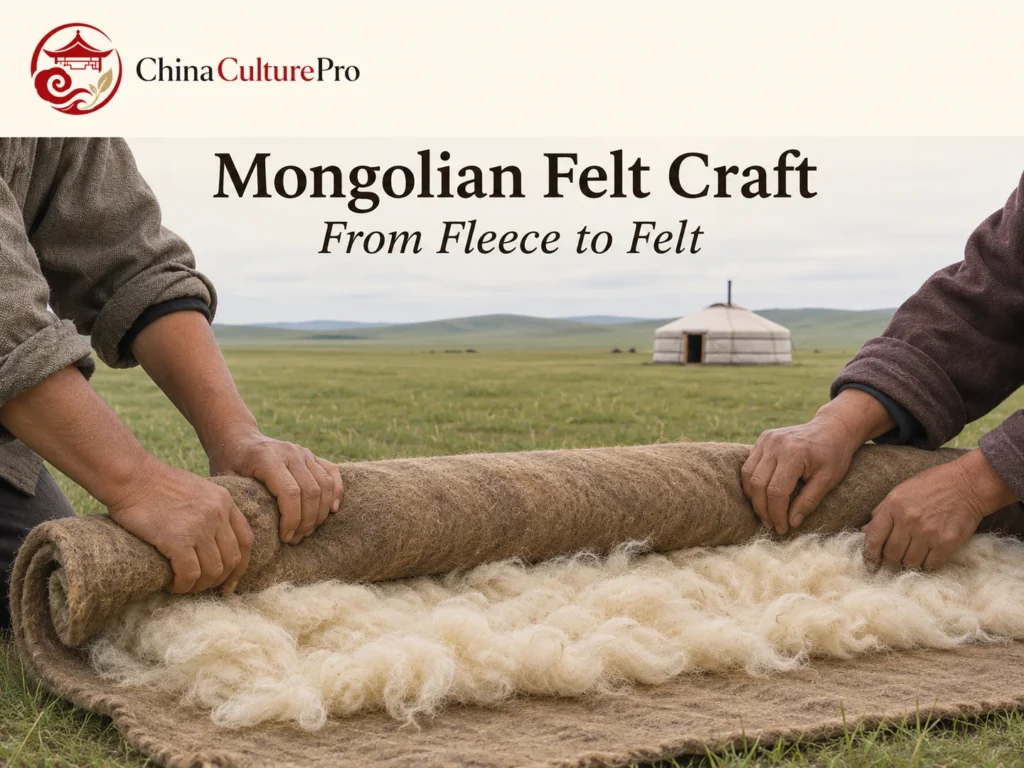

Quick Answer: What Is Mongolian Felt Craft?
Traditional Mongolian felt rolling (蒙古族传统擀毡技艺, Měnggǔzú chuántǒng gǎnzhān jìyì) turns loose sheep’s wool into a compact sheet. In documented communities in China’s Inner Mongolia, makers spread and dampen wool, roll it tightly and work it until the fibers hold together. [1][2][3]
- Material: Loosened wool is laid in an even layer.
- Making: Moisture, pressure and repeated rolling mat the fibers.
- Uses: Felt sheets and pieces can cover dwellings or become cushions, saddle pads and other items. [1][2][3][4][6]
A finished sheet can be folded, cut or sewn according to what it needs to cover.
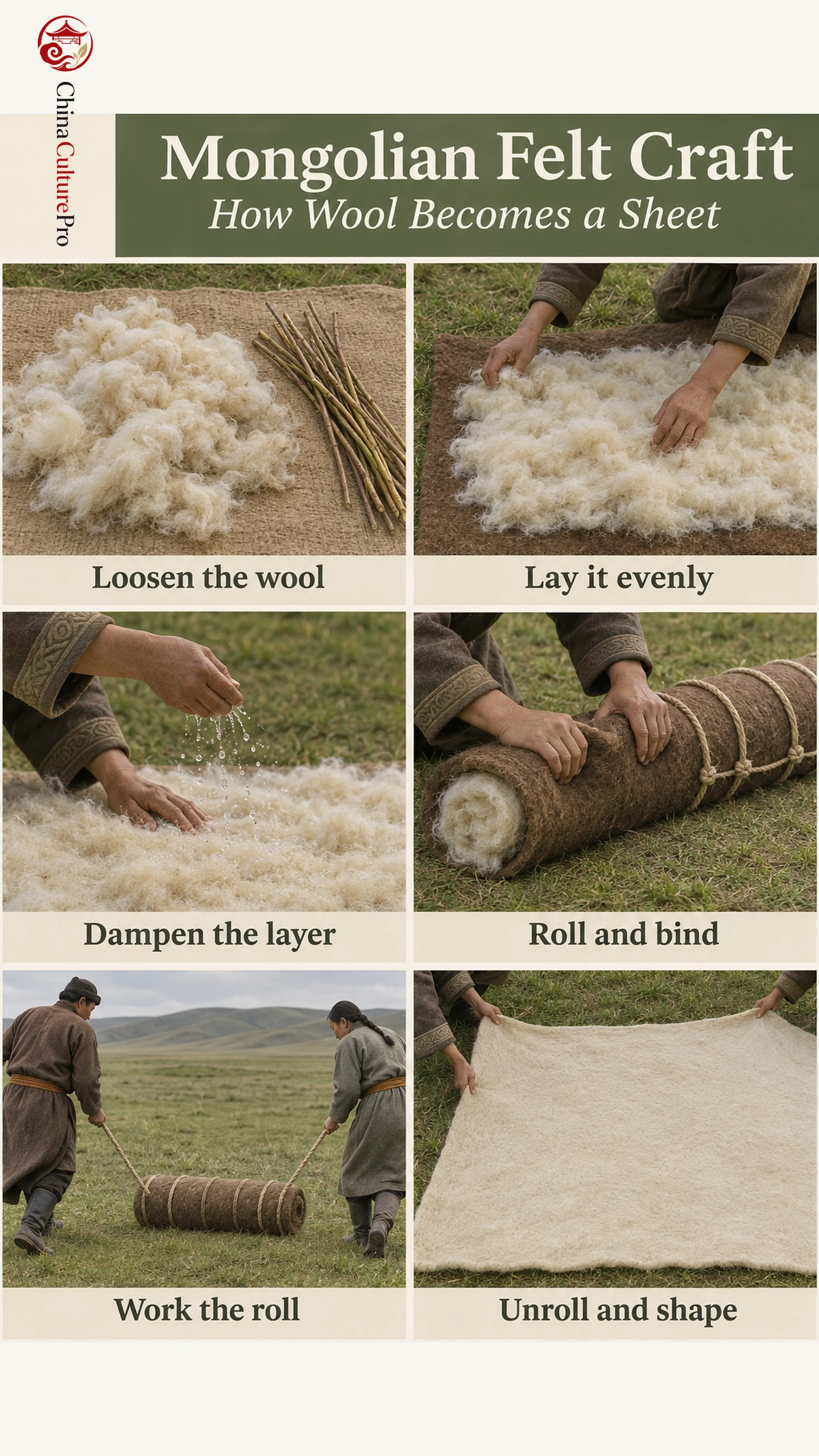
To make a large sheet, felt makers spread loose fleece across a base mat on level ground. Several people may roll it together and secure it with rope. When the roll is opened, fibers that once pulled apart begin to move as one surface.
Why Loose Wool Can Become a Sheet
The Urad account describes using longer wool from early summer and shorter wool from late autumn. Makers beat the fleece with willow rods to loosen clumps before laying it on a base mat. Spreading the loosened wool evenly before rolling helps keep the finished sheet from having thin patches. [1][6]
Wool fibers have a scaly surface. Moisture and repeated pressure allow the fibers to shift and interlock. As more of them catch against one another, the loose layer compresses into a fabric that can be lifted as a sheet. [3]
How a Large Roll Is Made and Finished
An Urad account describes spreading damp wool over an existing piece of felt, rolling the layers together and tying them with camel-hair rope. A camel pulls the roll over the ground so that it turns repeatedly. A July 2026 photo report from West Ujimqin records a variation with mounted herders towing the roll by rope. [1][2][6]
The West Ujimqin report also shows what happens when the roll is opened. Makers spread the felt, beat it and pull it into shape, then clear loose fibers from its surface before drying it. These finishing actions give the sheet a more even edge and surface. [2]
What Felt Does in a Home or on a Saddle
A ger, the round dwelling also called a Mongolian yurt, can use separate felt covers over the roof, around the lattice wall and over the roof opening. The national record describes a West Ujimqin ger with layers of wool felt secured around the wooden lattice with ropes. The covers can be packed separately when the frame comes apart. [4]
Smaller felt pieces can become saddle pads or cushions. In Sunite felt embroidery, the maker first makes a felt ground and then stitches designs, sometimes using camel-wool thread. A firm felt ground supports the stitches on door covers, saddle pads and bags. [5][6]
Felt Making as Shared Work
The Urad account describes households asking neighbors to help with a roll. Some participants brought milk, and the account describes a small amount being sprinkled on the finished felt along with spoken blessings. The work brought together people from households that often lived far apart. [1][6]
In July 2026, China News Service photographed older and younger herders working together in West Ujimqin. The makers shared the labor of spreading and turning a sheet while younger people could observe how the fibers and edges changed. These gatherings are one way of passing on traditional craft skills. [2]
FAQs About Mongolian Felt Craft
Is Mongolian wool felt woven?
Felt is a nonwoven textile. Damp wool fibers mat together as they are rolled and worked. Sewing or embroidery can be added after the sheet is made. [3][5]
Why are horses or camels sometimes used in felt making?
A large roll can be pulled over the ground so it keeps turning and the damp wool compresses. Urad documentation describes a camel, while a West Ujimqin photo report shows riders towing a roll. [1][2][6]
When was traditional felt rolling listed in Inner Mongolia?
Traditional Mongolian felt rolling was included in Inner Mongolia’s regional intangible cultural heritage list in 2009. Ger construction and Sunite embroidery have their own national listings. [2][4][5][6]
Sumber
[1] Inner Mongolia Intangible Cultural Heritage Public Service Platform via the Inner Mongolia Local History Office. Traditional Mongolian Felt Rolling
[2] China News Service. Traditional Felt Rolling on the West Ujimqin Grassland
[3] Southeast Fiber Arts Alliance. Felting
[4] China Intangible Cultural Heritage Network. Ger Construction Techniques
[5] China Intangible Cultural Heritage Network. Sunite Mongolian Embroidery
[6] Ba Wen, Inner Mongolia News. Traditional Urad Mongolian Felt Rolling