

Quick Answer: Who Was Wang Jian of Qin?
Wang Jian (王翦, Wáng Jiǎn) was a late Warring States general of Qin (秦, Qín). He helped defeat Zhao and take the Yan capital, and led the renewed Qin offensive against Chu (楚, Chǔ). The early histories are much clearer about his campaigns than about the dates of his life.[1][2]
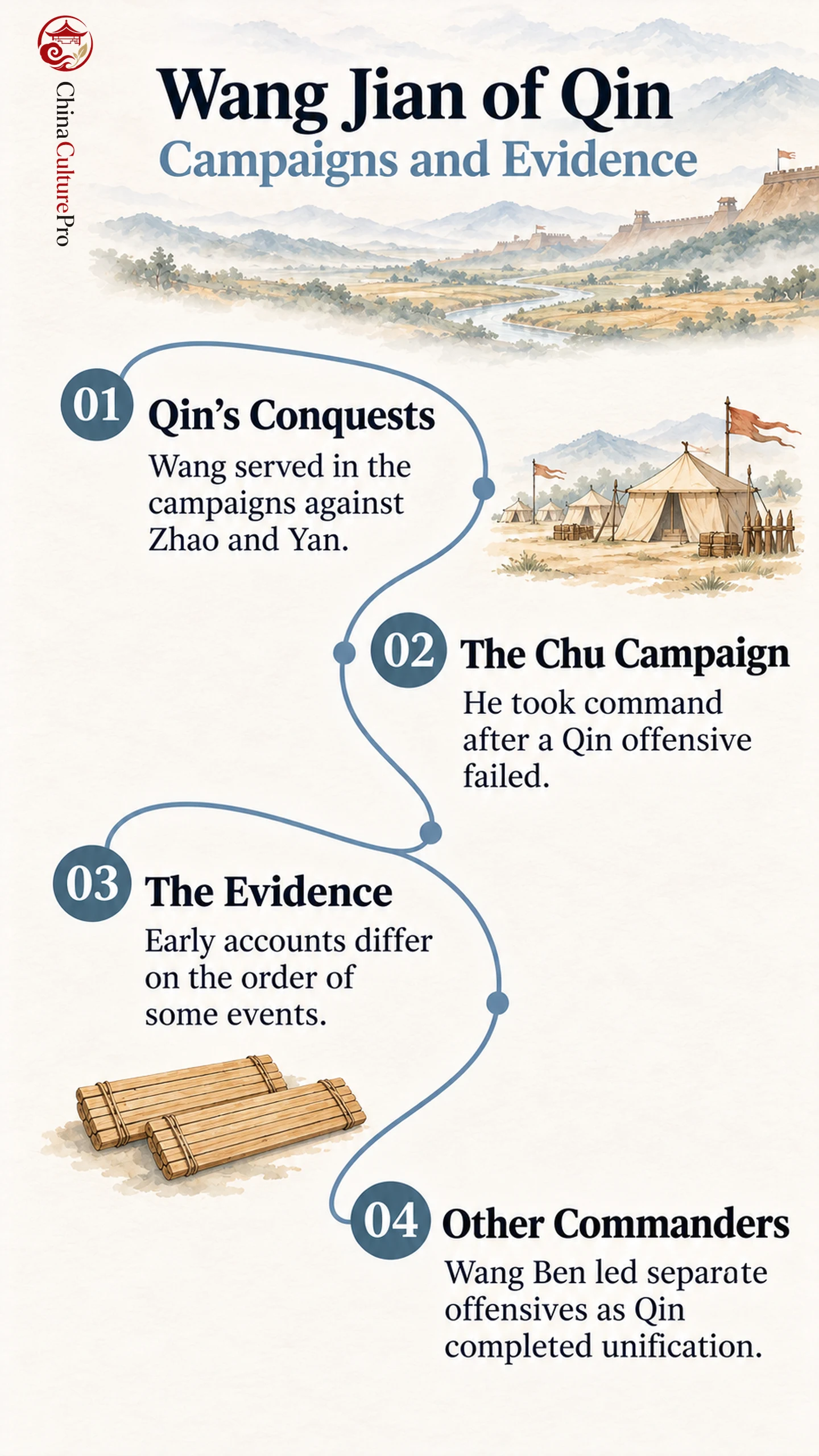
- Campaign: The king recalled him after an earlier Qin attack on Chu failed.
- Evidence: The biography and imperial annals organize parts of the Chu campaign differently.
- Family: His son Wang Ben (王贲, Wáng Bēn) commanded other Qin offensives.
The sources give a campaign history with several commanders and a separate biographical story about Wang.
Wang Jian’s best-known campaign began with a disagreement over the size of an army. The story makes his judgment vivid. Read it alongside the reign-year entries and research on Qin mobilization to see which parts of the account carry the most weight.
His Place in the Qin Conquests
Wang served in the last decades of the Warring States period, when territorial states could mobilize far larger forces than older aristocratic armies. His ruler was the king of Qin, later known as Qin Shi Huang. Qin Shi Huang is the title by which he is usually known. During the conquests, his authority was that of Qin’s king.[1][2][4]
The annals place Wang in the attack on Zhao that led to the capture of its king in 228 BCE. They name other Qin commanders in the same operations. Wang also took part in the offensive against Yan and the seizure of its capital, Ji, in 226 BCE. The Yan ruler fled east and held on in Liaodong. Taking the capital and capturing the ruler were separate events.[1][2]
The two episodes show why a state’s defeat cannot always be assigned to one day or one general. The fall of an important city could break a government’s hold over a region while resistance continued elsewhere. The Qin annals track several such developments by reign year.[2]
Why the Chu Campaign Changed Commanders
The biography contrasts Wang’s advice with that of Li Xin (李信, Lǐ Xìn). Li proposed a smaller force for the attack on Chu. The king chose his plan, and the offensive under Li and Meng Tian ended in defeat. Wang returned to command after the king agreed to send the larger force he had requested.[1][3]
In the biography, Wang’s next move was to wait behind fortifications and maintain the condition of his troops. He declined repeated challenges. When the Chu army withdrew, Qin pursued. The account explains a decision about when to commit forces, rather than describing victory as the automatic result of sending more soldiers.[1]
This is also a story about trust between king and commander. The biography presents Wang’s requests for property as an effort to reassure a ruler who had given him unusual military authority. The explanation belongs to the biographical account and cannot by itself establish what either man privately thought.[1]
What the Accounts Can Establish
Two sections of the Records of the Grand Historian agree that Wang played a major part in defeating Chu. They give different sequences for some details. The biography places the defeat and death of the Chu general Xiang Yan (项燕, Xiàng Yān) before the capture of Chu’s king. The annals put the king’s capture in 224 BCE and Xiang Yan’s death in the following year.[1][2]
The figure of 600,000 comes from the biography’s account of the force assigned to Wang. Military historian Kiyoshi Miyake compares the report with other evidence for Qin mobilization and distinguishes a large deployment from certainty about the precise total. A reported force could also include people needed to hold territory and maintain supply, rather than just those who fought in one battle.[1][3]
Wang Jian, Wang Ben and Qin’s Military Legacy
After the defeat of Qi in 221 BCE, the king assumed the imperial title. Wang Ben is particularly important to the story of the Qin Dynasty because the annals credit him with operations against Wei and with the later defeats of the remaining Yan and Qi. Their careers overlap, and several offensives involved both family and non-family commanders. Check which man the source names before carrying a statement about one campaign over to another.[1][2]
Sima Qian pairs Wang Jian with the earlier Qin general Bai Qi (白起, Bái Qǐ) in one chapter. The historian praises military ability and then judges its limits. In Wang’s case, success in conquest does not settle the question of whether he helped put Qin rule on a durable footing. The final assessment is a moral and political judgment, distinct from the account of a campaign.[1]
FAQs About Wang Jian of Qin
Was Wang Jian the same general as Bai Qi?
They were separate Qin commanders. Bai Qi served earlier and is associated with Changping. Wang Jian held major commands during the later unification campaigns.
Did Wang Jian really command 600,000 troops?
That is the figure given in the received biography. The sources support a major mobilization, while the exact size of the force remains uncertain.
Did Wang Jian conquer all six rival states himself?
Qin used several commanders over a series of campaigns. Wang Jian was central to operations against Zhao, Yan and Chu. Other generals, including Wang Ben, played major roles elsewhere.
Sumber
[1] Sima Qian, Records of the Grand Historian, chapter 73. Biographies of Bai Qi and Wang Jian
[2] Sima Qian, Records of the Grand Historian, chapter 6. Basic Annals of the First Emperor of Qin
[3] Kiyoshi Miyake, Bamboo and Silk. The Military History of Qin and the Composition of Its Expeditionary Forces
[4] Mark Edward Lewis, The Cambridge History of Ancient China. Warring States Political History