
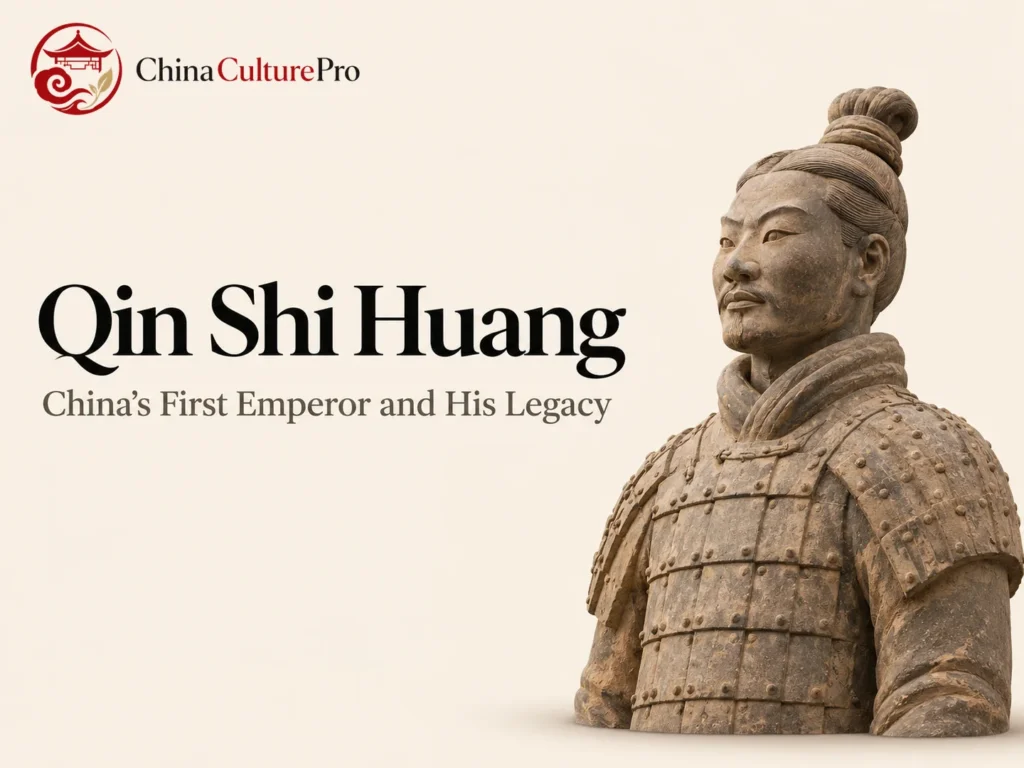

Quick Answer: Who Was Qin Shi Huang?
Qin Shi Huang (秦始皇, Qín Shǐ Huáng) became the first emperor of a unified China in 221 BCE, after the state of Qin conquered the last of its rival kingdoms. He ruled as emperor until his death in 210 BCE.[1][2]
- Name: He was born Ying Zheng (嬴政, Yíng Zhèng) and became king of Qin while still young.
- Unification: Qin’s conquests ended the competition among the major kingdoms of the Warring States.
- Government: His court administered conquered territories through officials and issued common standards for weights and measures.
- Burial: The clay soldiers found near his tomb were part of an extensive burial complex.[1][2][3][8][10]
He had been king for years before taking the imperial title.
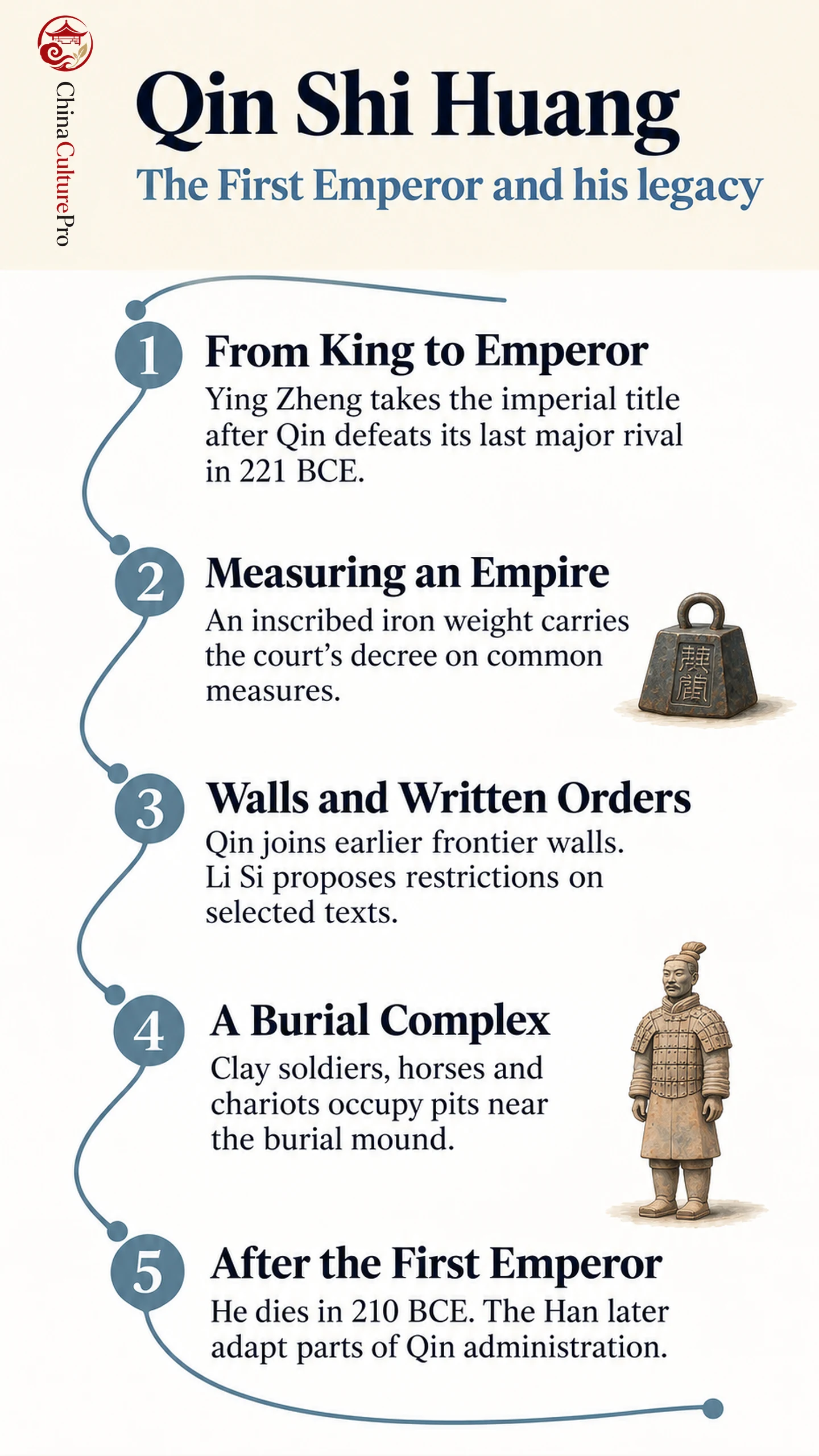
A heavy iron weight and a clay soldier offer two ways to approach Qin Shi Huang. The weight carries a decree about how to measure things across a new empire. The soldier belonged to a burial complex designed for one ruler. The decree and the burial both date to the emperor’s lifetime. The familiar stories about his last days reach us mainly through a history written under the succeeding dynasty.[3][8]
From King of Qin to First Emperor
Born in 259 BCE, Ying Zheng inherited the throne of Qin while still young. By the time he became king, Qin had already absorbed smaller territories to its west and south. That earlier expansion helped put it in a strong position during the Warring States period. Ying Zheng’s armies defeated the remaining six major rivals, completing the conquest in 221 BCE.[1][2]
He adopted an imperial title once the conquest was complete. Before 221 BCE he had been the king of one state, even as his territory grew. As First Emperor he claimed authority over the former rival kingdoms and their populations. The distinction between king of Qin and emperor of Qin explains why the same man appears under different names or titles in different parts of his biography.[1][2][10]
How He Governed the New Empire
The court extended a hierarchy of commanderies and counties governed by appointed officials. That system gave the Qin dynasty a way to send orders to local offices and keep records across a much larger territory. The government also set common standards for writing and measurement.[1][4][10]
An iron steelyard weight in the National Museum of China gives the measurement policy a physical form. Its attached plaque bears the text of the 221 BCE edict on standardizing weights and measures. Local officials handling grain or other supplies could use a common unit when comparing deliveries and balances across offices.[3]
Documents excavated at Liye (里耶, Lǐyē) show how standardization worked in a county office. Scholars can compare repeated features of the paperwork with the variations that persisted in daily use. The inscription tells us what the court ordered. The working documents give us a view of how local officials applied administrative rules in practice.[3][4]
Walls, Labor and the Written Record
Qin extended and joined parts of older frontier walls under the First Emperor. Later dynasties built and rebuilt defensive lines over many centuries. Many of the familiar brick-and-stone stretches date to the Ming dynasty. The Qin works were an early phase in the history of the Great Wall and required the state to mobilize labor far from the capital.[5][9]
The court also sought to control the circulation and use of some texts. A proposal dated to 213 BCE by the minister Li Si (李斯, Lǐ Sī) survives in the history of Sima Qian (司马迁, Sīmǎ Qiān), who wrote under the Han. The proposal targeted records of rival states and private possession of selected works. It allowed exemptions for certain practical writings, including medicine and agriculture.[1][6]
Sima Qian also describes a separate episode of executions. Later retellings often pair it with the book burning. Historians have questioned both how the story was interpreted and whether the killings took place as described. Read the proposal as evidence of the controls a minister advocated and the later narrative as evidence of how the reign was recorded and remembered.[6][7][9]
The Mausoleum and Terracotta Army
Work on the emperor’s burial complex near modern Xi’an began during his years as king. The Terracotta Army (兵马俑, Bīngmǎyǒng) was discovered in 1974. Its life-sized soldiers, horses and chariots occupied pits near the burial mound. The ranks include infantry as well as figures associated with horses and chariots. The pits preserve how the burial planners arranged these parts of the army.[2][8]
The army is one part of a much larger site. For example, archaeologists also found bronze models of chariots and horses in the burial complex. The objects give a sense of the variety of people, animals and equipment represented there, as well as the labor and resources devoted to the burial. Sima Qian’s written account describes a rich underground chamber. The excavated pits are direct evidence of what stood in those parts of the complex.[2][8][9]
Death, Succession and Legacy
Qin Shi Huang died in 210 BCE during a tour of his empire. His younger son Huhai (胡亥, Húhài) became the second emperor. The account preserved by Sima Qian gives court insiders a central role in the succession. It was written after the events, so its reconstruction of private decisions should be read with that distance in mind.[1][2][9]
The dynasty collapsed within a few years of the First Emperor’s death. The Han dynasty reused and adapted elements of Qin administration, including territorial offices. Those offices outlasted the ruling family, a distinction that helps explain the dynasty’s place in Chinese history.[1][10]
FAQs About Qin Shi Huang
Why is Qin Shi Huang called the First Emperor?
He took the title after Qin conquered the last major rival kingdom in 221 BCE. It marked his claim to rule the unified empire. Before then, he was known as Ying Zheng, king of Qin.[1][2]
Did Qin Shi Huang build the Great Wall?
His government joined and extended some earlier northern fortifications. The Great Wall is the result of work in many periods, and many of its best-known masonry sections date to the Ming dynasty.[5]
What does the Terracotta Army tell us about him?
Its scale, military organization and placement show the resources devoted to his burial and the role of military imagery in the complex. The figures also preserve physical details of arms, armor and equipment for archaeologists to study.[2][8]
Sumber
[1] The Metropolitan Museum of Art. Qin Dynasty
[2] National Museum of Australia. Timeline of the First Emperor of Qin
[3] National Museum of China. Qin Iron Steelyard Weight
[4] Bulletin of the School of Oriental and African Studies. The Pragmatics of Standardization in Qin Administration
[5] UNESCO World Heritage Centre. The Great Wall
[6] Columbia University Asia for Educators. Li Si’s Memorials as Recorded by Sima Qian
[7] UCLA International Institute. Burning the Books and Killing the Scholars
[8] UNESCO World Heritage Centre. Mausoleum of the First Qin Emperor
[9] University of California San Diego. Sima Qian’s Account of the First Emperor
[10] Smithsonian National Museum of Asian Art. Qin Dynasty