

Quick Answer: Who Was Wang Anshi?
Wang Anshi (王安石, Wáng Ānshí, 1021–1086) was a Northern Song official and writer. As a leading minister under Emperor Shenzong (神宗, Shénzōng), he helped design the New Policies (新法, xīnfǎ), a program that changed how the court raised resources and organized public service.[1][4][5]
- Credit: The government offered seasonal loans under one measure.
- Service: Other laws changed how households contributed labor or performed local security duties.
- Debate: Supporters and opponents disputed which burdens the state could legitimately impose.
The policies’ stated aims, legal mechanisms and local effects require different kinds of evidence.
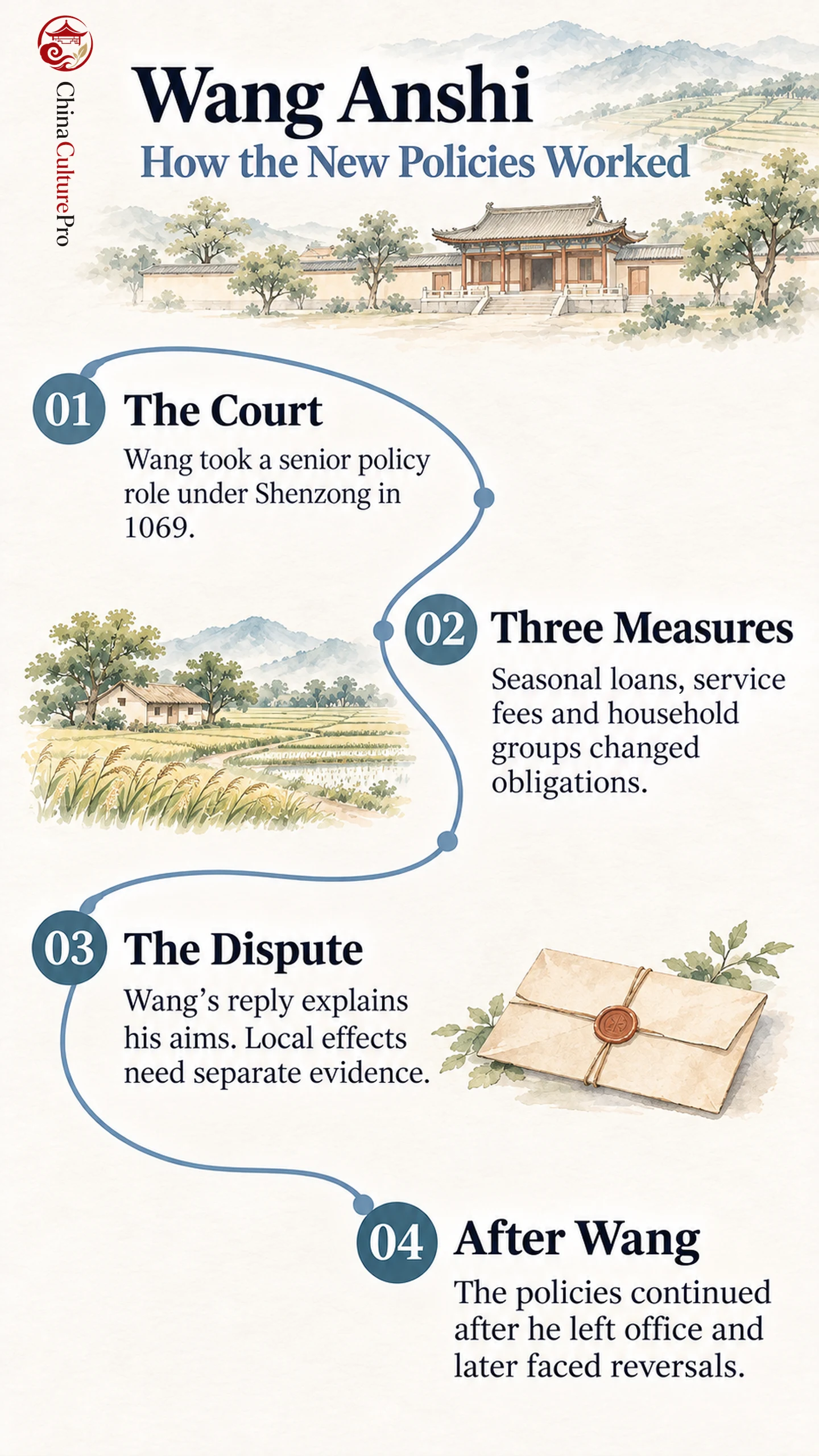
Wang Anshi’s reforms are easier to understand through the obligations they changed. A loan, a service payment and a security duty put households in different relationships with government. The disputes that followed were about those obligations as much as they were about one minister.
From Local Office to the Court of Shenzong
Wang came from Linchuan and served in local and central posts in the Song Dynasty. His 1058 memorial to Emperor Renzong set out a case for changing government before he had the authority to put a broad program into operation. The memorial shows what Wang thought institutions should do. An account of his later office tells us when he acquired authority to act on those views.[1][2][5]
When Shenzong took the throne in 1067, he inherited military and fiscal pressures that had accumulated over earlier reigns. In 1069, Wang took a senior policy role and helped organize the drafting of a series of measures. The court created a commission to work on the measures. Shenzong’s backing turned a minister’s program into an imperial initiative.[1][4]
The chronology matters when reading the earlier memorial. Wang framed institutional change as a way to govern effectively in the present, even when he invoked the example of ancient rulers. A reader should look for that argument in the memorial and look separately to the later biography for the list of laws enacted under Shenzong.[1][2]
What the New Policies Changed
Three measures illustrate how the New Policies reached households. Each used a different tool. The table describes the design of the measures. Implementation could vary across districts.[1]
| Measure | What it changed |
|---|---|
| Green Sprouts (青苗法, qīngmiáofǎ) | The state advanced resources to households in the agricultural cycle and sought repayment with interest. |
| Service exemption (免役法, miǎnyìfǎ) | Payments funded hired personnel to perform duties previously assigned directly to households. |
| Baojia (保甲, bǎojiǎ) | Officials grouped registered households for mutual responsibility, local security and training. |
Seasonal credit could make resources available before harvest. It also created a repayment obligation. Hiring people to perform service could change who had to leave their own work. The dynastic account also says some households that had previously been exempt from service now owed a contribution. For security, grouping households gave officials a way to organize people below the level of a county office. The cases show why an argument about household burden has to specify the obligation and which households owed it.[1]
Why the Policies Divided the Court
Wang’s reply to Sima Guang (司马光, Sīmǎ Guāng) makes the disagreement visible in the language the officials used. Wang defended policy initiative as part of serving the ruler and distinguished administering resources for the realm from seeking revenue for its own sake. The letter shows how he wanted his actions understood. It does not measure how much households paid or how administrators collected it.[3]
The dynastic biography is another kind of evidence. It describes policy provisions and also condemns aspects of Wang’s conduct and the program’s consequences. Treat those parts separately. A description of what a law required is a starting point for understanding its design. A judgment about widespread disturbance calls for evidence about where and when the rules were applied. A policy could create a new benefit for one household while imposing a new cost on another.[1]
The service measure makes the distinction concrete. A household previously called away for compulsory duty might benefit from hired replacements. A household newly required to pay might judge the same policy differently. The rule itself identifies these positions without establishing how many families in a district stood to gain or lose.[1]
Wang Anshi the Writer and His Later Reputation
Wang left high office before Shenzong’s death in 1085. Policies continued to be administered and disputed after his retirement, and the political transition after the emperor’s death opened the way to reversals. The career of the reformer and the life of a particular law therefore have separate chronologies.[1][5][6]
His reputation in Chinese literature extends beyond his official career. The Palace Museum identifies him with the celebrated prose writers of the Tang and Song. The memorial makes a sustained case to an emperor. The letter to Sima Guang is a shorter defense addressed to a critic. Both texts are evidence of political writing, while each addresses a different audience and problem.[2][3][5]
The biography also records that new interpretations of several classics were issued to government schools. It connects those readings with official selection. The episode shows one way Wang’s intellectual work entered an institution. His prose can therefore be read both as a literary achievement and as writing made in the course of governing.[1][5]
FAQs About Wang Anshi
Was the Green Sprouts policy the whole reform program?
It was one of several measures. Green Sprouts dealt with seasonal lending. Other laws changed service obligations, organized household groups or affected the way the state managed resources.
Did the New Policies end when Wang Anshi retired?
The program continued under Shenzong after Wang left office. Political changes after Shenzong’s death led to reversals, with individual measures following their own histories.
Was Wang Anshi also a writer?
Yes. He was an important writer of prose as well as a minister. His memorial to Renzong and reply to Sima Guang are two ways to read his arguments in his own words.
Sumber
[1] History of Song, chapter 327. Biography of Wang Anshi
[2] Wang Anshi. Memorial on affairs to Emperor Renzong
[3] Wang Anshi. Reply to Sima Guang
[4] Paul Jakov Smith, The Cambridge History of China. Shen-tsung’s Reign and the New Policies of Wang An-shih, 1067–1085
[5] Palace Museum. Wang Anshi
[6] Yuhua Wang, American Political Science Review. Blood is Thicker Than Water: Elite Kinship Networks and State Building in Imperial China