


Quick Answer: What Is The Golden Cangue About?
The Golden Cangue (金锁记, Jīnsuǒ Jì) is a novella by Eileen Chang (张爱玲, Zhāng Àilíng) about Cao Qiqiao (曹七巧, Cáo Qīqiǎo), a woman who marries into a wealthy household and later gains power within her own branch of the family. The money that promises security also shapes how she treats the people closest to her. A cangue (枷, jiā) is a restraint worn around the neck.
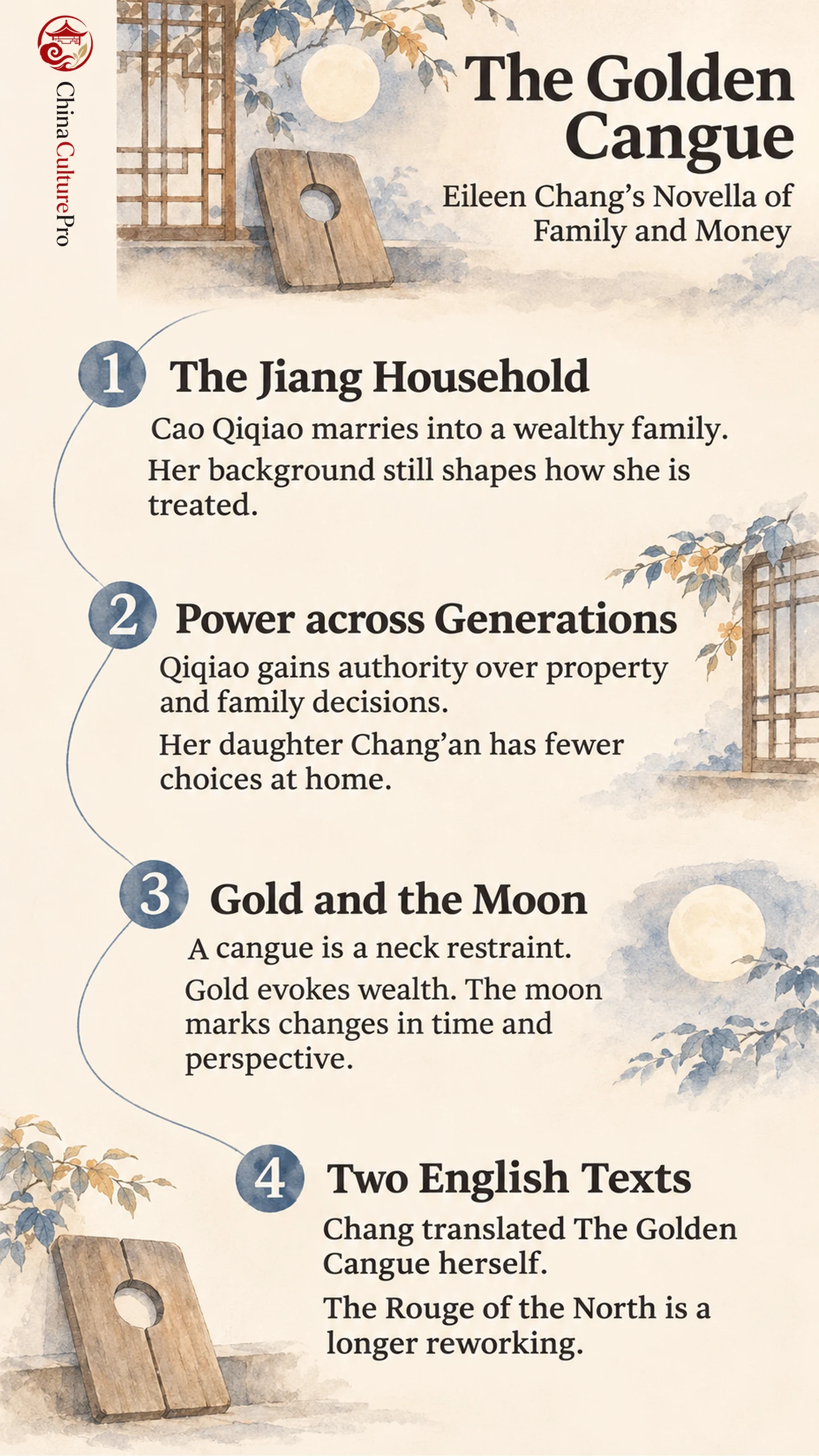
- The household: Qiqiao’s marriage gives her a place in the Jiang family without ending its contempt for her background.
- The title: The English title puts the image of restraint beside the appeal of gold.
- The English text: Chang translated the novella herself. The Rouge of the North is a longer work she developed from related material.
The story follows the effect of family power across years. Its most important changes often appear through everyday decisions about money, education or marriage.
A person can have money, a room in a large house and a recognized place in the family without feeling secure. Qiqiao’s predicament becomes more difficult to understand when she gains the authority she once lacked. Eileen Chang follows what happens when someone who has learned to defend herself through suspicion can decide how other people live.
How Cao Qiqiao Enters the Jiang Household
First published in 1943, the novella begins with Qiqiao already married into the wealthy Jiang family. She comes from a family associated with a sesame-oil shop, and the people around her use that background to mark a difference in standing. Her husband lives with a serious illness. The marriage makes her part of the household while leaving others free to treat her as someone beneath them. [1][2]
Read the early exchanges for who can speak plainly and who has to judge how a remark will be taken. A slight about her origins makes the unequal marriage visible in an ordinary exchange. Qiqiao’s sharp speech gives her a way to strike back in the moment. It cannot guarantee the place she wants inside the family.
For a first encounter with Eileen Chang’s fiction, this is a useful example of how conversation carries social information. The author can tell the reader a great deal about a person’s position by showing who feels entitled to laugh at a remark and who has to absorb it.
How Power Changes across Generations
As the household changes and Qiqiao gains control over property and family decisions, she can exercise authority that others once held over her. The second generation shows what she can now decide for other people. [2][3]
Her daughter Chang’an (长安, Cháng’ān) spends time away from home at a boarding school for girls. The change in environment offers one way to see what living under her mother’s scrutiny costs her. School is a small opening in a family story told over many years. Watch how quickly a decision that appears to concern education can become a decision about the family’s standing. [3]
It is possible to recognize the restrictions that shaped Qiqiao and still pay attention to the harm she causes. If you read her only through the early household scenes, it is easy to miss the reach of her later power. If you begin with her treatment of her children, you miss the family that taught her what holding on to money could mean.
What the Golden Cangue and the Moon Convey
A historical cangue could consist of two sections of a broad wooden board fastened around a person’s neck. The Chinese title refers to a golden lock. Chang’s own English wording chooses a specific kind of restraint. Gold suggests wealth and value, while a cangue brings weight and confinement to mind. The combination captures something about security that seems desirable and can still limit what a person is able to do. [4]
The novella also returns to the moon. Pay attention to its appearance near the beginning and again as the story looks across years. The image can hold different feelings for people remembering an earlier time and for people living through it. Its repetition lets the reader notice a change of perspective without a character having to announce it. [3]
These are distinct reading cues. The title directs attention to the power people attach to wealth. The moon helps organize the passage of time and the feelings that accumulate around it. Together they show how this work of modern Chinese literature makes meaning through objects and images as well as events.
Which English Text to Read
If you want the novella, look for The Golden Cangue in the contents of Twentieth-Century Chinese Stories, published by Columbia University Press in 1971. The catalogue credits Chang as both author and translator. [5]
The Rouge of the North, first published in English in 1967, is related to the novella but has been reworked into a longer book. Its central figure is Yindi. Choose it if you want to compare how Chang developed the material in a different form. If you are following a discussion of Qiqiao or a passage from The Golden Cangue, select the novella. [6][7]
Readers interested in another writer’s use of Shanghai and private memory can turn to Wang Anyi’s The Song of Everlasting Sorrow. The change of author and scale offers a separate reading path into lives told across decades.
FAQs About The Golden Cangue
What is a cangue?
It is a rigid restraint worn around the neck, often made of wood. In the novella’s English title, it supplies the image of confinement beside gold’s promise of wealth.
Did Eileen Chang translate The Golden Cangue herself?
Yes. The contents of the 1971 Columbia anthology Twentieth-Century Chinese Stories credit Chang as the novella’s author and translator.
Is The Rouge of the North the same English text?
No. Chang developed the longer novel from related material and named its central character Yindi. Use The Golden Cangue to read the author’s English translation of the original novella.
Sumber
[1] Hong Kong Film Archive. Eileen Chang: Biographical Note
[2] Liu Zaifu, MCLC Resource Center. Eileen Chang’s Fiction and C. T. Hsia’s A History of Modern Chinese Fiction
[3] Xiaohu Jiang, Journal of Austrian Studies. An Adlerian Analysis of the Problematic Mother-Daughter Relationship
[4] Horniman Museum and Gardens. Cangue, Collection Object 2.114
[5] Indiana University Libraries. Twentieth-Century Chinese Stories: Contents and Credits
[6] Humanities and Social Sciences Communications. Literary Metamorphosis: The Rouge of the North and The Golden Cangue
[7] University of California Press. The Rouge of the North: Book and Foreword