


Quick Answer: What Is The Deer and the Cauldron About?
The Deer and the Cauldron (鹿鼎记, Lùdǐng Jì) is the final martial-arts novel by Jin Yong (金庸, Jīn Yōng). It follows Wei Xiaobao (韦小宝, Wéi Xiǎobǎo), a streetwise boy whose rise brings him into the confidence of the young emperor and into a society that opposes Qing rule.
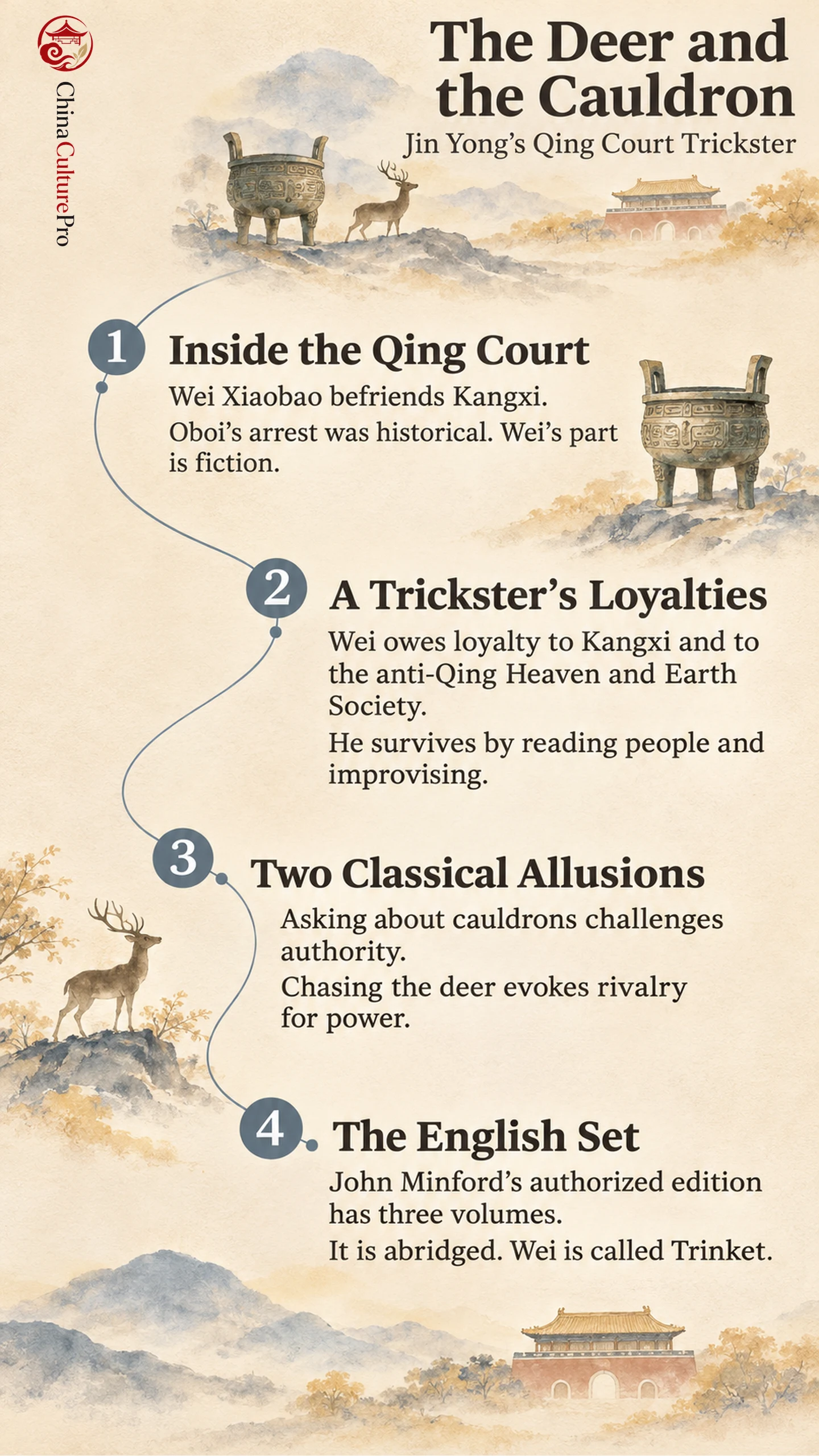
- At court: Wei befriends the Kangxi Emperor (康熙皇帝, Kāngxī Huángdì) and learns to survive by reading people and taking chances.
- Outside court: His membership in the Heaven and Earth Society (天地会, Tiāndìhuì) gives him an obligation that can pull him in the opposite direction.
- In English: The authorized Oxford University Press edition is an abridged three-volume translation credited to John Minford, who calls Wei Trinket.
The novel is a standalone historical adventure with a comic streak. The central relationships are more useful to track than the full cast on a first reading.
Wei Xiaobao survives situations that might defeat a far better fighter. He is willing to flatter a patron, use a disguise or let someone draw the wrong conclusion about him. In a court divided by rival interests, the ability to improvise gets him remarkably far. Each favor he accepts also gives someone a reason to call on him later.
How Wei Xiaobao Enters the Qing Court
Jin Yong finished this novel in 1972, closing a martial-arts writing career that began with The Book and the Sword. The story opens in a much earlier world, during the early Qing. Wei grows up in a Yangzhou brothel and reaches the palace under the identity of a young eunuch. He meets the young emperor without immediately understanding whom he is dealing with. Their friendship soon brings him close to a struggle over who exercises power. [1][2]
That struggle has a historical anchor. Oboi (鳌拜, Áobài) was one of the regents appointed to govern during Kangxi’s minority. He accumulated power and was arrested in 1669 as the young ruler moved to take control. The historical record helps explain why the arrest matters. Wei’s role in the novel belongs to Jin Yong’s fictional version of events. [3]
Away from the palace, the young man takes on a second allegiance. Chen Jinnan (陈近南, Chén Jìnnán), a leader of the Heaven and Earth Society, becomes his teacher. To Kangxi, Wei is a trusted companion. To Chen and the society, he is someone with obligations to an anti-Qing cause. The two relationships create much of the book’s tension. [2]
For historical orientation, read the novel alongside a guide to the Qing dynasty. An official title or event may be recognizable even when the dialogue, motives and private dealings are inventions.
Why the Novel Follows a Trickster
The book belongs to wuxia (武侠, wǔxiá), the tradition of martial-arts fiction about fighters, alliances and obligations. Wei, however, is a comic antihero. He pays close attention to what an influential person wants to hear and which part of a story can be left unsaid. For a newcomer to Chinese wuxia, the difference lies in what helps the protagonist succeed. A better fighter can still be outmaneuvered by someone who understands the room. [4][6]
Read Wei’s scenes with Kangxi and Chen Jinnan with two questions in mind. Which obligations come from gratitude or affection? Which ones come from the emperor’s power or the society’s cause? His affection for the people on either side makes their incompatible demands harder to evade. [4]
That tension gives the comedy a sharper purpose. An excuse can solve the problem of getting out of a room without answering what Wei owes the person still in it. As the cast expands, tracking those unpaid obligations is a better way to remember a returning character than memorizing every faction and title at once.
What the Deer and the Cauldron Signify
The title draws on two classical images of political ambition. The novel introduces both near the beginning, before the reader sees what a contest for power looks like from Wei’s position. [2]
The first is asking about the cauldrons (问鼎, wèndǐng). An episode in the Commentary of Zuo tells how the ruler of Chu asked about the weight of the Zhou royal cauldrons. The Zhou envoy’s reply locates legitimacy in the ruler’s virtue, which makes the exchange a dispute about authority as much as a question about bronze vessels. [8]
The second is chasing the deer (逐鹿, zhúlù). A passage in the Records of the Grand Historian compares the struggle that followed the collapse of Qin power to a pursuit of the deer that Qin had lost. Here, a hunt supplies an image for several rivals competing to rule. [9]
Read the two images together. The cauldrons raise the question of who can claim authority. The chase makes the rivalry for that authority visible. Wei gets close to people engaged in the contest even when his immediate goal is simply to keep a friend or get out of trouble.
How to Find the English Translation
Search under The Deer and the Cauldron and check that the catalogue lists John Minford. Oxford University Press offers the authorized three-volume English set. Library catalogues also list individual books from the English set. Check the book number or the number of volumes before choosing a copy. [6][7]
Minford explained that he and David Hawkes shortened the work for the English edition and that Hawkes chose to remain uncredited on the books. A complete set of the English volumes is still a shortened version of the Chinese work. This matters if you intend to align chapter numbers or trace a minor subplot across editions. [5]
If you want to compare how Jin Yong uses the Qing court at either end of his career, pair this novel with The Book and the Sword. The earlier book follows a society leader who hopes to use a family connection against a ruler. The later book gives a court insider relationships he wants to keep on both sides.
FAQs About The Deer and the Cauldron
Why is Wei Xiaobao called Trinket?
Trinket is the name Minford uses for Wei Xiaobao in the English translation. It refers to the same protagonist you will see named in guides to the Chinese text.
Is the English translation abridged?
Yes. The authorized Oxford University Press translation is issued in three volumes and shortens the Chinese original.
Do I need to read Jin Yong’s earlier novels first?
No. Start here if the Qing court and Wei’s double allegiance interest you. Earlier novels provide context for the author’s approach to martial-arts fiction.
Sumber
[1] Hong Kong Heritage Museum. Jin Yong Gallery
[2] WuxiaSociety. The Deer & the Cauldron
[3] Robert B. Oxman, The Journal of Asian Studies. Policies and Institutions of the Oboi Regency 1661–1669
[4] David Hazard, International Journal of Asian Studies. From the Mandate of Heaven to the Modern State: The Nation According to Wei Xiaobao
[5] John Minford, China Heritage. Louis Cha’s The Deer & the Cauldron in English
[6] Oxford University Press (China). The Deer and the Cauldron (3-Vol Set)
[7] Hong Kong Public Libraries. Selected Jin Yong Bibliography
[8] Chinese Text Project (Chinese Text Project). Commentary of Zuo: Duke Xuan, Year Three
[9] Chinese Text Project. Records of the Grand Historian: Biography of the Marquis of Huaiyin