
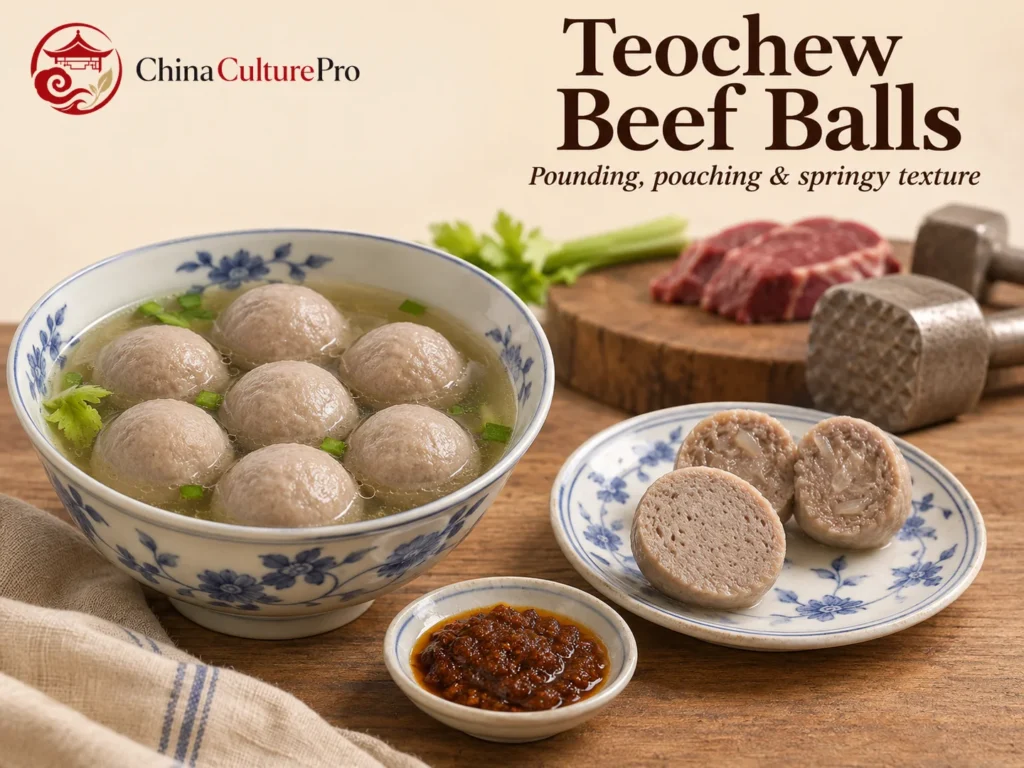

Quick Answer: What Are Teochew Beef Balls?
Teochew beef balls (牛肉丸; niú ròu wán) are springy meatballs associated with the Chaoshan region. Traditional preparation works trimmed beef into a cohesive paste before hand-shaping and gently cooking the balls.[1]
- Ingredient choice: Plain beef and beef-tendon versions offer different textures.
- Technique: Pounding, mixing and shaping matter as much as the round form.
- Serving: Clear broth and beef hot pot are familiar settings.[4]
A regional name does not identify every seasoning or tell you whether a packaged product is already cooked.

The rounded shape is easy to recognize; the worked meat paste is what distinguishes the texture from a loose, crumbly mince ball. This guide places the ingredients and making process within Teochew cuisine, then follows the choices that matter when buying or ordering.
Beef, Tendon and Seasoning Choices
Beef tendon balls (牛筋丸; niú jīn wán) combine beef with tendon rather than consisting only of tendon. One documented producer’s version also adds beef fat and garlic, illustrating how ingredients can change alongside texture.[2]
One hand-pounding competition used beef, salt and ice water, illustrating a specific formula rather than a universal list.[1]
Other documented preparations include starch, cold water and seasonings in the worked paste. For a packaged product, read the actual list rather than assuming that springiness proves either the absence or presence of a particular additive.[2]
When comparing plain and tendon versions, ask which texture you prefer and what is included. The word “tendon” is useful information, but it does not tell you the size of the pieces, the exact formulation or how a particular manufacturer has prepared them.
Traditional Pounding, Shaping and Poaching
This traditional process overview does not supply a fixed home-batch formula.[1]
- Trim and pound: Trim the beef, cut into pieces and pound into a paste using the traditional tools.
- Season and work the paste: Add salt and ice water, then mix and slap the paste until cohesive. Control its temperature during the work.
- Shape the balls: Squeeze paste through the hand and use a spoon to release rounded portions into water.
- Poach through: Cook gently, stirring as needed, until the balls are fully cooked. Match timing to their size and the recipe.
Shaping and cooking are separate stages; a firm shape alone does not establish doneness.
For a raw ground-beef mixture, use a food thermometer to check an internal temperature of 160°F (71°C). A short time copied from a demonstration, or floating at the surface, is not a substitute for checking the product you are cooking.[5]
The Chinese cooking methods guide provides broader context for gentle poaching. Traditional handwork also coexists with larger-scale production: an inheritor’s account describes integrating the skill with modern manufacturing, so the name alone is not proof that every ball was hand-pounded in the shop.[3]
Regional Serving Styles and Packaged Products
Clear beef-bone broth lets the balls sit alongside sliced beef and other ingredients in a hot-pot meal. Dipping sauces are served separately; documented choices include shacha sauce (沙茶醬; shā chá jiàng), peanut sauce and chili sauce.[4]
For that meal format, see the Chaozhou beef hot pot guide and the practical hot-pot cooking guide. Beef balls and thin beef slices are different products, so do not copy a sliced-meat cooking time onto a meatball.
A separate dip lets you compare the plain broth-and-beef taste with a stronger condiment. The hot pot dipping sauces guide explains the wider range; ask what the specific sauce contains before choosing it.
When buying frozen or chilled balls, check storage instructions, cooking status and whether the maker asks you to thaw first. Follow directions written for that product. A ball may have been shaped or partially cooked before packaging without being ready for immediate eating.
FAQs About Teochew Beef Balls
Are beef tendon balls made only from tendon?
No. They combine beef and tendon; other additions depend on the recipe.[2]
Does every Teochew beef ball have only beef and salt?
No. Documented versions can include starch, water and other seasonings.[2]
Are floating beef balls ready to eat?
Floating alone does not establish doneness. Follow the product directions and check raw ground-beef mixtures reach 160°F (71°C).[5]
Sumber
[1] Guangdong Federation of Trade Unions, original competition reporting. 潮汕手打牛肉丸制作技艺竞赛
[2] Abin enterprise entry, Ministry of Commerce digital museum. 阿彬牛肉:牛肉丸制作技艺
[3] Nanfang Plus, original inheritor interview. 汕头深挖潮汕菜文化内涵
[4] Guantang Brothers enterprise entry, Ministry of Commerce digital museum. 官塘兄弟:牛肉火锅与牛肉丸
[5] USDA FSIS. To what temperature should I cook beef?