
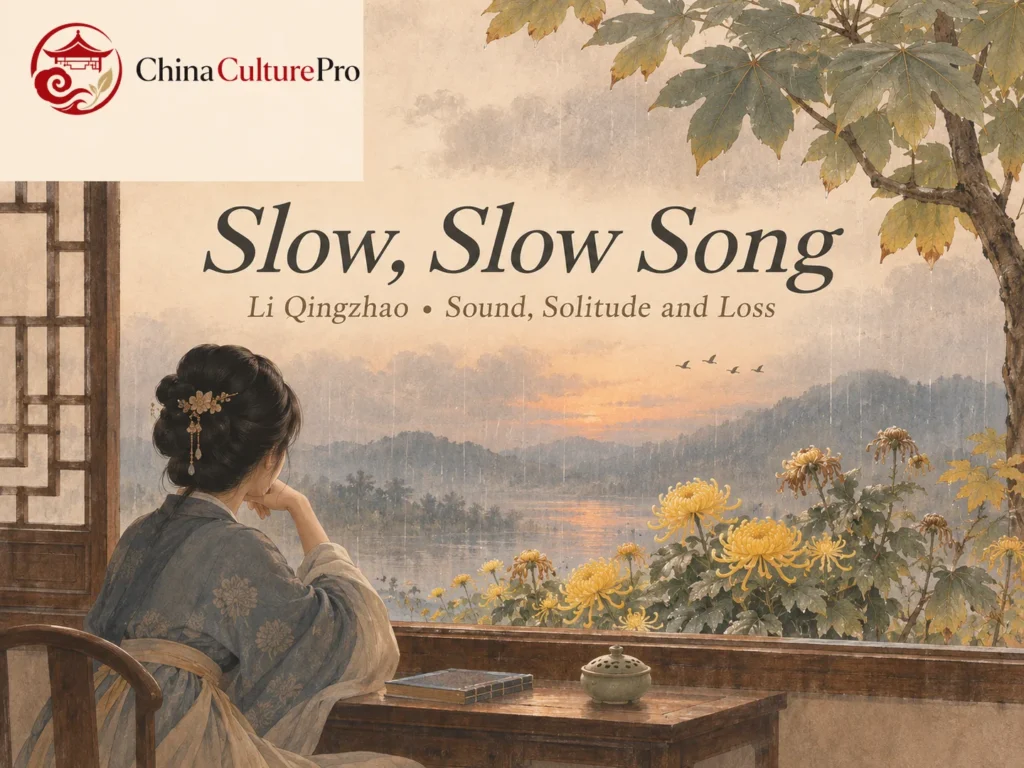

Quick Answer: What Is Slow, Slow Song About?
Slow, Slow Song (聲聲慢, Shēngshēng Màn) by Li Qingzhao (李清照, Lǐ Qīngzhào) gives grief a sensory form through repeated sounds, unsettled weather and familiar objects that intensify loneliness.
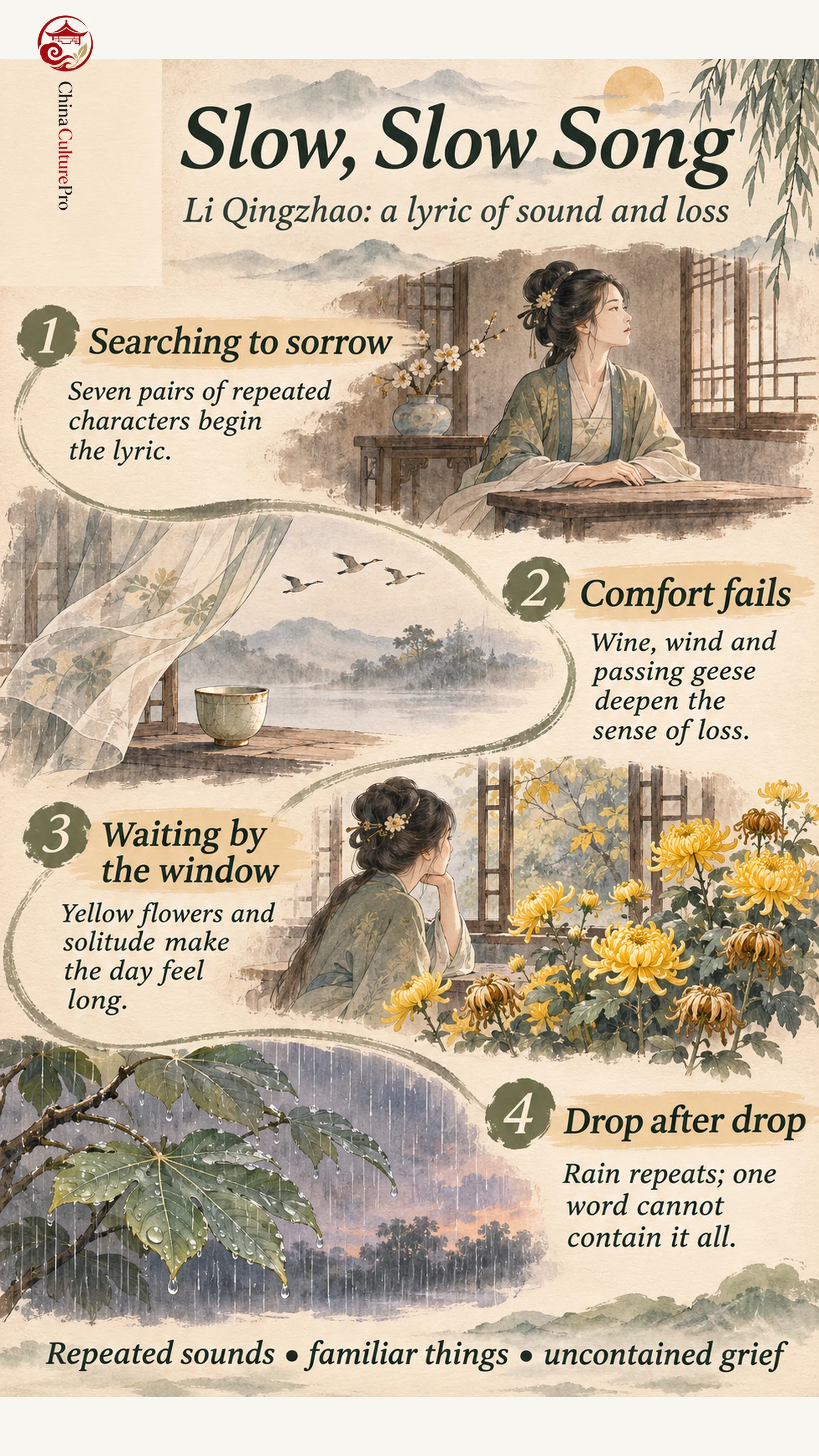
- Opening: Seven pairs of repeated characters move from searching to cold emptiness and distress.
- Experience: Wine, wind, geese, flowers and a window make absence felt through the surroundings.
- Ending: Repeated raindrops return the lyric to sound before the speaker asks how one word could contain the whole condition.
This is a ci (詞, cí), a song lyric written to a tune pattern. The complete received text has two stanzas and 97 Chinese characters; its changing phrase lengths belong to that form.[1][2]
An ordinary day becomes difficult to endure when every small thing recalls absence. Searching, changing weather, a passing bird, flowers and rain gather around a solitary speaker. By the close, the familiar word for sorrow seems too small for what the lyric has made us experience.
The Complete Lyric and an English Sense Translation
The following is the whole lyric in eight reading groups, with a divider between its two stanzas. The English is an original sense translation. It follows the received “evening wind” reading, 晚來風急; other texts have “morning wind,” 曉來風急.[1][2]
| Chinese text | English sense translation |
|---|---|
| 尋尋覓覓,冷冷清清,悽悽慘慘戚戚。 | I search and search, seek and seek: all is cold and empty, desolate, anguished, distressed. |
| 乍暖還寒時候,最難將息。 | In this spell of sudden warmth turning cold again, finding rest is hardest. |
| 三杯兩盞淡酒,怎敵他、晚來風急? | A few cups of thin wine—how could they hold off the evening’s fierce wind? |
| 雁過也,正傷心,卻是舊時相識。 | Geese pass overhead, just as grief strikes; yet they are acquaintances from former days. |
| — | — |
| 滿地黃花堆積。憔悴損,如今有誰堪摘? | Yellow flowers mass across the ground. Worn down—who now can bear to gather them? |
| 守著窗兒,獨自怎生得黑? | Keeping watch beside the window, alone: how shall I last until darkness? |
| 梧桐更兼細雨,到黃昏、點點滴滴。 | The Chinese parasol tree (梧桐, wú tóng), and fine rain besides: through dusk, one drop, then another. |
| 這次第,怎一個愁字了得! | In such a state, how could the single word “sorrow” contain it all? |
“A few cups” renders the conventional small quantity in “three cups, two bowls”; it should not become a precise total of five drinks. The flower row also leaves room for interpretation: whether the flowers or the speaker are described as worn down affects how the scene is imagined.[1][2]
The Tune and the Context of Loss
The title names a tune pattern, not a command to read every word at one fixed slow speed. The broader guide to Song ci poetry explains how a pattern governs a lyric’s phrases.
The work is traditionally read among Li Qingzhao’s later lyrics, against displacement to the south and the death of her husband. That context deepens the language of former acquaintance and present solitude. The Li Qingzhao guide provides the wider life history.[2]
The lyric itself names neither the person lost nor an exact occasion. Its power comes from the immediate experience arranged in the words: attempting to settle, recognizing something familiar and continuing to wait.
Seven Pairs of Repeated Characters
The opening has seven pairs, not fourteen pairs: 尋尋 / 覓覓 / 冷冷 / 清清 / 悽悽 / 慘慘 / 戚戚. In modern Mandarin pinyin, they read xún xún / mì mì / lěng lěng / qīng qīng / qī qī / cǎn cǎn / qī qī.[1]
The first two pairs suggest repeated searching without naming the thing sought. The next two establish a cold, empty atmosphere. The final three intensify inward distress. Sound lets the reader feel recurrence before any explanatory story is supplied.
A fluent English sentence cannot reproduce every feature of those paired sounds. The sense translation preserves the repeated searching, while the Chinese shows how insistently the opening turns back upon itself. The pattern gives the distress a recurring audible shape.
Wine, Geese and Chrysanthemums
The wine does not withstand the wind, and concern does not pass away. The contrast turns an attempted comfort into another measure of exposure. The lyric’s “thin” wine belongs to that experience; no chemical strength is specified.[1]
The geese become “old acquaintances.” Their familiarity connects present loneliness with an earlier world. A companion reading is One Cut of Plum (一剪梅, Yījiǎn Méi), where geese appear alongside the hope of a letter. Here, recognition brings renewed pain rather than reassurance.[2]
The yellow flowers are conventionally understood as chrysanthemums. Their broader Chinese cultural meanings do not replace the particular question this lyric asks: who now has the heart to gather them?
Some readings imagine withered flowers and fallen petals. Others understand densely blooming chrysanthemums, with the weariness falling upon the person who cannot enjoy them. Both are discussed in the teaching commentary cited below. The choice changes whether the eye rests on physical decay or beauty the speaker cannot enjoy.[2]
The Window, the Rain and the Final Question
Waiting beside the window makes the passage toward darkness feel prolonged. The speaker has a fixed place from which weather and memory keep arriving. Her question makes the remaining hours something to endure.[1]
Fine rain then provides a sound that will not end quickly. 點點滴滴, “one drop, then another,” brings paired repetition back near the close. The opening’s insistent searching has found a counterpart in the continuing external sound.
The last question gathers this whole condition into view. Chou (愁, chóu), “sorrow,” is a familiar word, but a single label cannot carry all the particular sensations just presented. The ending expands the feeling by calling the label insufficient. The lyric has already given the feeling a precise sensory form.[1]
How to Read the Lyric’s Sound and Images
- Hear the opening pairs: Follow the movement from searching through empty surroundings to inward distress.
- Notice attempted comfort: Read wine and familiarity against the continued force of wind and loss.
- Stay at the window: Let waiting make the approach of darkness feel slow.
- Listen for the return: Connect the raindrop pairs with the opening before reading the final question.
FAQs About Slow, Slow Song
Is the lyric set in spring?
Its chrysanthemums and traditional interpretation place the scene in autumn. The phrase about warmth returning to cold can describe changeable conditions within that setting; it need not establish an early-spring date.[2]
Why do some translations mention morning wind?
The Chinese is transmitted with both 晚, “evening,” and 曉, “morning.” This page follows the evening reading consistently. A translation using morning may be following another received text rather than mistranslating the same character.[1][2]
Are the yellow flowers necessarily fallen petals?
No. Withering is one reading; abundant blooms contrasted with the speaker’s exhaustion are another. The emotional inability to gather or enjoy the flowers is central in either approach.[2]
Does the lyric name the person being mourned?
No. Its later-life interpretation is informed by the poet’s losses, but the lyric does not explicitly name her husband or narrate his death.[1][2]
Sumber
[1] Li Qingzhao; Chinese Wikisource. Shengshengman: Autumn Feeling
[2] Hong Kong Education Bureau. Recommended Classical Passages: Shengshengman