
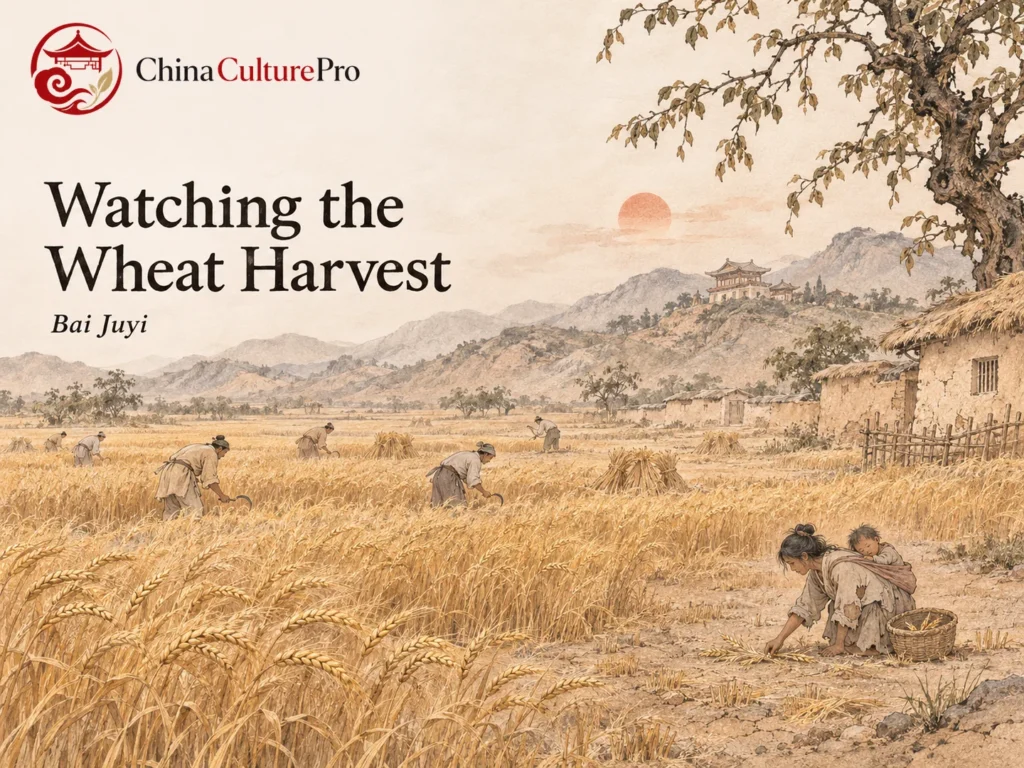

Quick Answer: What Is Watching the Wheat Harvest About?
*Watching the Wheat Harvest* (观刈麦, Guān Yì Mài) is a Tang poem by Bai Juyi (白居易, Bái Jūyì). An official watches a family reap wheat in the heat, hears why a woman must pick up leftover grain and thinks about the salary that keeps his own household fed.[1]
- The harvesters: They work through the heat because the long day lets them cut more wheat.
- The woman: With a child and a worn basket, she gathers fallen ears to eat after taxes have taken her household’s crop.
- The speaker: He has grain to spare at year’s end, and the sight of the field leaves him ashamed.
The poem reaches its judgment through details of who works, who eats and who has grain left over.[1]
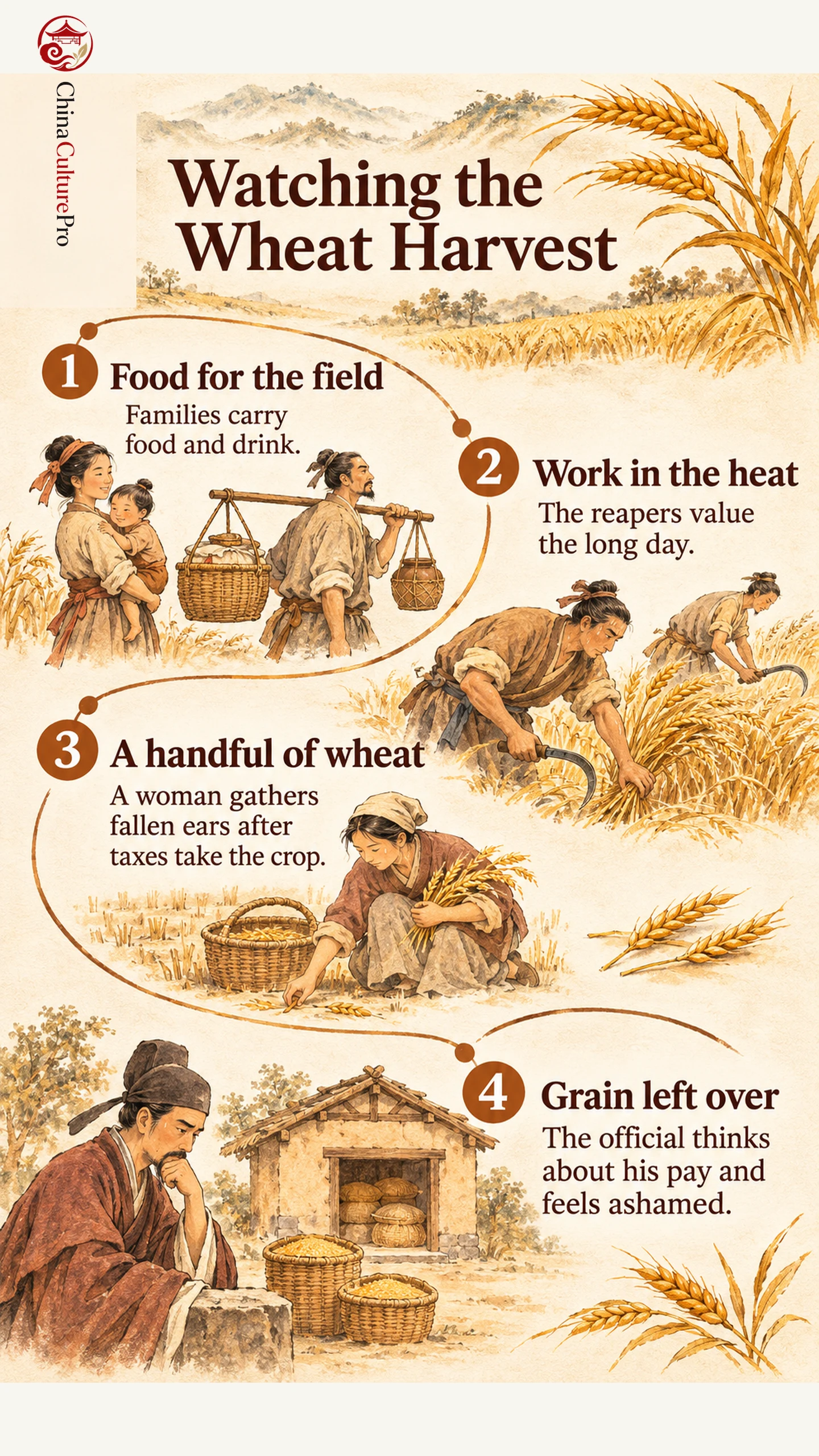
Watch what the people in the wheat field carry. A meal for the workers and a handful of leftover grain show two sides of the harvest.
Watching the Wheat Harvest in Chinese, Pinyin and English
The table follows the received text, using simplified characters and modern Mandarin pinyin. Each row contains two of the original five-character lines. The English is a fresh rendering.[1][2]
| Tionghoa | Pinyin | English |
|---|---|---|
| 田家少闲月,五月人倍忙。 | Tián jiā shǎo xián yuè, wǔ yuè rén bèi máng. | Farm households have few quiet months. In the fifth they’re twice as busy. |
| 夜来南风起,小麦覆陇黄。 | Yè lái nán fēng qǐ, xiǎo mài fù lǒng huáng. | A south wind rose in the night. Ripe wheat lies yellow over the field ridges. |
| 妇姑荷箪食,童稚携壶浆。 | Fù gū hè dān sì, tóng zhì xié hú jiāng. | Women carry food in bamboo baskets. The children bring jars of drink. |
| 相随饷田去,丁壮在南冈。 | Xiāng suí xiǎng tián qù, dīng zhuàng zài nán gāng. | Together they take the meal out to the fields, where the men work on the southern slope. |
| 足蒸暑土气,背灼炎天光。 | Zú zhēng shǔ tǔ qì, bèi zhuó yán tiān guāng. | Heat steams up around their feet. Blazing daylight scorches their backs. |
| 力尽不知热,但惜夏日长。 | Lì jìn bù zhī rè, dàn xī xià rì cháng. | Spent, they scarcely feel the heat. They prize the length of the summer day. |
| 复有贫妇人,抱子在其傍。 | Fù yǒu pín fù rén, bào zǐ zài qí páng. | Beside them is a poor woman, holding a child. |
| 右手秉遗穗,左臂悬弊筐。 | Yòu shǒu bǐng yí suì, zuǒ bì xuán bì kuāng. | Her right hand grips stray ears of wheat. A worn basket hangs from her left arm. |
| 听其相顾言,闻者为悲伤。 | Tīng qí xiāng gù yán, wén zhě wéi bēi shāng. | Those who hear the words she exchanges with others are saddened. |
| 家田输税尽,拾此充饥肠。 | Jiā tián shū shuì jìn, shí cǐ chōng jī cháng. | What her family’s field yielded went in taxes. She picks up this grain to fill an empty belly. |
| 今我何功德?曾不事农桑。 | Jīn wǒ hé gōng dé? Zēng bù shì nóng sāng. | What have I done to deserve my place? I’ve never tilled a field or tended mulberries. |
| 吏禄三百石,岁晏有馀粮。 | Lì lù sān bǎi dàn, suì yàn yǒu yú liáng. | My official pay is three hundred measures of grain. At year’s end I have grain left over. |
| 念此私自愧,尽日不能忘。 | Niàn cǐ sī zì kuì, jìn rì bù néng wàng. | Thinking of it, I feel ashamed in myself. All day I can’t put it out of mind. |
Why the Harvesters Want the Day to Last
A basket of food and jars of drink show what it takes to keep the harvest going. The people working on the slope need a meal, and other family members bring it out. Bai Juyi then describes heat against two parts of the body. Heat rises from the earth and the sun beats down on their backs. The work takes place between those two sources of heat.
The next couplet can seem surprising. After describing exhaustion, the speaker says the workers prize the long summer day. A longer day gives them more time to finish the cutting. The same sunlight that hurts them makes that time available. The poem lets their need for daylight explain why they stay in the field.[1]
What the Woman Gathering Wheat Reveals
The woman appears beside the other workers, but her actions are different. She has a child with her. Her hand gathers what remains after cutting, and the basket on her arm is already worn. This is gleaning, the collection of ears the harvest has left behind.
The poem shifts from watching to listening. Only when people hear what she says does the economic fact become clear. Taxes have taken what her household’s field produced, and she is gathering the fallen grain to eat. The earlier basket brought a meal into the field. Her basket is for what she can find of a meal.[1][2]
Why the Official Ends With His Own Salary
The title note places Bai Juyi in office as a county lieutenant at Zhouzhi (盩厔, Zhōuzhì).[1] The poem changes its time scale as it moves from the longest days in the field to the official’s grain supply at the end of the year. The amount is expressed in a historical grain unit, and what matters to the comparison is his surplus.
The speaker asks what he has done to merit that security. He points out that he has done no farm work, including the mulberry cultivation associated with silk, then gives the amount of his pay. Putting that amount next to the woman’s handful of wheat is what makes the last two lines personal. In The Song of Everlasting Sorrow, Bai Juyi also lets concrete details carry the emotional weight of a story, there on the scale of the imperial court.
FAQs About Watching the Wheat Harvest
What does the title Watching the Wheat Harvest mean?
The middle character means to cut or reap. The title therefore points specifically to watching wheat being cut. The poem widens that view by including the people who bring food and the woman who gleans.
Does the fifth month mean May?
It refers to the fifth month in the traditional Chinese calendar. Its dates move against the Gregorian calendar. In the poem the month establishes the season of ripe wheat, heat and long days.
Sumber
[1] Bai Juyi. Watching the Wheat Harvest in the received text
[2] Complete Tang Poems. Bai Juyi’s poems in the digitized collection