


Quick Answer: What Were Silver Sycee and Taels?
Chinese silver sycee were cast silver ingots, a form of yin ding (銀錠, yíndìng). A tael, or liang (兩, liǎng), was a measure of weight that also appeared in silver accounts. Qing buyers and sellers could agree on a price in taels and then assess the actual metal offered in payment.[1][2][3][4]
- Object: An ingot was a piece of silver with a particular shape, weight and composition.[1][2][3]
- Measure: The tael used to weigh it depended on the applicable standard.[3][4][5]
- Account: Some commercial taels provided a common unit in which prices and balances could be stated.[3][4]
A single figure for grams per tael would miss the different standards documented in Qing markets and records.[4][5]
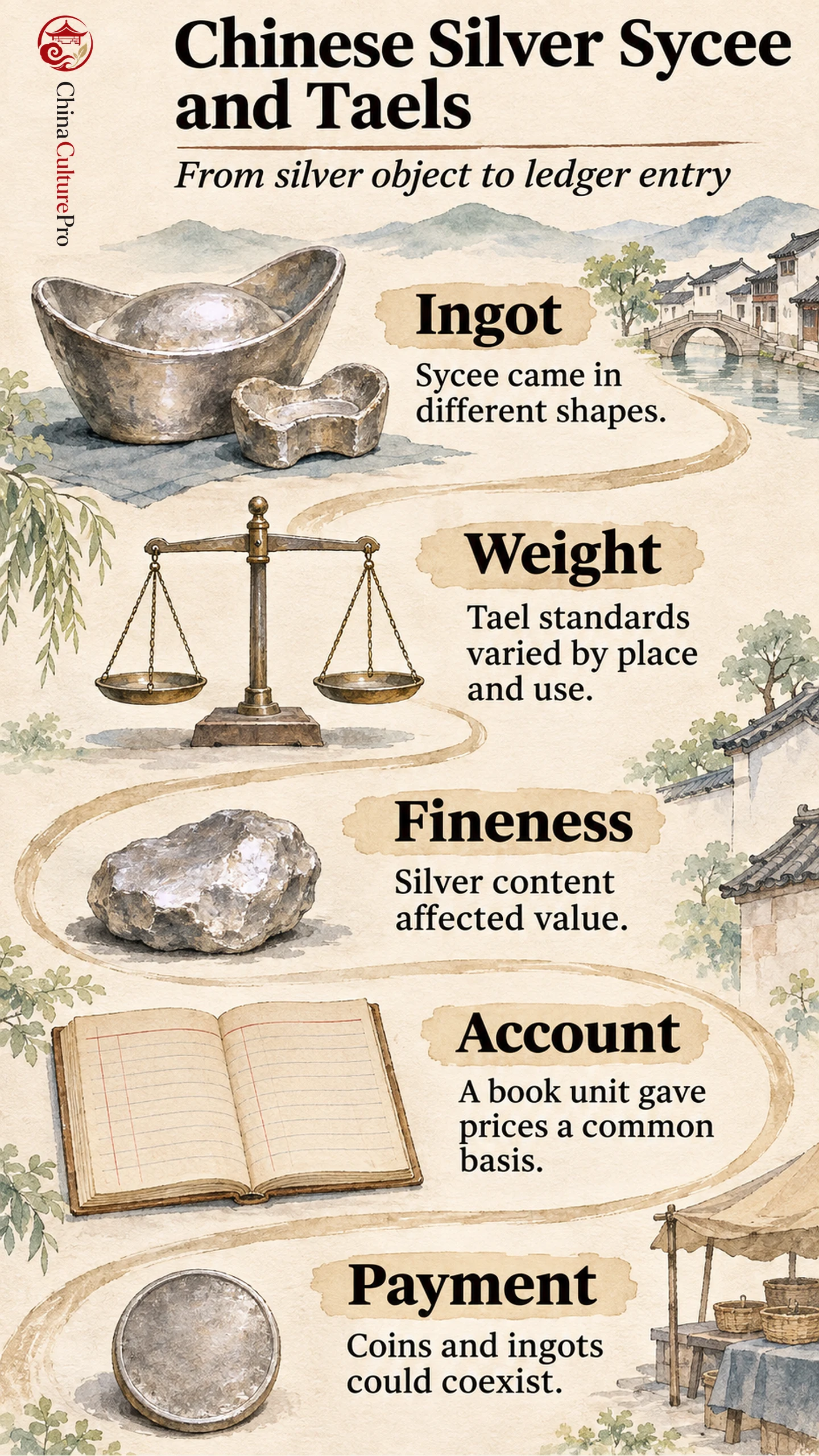
A display case gives you the shape of a sycee. A deed might give you an amount in taels. A historian needs the context of both to work out what silver was worth or what someone was expected to pay.[1][2][3][5]
What Museum Objects Show
The object could be a large boat-shaped casting or a much smaller piece with a different profile. The Smithsonian’s National Numismatic Collection describes one boat or slipper-shaped sycee as equaling 50 taels and bearing two stamps. Another entry describes an unstamped horseshoe-shaped example equaling two heavy taels. The two catalogue records show variation in size, shape and marking.[1][2]
A stamp can help identify an origin or producer where the inscription is known. The stamp on a documented object and the standard used in a particular market are separate pieces of evidence. Studies of exchange also show that sycee could be recast to fit another trading area’s practices.[1][3]
Which Tael Did a Qing Record Mean?
Qing silver weight varied across places and uses. Researchers studying Beijing house-sale deeds found two commonly used standards, shiping and jingping, with different weights per tael. The same count of taels could denote different weights, even in contracts from one city. Before converting a recorded price, check the deed’s date, place and named silver standard.[5]
There were also bookkeeping taels. In Shanghai, for example, a commercial tael could provide a common unit for transactions involving forms of silver with different physical characteristics. Someone reading an account can ask what its numbers measure before assuming a clerk counted out standard pieces. The broader history of monetary weights explains why naming the standard matters.[3][4]
Why Fineness Mattered
Fineness measures the proportion of silver in a piece. Two ingots of equal gross weight can contain different amounts of silver. Merchants therefore had to consider weight and quality when accepting silver and converting it into the local standard.[3][4]
Silver coins also circulated. For some Spanish and Mexican dollars, the market price could exceed the value of the silver as bullion. Familiarity and acceptance could matter alongside metal content. A sycee, a traded silver coin and an accounting figure could all feature in the same monetary system.[3][4]
The role of silver went beyond trade. A Qing land-tax account records obligations in silver terms. A Shanxi draft bank could arrange payment in another place through its branches. An amount on paper therefore needs to be read in light of the institution that recorded it.[3][4][5]
FAQs About Silver Sycee and Taels
Was a sycee always boat-shaped?
The Smithsonian has a boat-shaped example and a much smaller horseshoe-shaped piece. Shape varied, and a catalogue may identify an object’s form, weight and marks separately.[1][2][3]
How many grams were in a Qing tael?
That depended on the standard. The Beijing contracts studied by economic historians use different weights, even within the same city.[4][5]
Why could two ingots of the same weight be valued differently?
They could contain different amounts of fine silver. Local trading standards also affected how an ingot was assessed in exchange.[3][4]
Sumber
[1] Smithsonian National Museum of American History. Sycee, China, 50-tael example
[2] Smithsonian National Museum of American History. Sycee, China, two-heavy-tael example
[3] Debin Ma and Liuyan Zhao, Economic History Review. Silver currency and silver units of account in China
[4] Financial History Review. Explaining Premiums for Spanish and Mexican Silver Coins in Qing and Republican China
[5] Wharton School. Beijing house-sale records and conversion of currency measures