
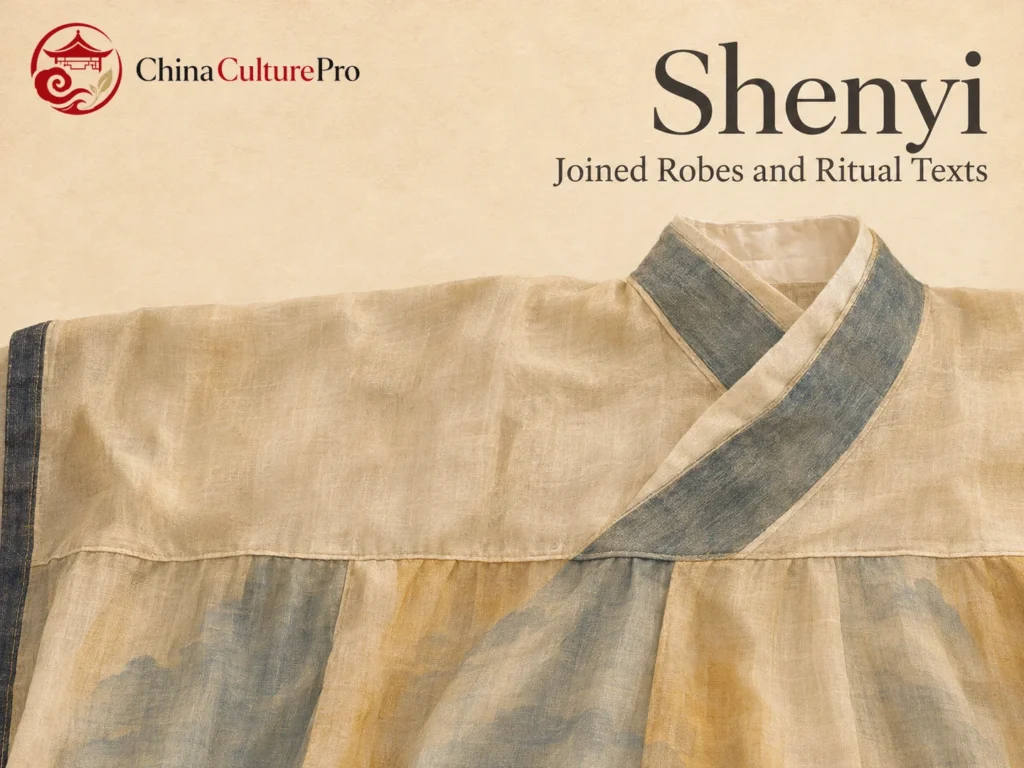

Quick Answer: What Is a Shenyi?
Shenyi (深衣, shēnyī) is a Chinese robe tradition in which the upper section and lower garment are joined. A classical ritual text gives rules for length, width and fabric sections. Later writers proposed different ways of turning those rules into a garment.[1][2][3]
- Construction: A join between upper and lower parts can be seen from the inside of a robe.[2]
- Classical number: The ritual text links twelve fabric sections to the months of the year.[1]
- Later interpretations: A Southern Song pattern and a later critique differ on the arrangement of the panels and edges.[2][3]
When you compare a textile with a dress text, check the date and what each source actually describes.

A long robe can have a line at the waist that is hidden by a belt or by another layer. To see how a shenyi was assembled, look for the join from the inside. A seam inside the robe can show whether the upper and lower sections were cut as separate parts.
How the Upper and Lower Parts Join
The upper and lower parts can be cut separately and then sewn together. In one pattern, the lower part widens toward the hem and attaches to the upper pieces around the body. Look at where the seams end and whether the join continues behind the visible front. A flat photo of the outside may hide those details.[2][3]
A ruqun (襦裙, rúqún) instead combines an upper garment and a separate skirt. A belt or waistband can make a line across either kind of outfit. A view of the laid-out pieces is more useful than a front silhouette when deciding whether they are joined.[7]
What the Book of Rites Prescribes
The Book of Rites (礼记, Lǐjì) gives a description of shenyi as a regulated garment. It says the hem should neither leave the wearer exposed nor drag on the ground. It describes a waist seam half the width of the lower edge. These rules describe the shape on the body as well as the way the cloth is cut.[1]
The chapter links the twelve fabric sections to the months. It compares the rounded sleeve, angular collar area, straight back and level lower edge with instruments for measuring or aligning. Read those images as part of the passage’s moral and ritual language. When examining a surviving robe, use its catalog and seams to identify its construction.[1]
Why Later Reconstructions Differ
In Family Rituals (家礼, Jiālǐ), attributed to Zhu Xi, a pattern calls for fine white cloth, four upper panels and a lower part formed from twelve pieces. The lower section joins the upper and extends to the ankles. The text also specifies rounded sleeves and an angular collar treatment.[2]
In a later critique, Jiang Yong disputes parts of the panel layout and describes disagreements about how the joined or turned edge should be formed. The disagreement matters in a modern recreation because two makers can follow the same chapter and make different choices about which pieces to join and how the outer edge overlaps.[3]
Archaeological studies use the shape of the actual front. A quju (曲裾, qūjū) wraps an extended lower edge around the body. A zhiju (直裾, zhíjū) has a front edge that falls more directly. Both forms appear among Western Han garments from Mawangdui. Their surviving shape gives evidence for those pieces, alongside the different kinds of claims made in ritual texts.[4][5]
A study of the later banded robe also compares its construction with the shenyi tradition. For the student-associated garment with a transverse lower section, see lanshan (襕衫, lánshān). A horizontal join is a feature to compare. It does not by itself establish the garment’s historical name.[6]
How to Read or Wear a Modern Shenyi
Ask whether the reconstruction follows a ritual text, a later dress manual or a surviving object. Look at the collar, the inside seam between upper and lower parts, and the edge of the outer front. These views help place the garment within the range of traditional Chinese clothing that shares a long silhouette.
Try the robe with its intended underlayers. Check arm movement and hem clearance, then sit to see how the lower part moves. When presenting the garment, name the interpretation and note where you changed the material, fit or closure.
FAQs About the Shenyi
Does shenyi mean a dark-colored robe?
The name identifies a robe tradition. The pattern in Family Rituals specifies fine white cloth.[2]
Did every robe called shenyi have the same panel count?
A classical rule describes twelve sections. Later writers disagreed over the arrangement of the panels, so check the rule or reconstruction attached to the specific example.[1][2][3]
Is shenyi the same as ruqun?
A shenyi pattern joins the upper and lower parts. A ruqun is worn as a combination of a separate top and skirt.[2][7]
Sumber
[1] Book of Rites. Shenyi, Chapter 39
[2] Zhu Xi, Family Rituals. Construction of the Shenyi
[3] Jiang Yong. A Study of Errors in Shenyi Construction
[4] Angela Sheng, Chinese Science. The Disappearance of Silk Weaves With Weft Effects
[5] CCTV News via Xinhua. Mawangdui’s Curving-Front Gauze Garment
[6] Song Weiqin, National Museum of China. A Study of the Origins of the Lanpao
[7] Fudan University Newspaper. Basic Forms of Traditional Chinese Clothing