
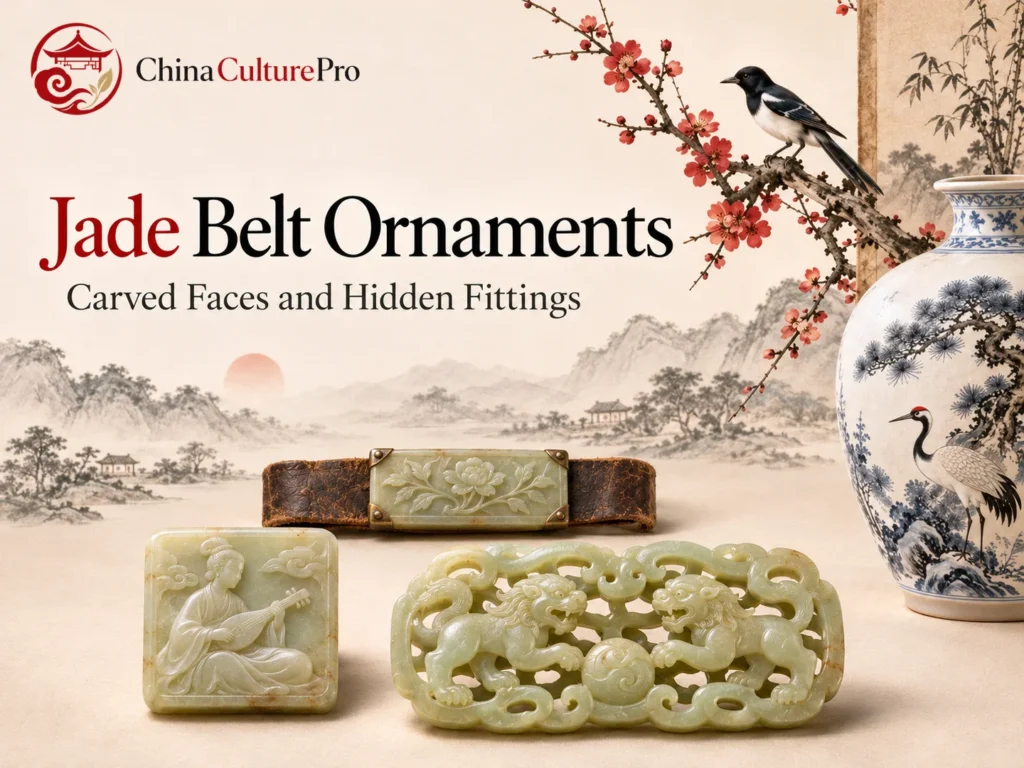

Quick Answer: What Are Jade Belt Ornaments?
A Chinese jade belt, or yudai (玉带, yùdài), could carry carved fittings mounted on a leather base. Individual belt plaques are called daikua (带銙, dàikuǎ).[2][4]
- Face: Carving can raise a design in relief or open gaps through the stone.[1][3]
- Back: Small drilled holes can give clues about attachment.[2]
- Belt: A complete example shows how plaques, leather and metal fittings worked together.[4]
Check the reverse and any surviving mount alongside the decoration.

Carving the Face: Relief and Openwork
A Tang nephrite set shows dancers and musicians carved in relief, with the raised figures standing against the plaque’s background.[1]
A sixteenth- or seventeenth-century Ming plaque in nephrite depicts lions and a ball in openwork. Openwork lets the background show through the gaps. Relief keeps a continuous stone background. See how these approaches fit within Chinese jade carving.[3]
Reading the Back and the Mounting
A Tang plaque with a cup-bearing figure is 0.8 cm thick. Its back lacks the relief design and has two holes at each corner. The reverse also carries an incised inscription.[2]
A 122 cm early Ming belt in the Palace Museum joins three leather sections and carries 22 jade fittings. The fittings include rectangular and clipped-corner forms, some with copper surrounds or sockets. This example preserves which elements sit on leather and which carry metal hardware. Compare other belt plaque materials and the way a court belt fits into the whole ensemble.[4]
Looking at Modern Jade Belt Ornaments
Ask for a side view of the mounting and a rear view of the belt. Check whether the plaque is fixed to the backing and whether the edges catch on the outer garment. Try the belt while seated as well as standing. On a modern piece, use the seller’s stated material and examine the mounting independently of the colour.
FAQs About Jade Belt Ornaments
Does a Jade-Like Colour Identify the Stone?
Colour alone provides limited evidence. A Ming glass set follows forms also used for jade belt plaques.[5]
Are the Cutouts and Back Holes the Same Feature?
Openwork forms part of the design. The small paired holes on the back of the Tang plaque can give evidence of how it was fixed.[2][3]
Does One Plaque Establish a Court Rank?
Material mattered within specific dress rules. The whole garment and belt, its date and its provenance matter when identifying a wearer.[2][4]
Sumber
[1] The Metropolitan Museum of Art. Tang Set of Decorative Belt Plaques
[2] The Palace Museum. Tang Jade Belt Plaque With a Cup-Bearing Figure
[3] The Metropolitan Museum of Art. Ming Nephrite Belt Plaque With Lions and a Ball
[4] Palace Museum Journal. Ming Jade Belts and Dress Regulations
[5] The Metropolitan Museum of Art. Set of Thirteen Glass Belt Plaques