
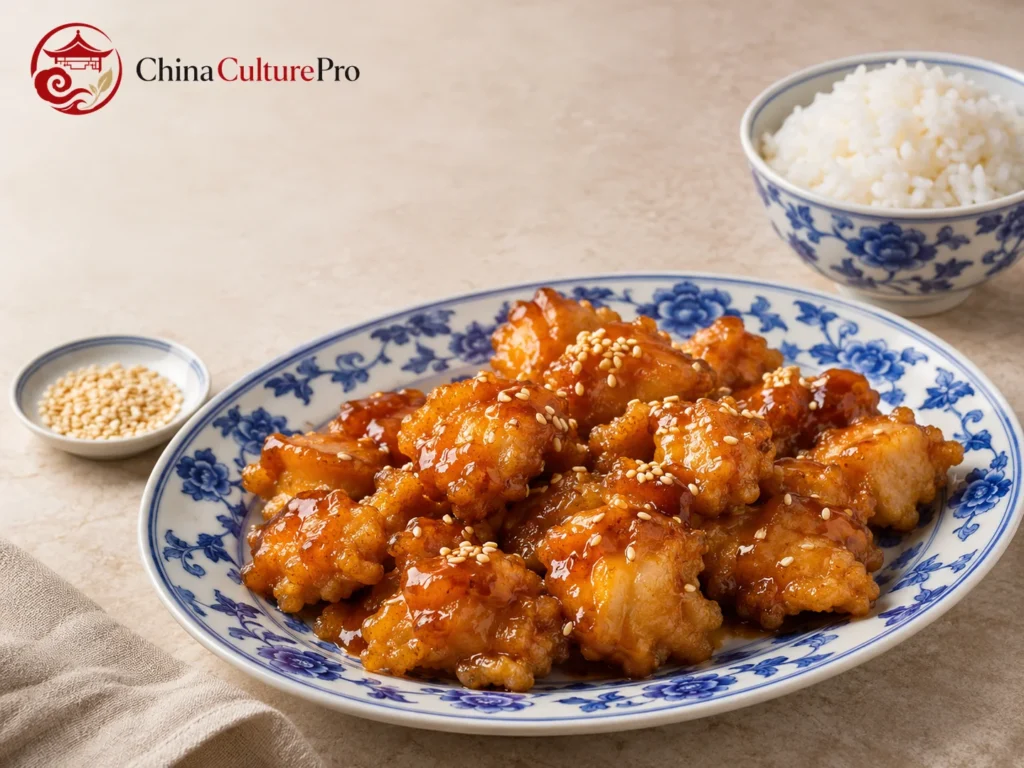

Quick Answer: What Is Sesame Chicken?
Sesame chicken (芝麻鸡, zhīma jī) is a Chinese-American takeout dish of chicken pieces coated in a sweet, savoury sauce and finished with sesame seeds.[2][3]
- Toasted seeds give the finished dish a nutty aroma.[2]
- Fried, baked and lightly pan-fried versions use different coatings and cooking methods.[3][4]
- Add thickener gradually, then coat the cooked chicken shortly before serving.[2]
The complete recipe below follows one double-fried version, with other cooking styles explained separately.
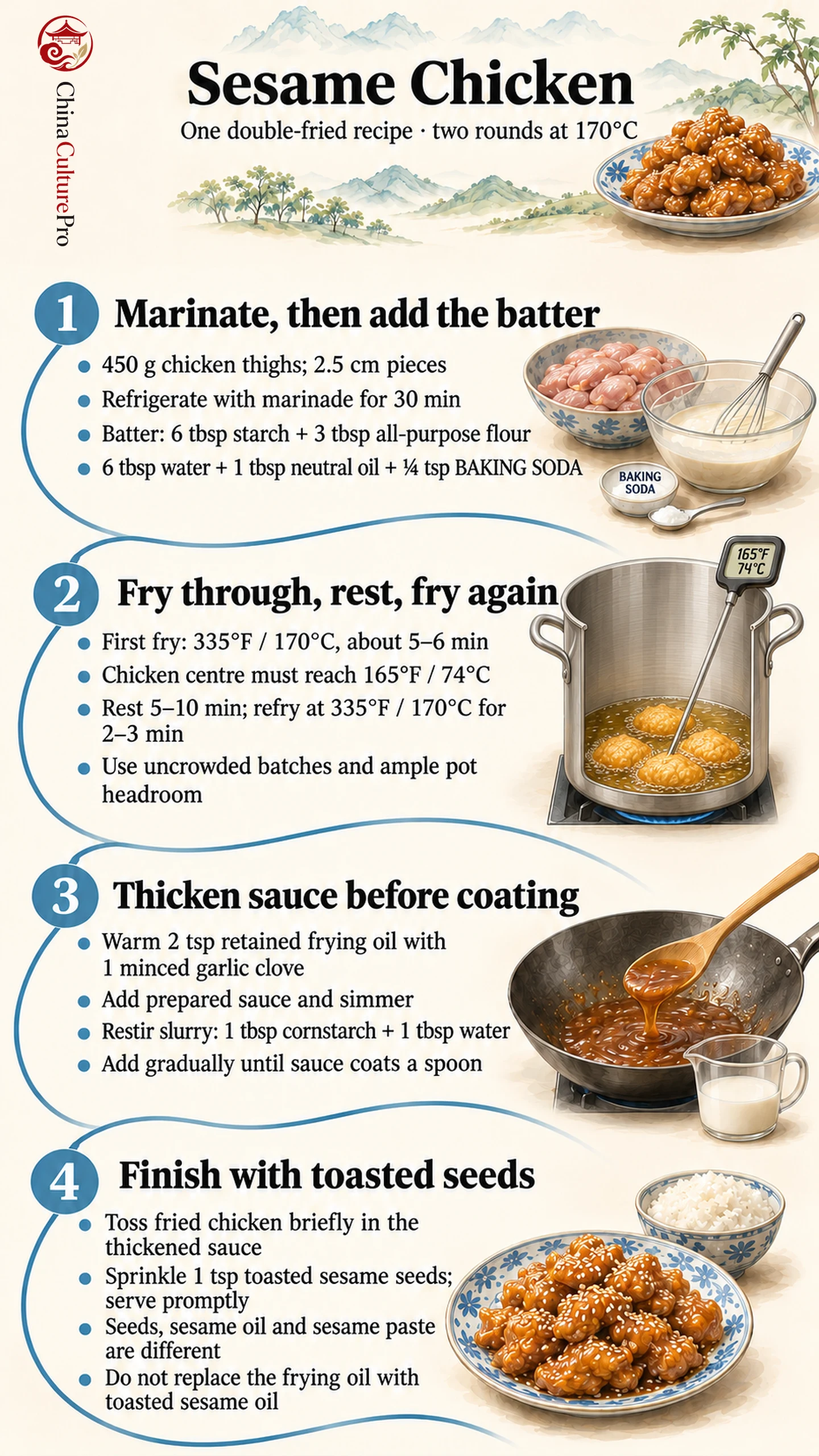
Measure the marinade, batter, sauce and slurry separately. Their water and starch amounts have different jobs; combining them into one bowl at the start changes the coating and sauce.
Chinese-American Context and Three Cooking Styles
This Chinese-American food favourite shares the fried-chicken-and-glaze format of General Tso’s chicken. Spice levels and sweetness vary between recipes, so the names alone do not guarantee a particular heat level.[2][3]
Choose the method before shopping:
- Double-fried style: Battered chicken is fried twice before meeting the sauce, giving a distinct shell around the meat.[2]
- Baked style: A separate oven recipe uses sesame paste (芝麻酱, zhīmajiàng), a flour-and-seed dredge and a baking-and-broiling sequence.[4]
- Pan-fried style: Small chicken pieces with a light starch coating cook in a skillet, then meet a sesame sauce; they have less of a batter shell.[3]
For a citrus-led glaze instead, the orange chicken guide explains a fresh-juice-and-zest version.[3]
Ingredients for Double-Fried Sesame Chicken
- Marinade: 450 g boneless, skinless thighs, 2.5 cm pieces; 2 tbsp water; 1 tsp Shaoxing wine (绍兴酒, Shàoxīng jiǔ); ½ tsp each salt and toasted sesame oil (香油, xiāngyóu); ¼ tsp white pepper; ⅛ tsp each garlic and onion powder.[1]
- Batter: 6 tbsp cornstarch; 3 tbsp all-purpose flour; 6 tbsp water; 1 tbsp neutral oil; ¼ tsp baking soda.[1]
- Sauce: ¾ cup hot water; 3 tbsp sugar; 1½ tbsp oyster sauce (蚝油, háoyóu); 1 tbsp each honey, light soy sauce (生抽, shēngchōu) and Shaoxing wine; 1½ tsp each toasted sesame oil and rice vinegar (米醋, mǐcù); ⅛ tsp white pepper.[1]
- Finishing: 1 minced garlic clove; 1 tbsp cornstarch mixed with 1 tbsp water; 1 tsp toasted sesame seeds; neutral frying oil, reserving 2 tsp for garlic.[1]
Use a heavy, stable, deep pot with ample headroom: the oil must occupy no more than half its capacity. Use dry, long-handled utensils and a frying thermometer. Leave bulk oil to cool before transferring it.[7]
How to Fry, Glaze and Finish the Chicken
- Marinate cold. Marinate chicken 30 minutes, refrigerated.[1]
- Mix separately. Coat chicken with batter. Combine sauce ingredients; reserve garlic, slurry and seeds.[1]
- Fry through. Heat 8 cm oil to 335°F/170°C. Fry uncrowded batches 5–6 minutes, turning; check thick pieces reach 165°F/74°C. Drain on a clean rack.[1][5]
- Crisp again. Rest 5–10 minutes, then refry at 335°F/170°C for 2–3 minutes until crisp; drain.[1]
- Glaze. Briefly cook garlic in reserved 2 tsp oil in a clean wok. Simmer sauce; restir slurry, adding gradually until spoon-coating. Toss chicken; sprinkle seeds and serve.[1]
Finish both frying stages in the same cooking session. Keep raw-chicken utensils away from cooked pieces and use a thermometer rather than coating colour to check doneness.[5]
Managing the Batter, Sauce and Sesame Finish
An egg-and-baking-powder batter needs its own formula; do not substitute its ingredients spoon for spoon here.[2]
Pour slurry in gradually while stirring. Stop when the sauce coats a spoon; dumping thickener in at once makes the texture harder to control. Coat the chicken after the sauce has thickened.[2]
Keep sesame seeds, oil and paste distinct. A paste-based sauce, such as the one used for bang bang chicken, is a different preparation from a seed garnish. Removing visible seeds alone also does not remove sesame from this recipe’s oil.[8][9]
FAQs About Sesame Chicken
Can I use chicken breast?
Yes. Breast is an option, but keep pieces evenly sized and stop cooking once they reach the required temperature. Small pieces can dry out with prolonged frying.[3][5]
Should sesame oil be the frying oil?
No. Here, toasted sesame oil is a measured flavouring. Use the separate neutral oil for deep-frying; do not replace that volume with aromatic sesame oil.[2]
Does sesame chicken require ketchup or chili?
No single rule covers every version. Some recipes use peppers or tomato paste, while others do not. This ingredient list contains neither; choose another complete formula if you want those flavours.[2][3]
How should I store leftovers?
Refrigerate shallow portions within 2 hours, or 1 hour above 90°F/32°C. Keep at 40°F/4°C or colder for 3–4 days; reheat to 165°F/74°C. Expect the coating to soften during storage.[6]
Sumber
[1] Bill Leung. Sesame Chicken
[2] Chung Sun Lau and Randy Lau. Dad’s Sesame Chicken: The Chinese Restaurant Way
[3] Gina Homolka. Sesame Chicken
[4] Bill Leung. Baked Sesame Chicken
[5] Centers for Disease Control and Prevention. Chicken and Food Poisoning
[6] U.S. Department of Agriculture. How Do I Handle Leftovers Safely?
[7] Iowa State University. Deep Fat Frying
[8] U.S. Food and Drug Administration. Food Allergies
[9] Tony Tan. Bang Bang Chicken