

Quick Answer: What Was the Revolt of the Three Feudatories?
The Revolt of the Three Feudatories (三藩之乱, Sān Fān Zhī Luàn) was a war against the Qing court from 1673 to 1681. Wu Sangui (吴三桂, Wú Sānguì) rose in Yunnan after the Kangxi Emperor (康熙帝, Kāngxī Dì) moved to abolish the regional military domains known as feudatories. Their leaders in Fujian and Guangdong joined at different times. Qing armies took the last rebel capital, Kunming, in 1681. [1][2][3][4]
- Cause: Ending the domains threatened the princes’ control of troops and provinces.
- Campaign: Qing advances and defections left Wu’s regime increasingly isolated.
- Result: The court ended these hereditary commands in southern China. [1][2][3][4][7]
The princes had gained their power serving the Qing conquest. Their revolt grew out of a decision about who would govern the conquered provinces. [1][2]
The early Qing used regional commanders to take territory it could not yet govern directly. Within a generation, the armies that had helped win southern China could be used against the court.
Why the Qing Created and Then Moved to Abolish the Feudatories
During the conquest, the Qing dynasty granted military leaders princely titles and regional commands. Wu Sangui held Yunnan and exercised authority in Guizhou. The Shang family commanded in Guangdong, and the Geng family came to hold Fujian. These arrangements let regional leaders keep their own forces and influence civil appointments. Wu’s influence over appointments extended beyond the two provinces where he was based. [1][2]
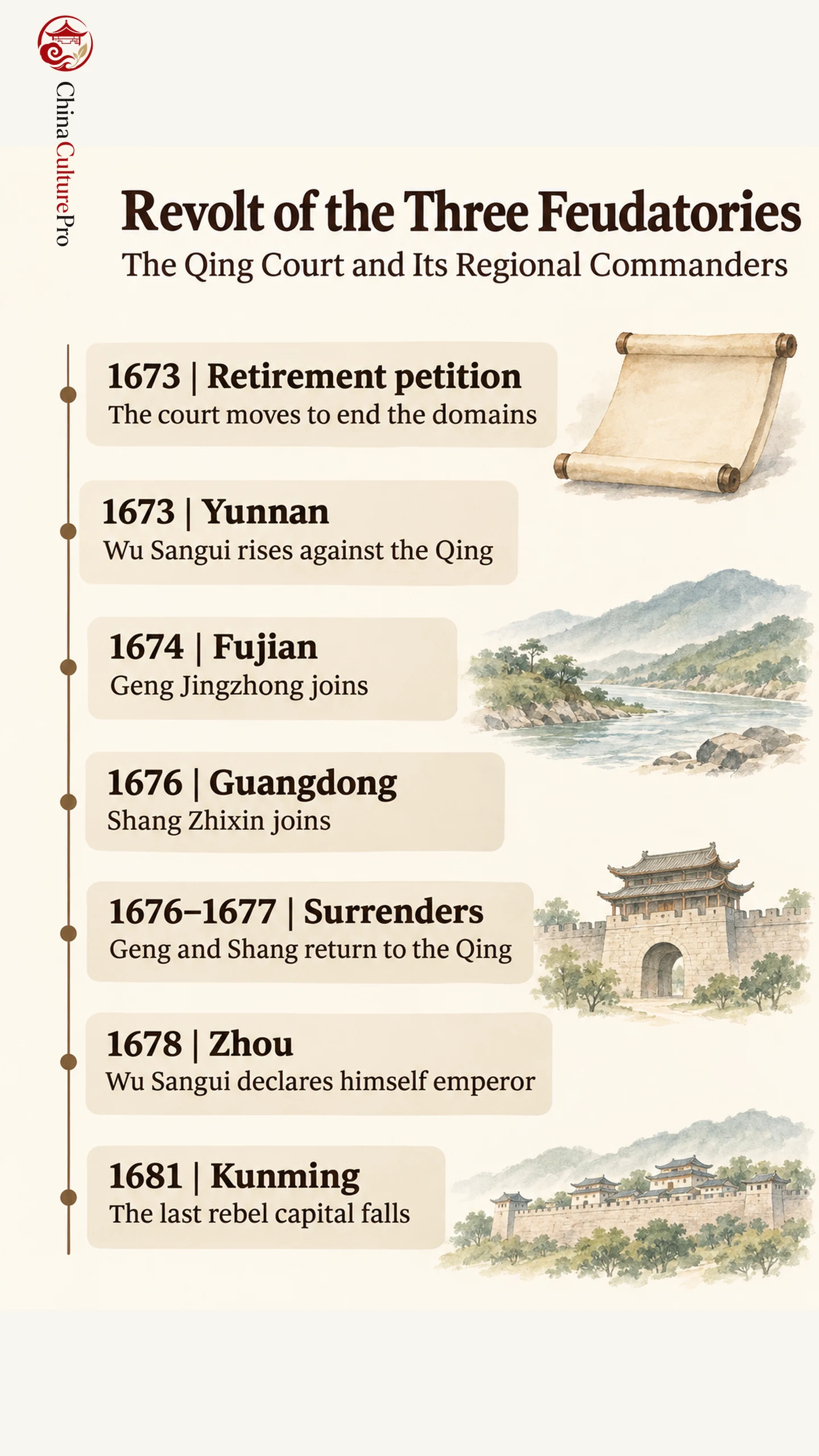
In 1673 the elderly Shang Kexi (尚可喜, Shàng Kěxǐ) asked to retire to Liaodong. The court agreed to his retirement but moved to end his domain instead of leaving its regional command to his son Shang Zhixin (尚之信, Shàng Zhīxìn). Wu and the Geng prince made similar retirement requests. Kangxi approved dismantling their domains despite disagreement among his officials. [1][2][3]
For the court, withdrawal meant bringing troops and administration under closer imperial control. For the princes, it meant giving up the ability to pass on military and political power. Wu answered the decision with an uprising in late 1673, killing the Qing governor of Yunnan. [1][2]
How the Revolt Spread Across Southern China
Wu’s forces moved through Guizhou into Hunan in 1674. He called for the restoration of Ming customs and won support outside his original domain. In Fujian, Geng Jingzhong (耿精忠, Gěng Jīngzhōng) also rose in 1674. In Guangdong, Shang Zhixin joined the rebellion in 1676 while his father was gravely ill. [1][2][3][4]
The campaigns did not all turn on Wu’s front in Hunan. A prince could commit troops in his own region, then make a separate deal with the court when the balance shifted. In 1676 the court regained the allegiance of Wang Fuchen, whose rebellion in the northwest had threatened the Qing outside the southern theater. Geng surrendered in Fujian later that year. Shang followed in 1677 and received the title his father had held. [1][2][3][6]
How the Qing Broke the Coalition
The court combined military pressure with offers to people who abandoned Wu. A surviving 1677 edict issued to Shang promised pardons to defectors and rewards for those who brought over troops or surrendered fortified places. Kangxi tasked Shang with recruiting men who still served Wu. The museum’s record also notes that Shang repeatedly evaded orders to fight Wu directly. [2][3]
Qing forces had concentrated north of the Yangzi in Hubei and blocked Wu’s advance from Hunan. He later lost ground in Hunan and Jiangxi. In 1678 he declared himself emperor of Zhou at Hengzhou in Hunan. He died later that year. His grandson Wu Shifan (吴世璠, Wú Shìfán) continued the resistance from Kunming as Qing forces retook territory. Wu Shifan inherited a shrinking domain. By the time the Qing laid siege to Kunming, he could no longer draw on the territories that had supported Wu Sangui at the height of the revolt. Wu Shifan took his own life as the regime fell in late 1681. [1][2][4]
What the Victory Changed and How We Know
The Qing victory ended these families’ hereditary military commands. It gave the emperor greater control of provincial appointments and forces in the south. The court’s 1673 decision became enforceable in the last rebel territories only after years of war. At the same time, the return of former rebels such as Shang shows that it could win back a province before the war was over. [1][2][7]
The court commissioned its Account of the Pacification of the Three Rebels after the war. The Palace Museum holds a 60-volume copy from 1686. The 1677 edict to Shang, written in Manchu and Chinese, shows the court still bargaining with one of the three. Historians Hosoya Yoshio and Zhang Yongjiang use records from China, Japan and Korea to examine how the court dealt with Shang and Geng after their surrender. Both men were eventually executed. The study places Geng’s execution after the formal proclamation of pacification. [3][5][6]
FAQs About the Revolt of the Three Feudatories
What was a feudatory in the early Qing?
A feudatory was a domain placed under a prince with substantial regional and military authority. In these cases, the court had rewarded commanders and their families for helping it conquer and control southern provinces. [1][2]
Did Wu Sangui try to restore the Ming?
Wu called for the restoration of Ming customs, which could appeal to former Ming subjects. In 1678 he proclaimed his own Zhou dynasty and took the imperial title for himself. [1][2][4]
Was the war over Taiwan part of the revolt?
The revolt on the mainland ended with Kunming in 1681. The Qing conquest of the Zheng regime on Taiwan was a later campaign, completed in 1683. [1][2][7]
Sumber
[1] Palace Museum, Beijing. The Pacification of the Three Feudatories
[2] Arthur W. Hummel Sr., ed.. Eminent Chinese of the Ch’ing Period: Wu San-kuei
[3] National Museum of China. Kangxi’s 1677 Edict to Shang Zhixin
[4] Chang Jen-chung. The Nature of the Three Feudatories Rebellion and the Causes for Its Failure
[5] Palace Museum, Beijing. Imperial Account of the Pacification of the Three Rebels
[6] Hosoya Yoshio and Zhang Yongjiang. The Promulgation of the Pacification Edict: The Fates of Geng Jingzhong and Shang Zhixin
[7] Jonathan D. Spence. The K’ang-hsi Reign