
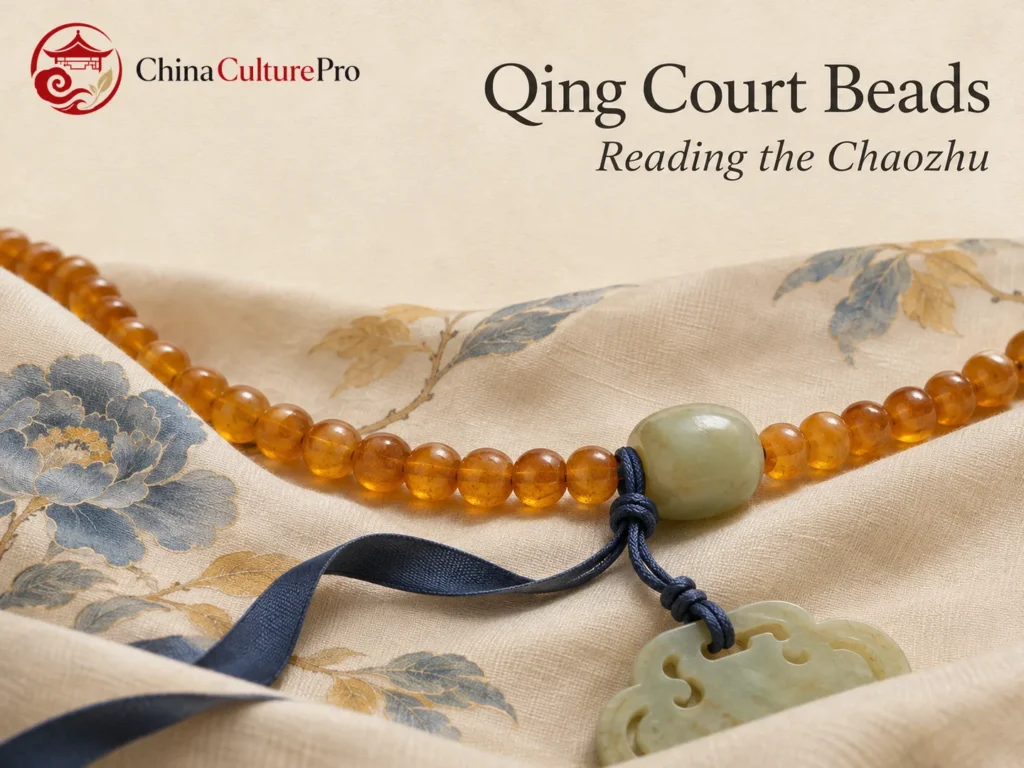

Quick Answer: What Are Qing Court Beads?
Chaozhu (朝珠, cháozhū) are a type of beaded necklace worn with Qing court and auspicious attire. The main loop conventionally contains 108 beads. Four larger dividers, three short side strands and a long assembly that drops down the back help identify the form.[1][2]
- Main loop: A surviving amber example has four groups of 27 main beads separated by jade beads.[1]
- Wearing position: The long pendant falls down the back, while the loop and short strands are visible in front.[5]
- Court use: Materials and ribbon colors could mark status or suit a specific rite.[6][7]
Identify the dress category and the necklace’s condition before using its details to interpret the wearer.
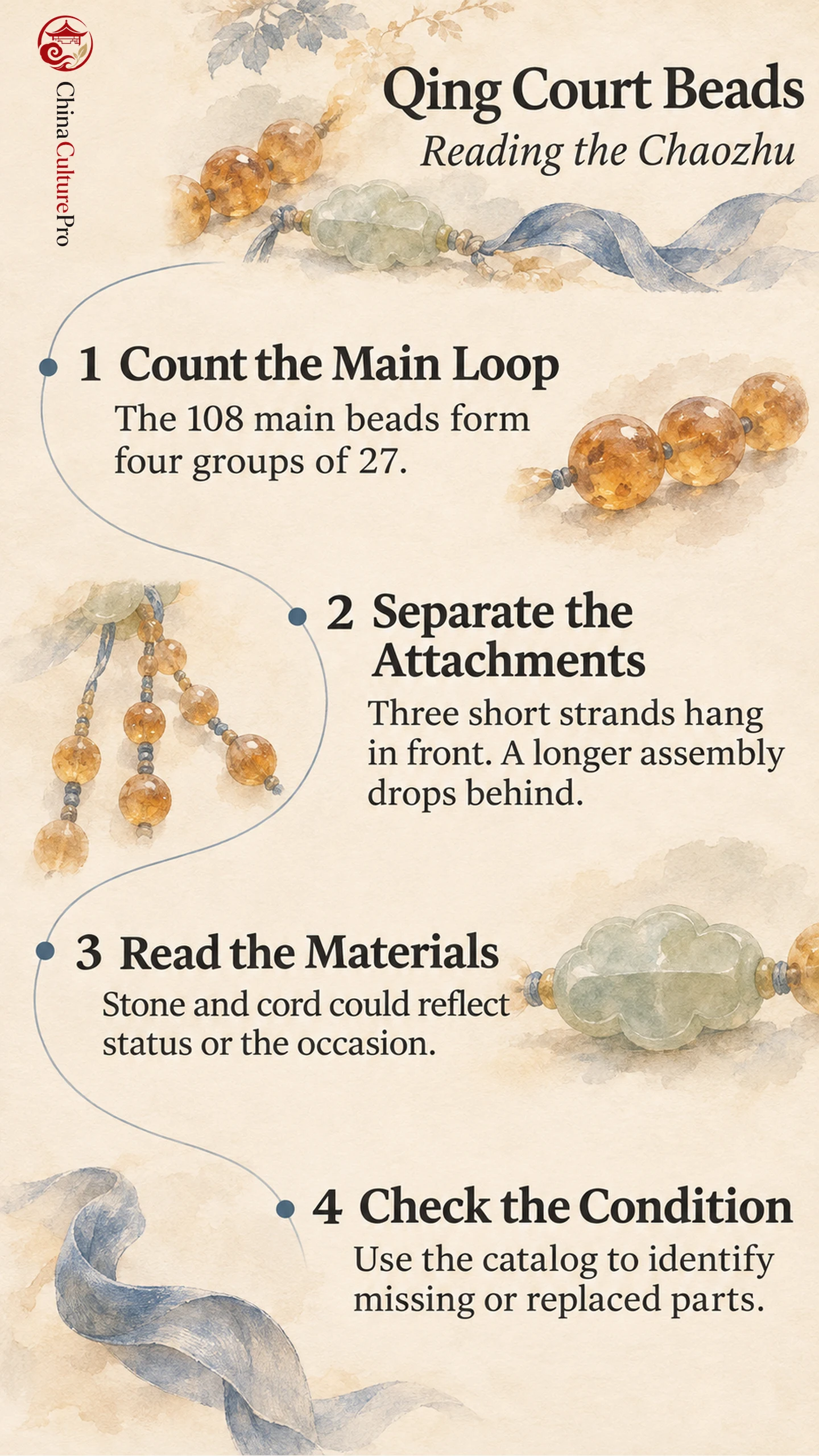
A chaozhu laid flat can look as if all its pendants hang together. On a person, one runs down the back. Start by separating the main loop from the attachments. That makes the count and the wearing arrangement easier to follow.
What the 108 Beads Include
On an amber necklace in the Powerhouse collection, the 108 amber beads make up four groups of 27. Four larger jade beads divide the groups. The dividers, called fotou (佛头, fótóu), are counted separately. One short strand lacks its drop, even though the main bead count is complete.[1][2]
The number on a label may refer to the intended pattern or to what actually survives. A lapis lazuli example in Beijing retains 58 lapis beads, along with its dividers and several fittings. The catalog identifies it as incomplete. Use that record when a surviving piece falls short of the standard count.[3]
How the Pendant and Side Strands Are Worn
At the rear of the loop, a divider can join a tower-shaped piece called a fota (佛塔, fótǎ). The back assembly drops from there. The beiyun (背云, bèiyún) is the decorative piece suspended on that back attachment, often with an additional drop below. A front-facing portrait can leave the whole arrangement hidden.[2][5]
The three short strands, called jinian (计捻, jìniǎn) in one catalog, usually carry ten small beads each in the examples described. The Taipei catalog gives a two-on-one-side, one-on-the-other arrangement when worn. Use the wearer’s left and right when comparing sides. A front-facing photograph reverses those sides for the viewer.[2]
For context on the complete ensemble, compare the Qing court and informal robe guide. In a portrait, check where the main loop lies against the robe and whether the rear attachment is visible.
What Materials and Occasion Reveal
In the Qing dynasty, rules specified who could wear these beads. One Palace Museum catalog gives eligibility from fifth rank for civil officials and fourth rank for military officials, with titled women from fifth rank. It also describes different cord colors and materials by role and occasion.[3]
Look at ritual use separately. Palace Museum descriptions associate lapis lazuli with the emperor’s sacrifice to Heaven and turquoise with his sacrifice to the Moon. If you find the same stone on an isolated necklace, check the date, the rest of the outfit and any known wearer before assigning a ritual use.[7]
Eastern pearls (东珠, dōngzhū) were freshwater pearls particularly valued by the court. A Shunzhi-period example in Beijing combines 108 of them with coral separators, colored stones and several fittings. The museum describes restrictions on the wearing of Eastern pearl necklaces at major palace ceremonies. A late Qing official necklace in New York instead uses rose quartz, agate, glass, silver and silk ribbon.[4][6]
How to Read or Wear a Modern Version
Begin with the front loop. Find the dividers and note whether all four groups survive. Turn the piece over to locate the long ribbon or pendant. Then find the three shorter strands. A missing drop, replaced cord or unlabeled stone is worth noting separately when describing a particular object.
For a modern interpretation, try it over the garment it will be worn with. Check that the back pendant hangs freely and that the shorter strands sit where you expect them. The guide to Chinese court necklaces provides a wider comparison of neck ornaments. For an example with blue feather decoration on a metal setting, compare the technique in the diancui guide.[3]
FAQs About Qing Court Beads
Are the separator beads part of the 108?
In the conventional arrangement, the four large separators sit between four groups of 27 main beads. The side strings and back drop are also separate from the 108.[1]
Did every official wear court beads?
Qing dress rules set eligibility by rank. The Palace Museum describes different thresholds for civil and military officials and provisions for titled women.[3]
Which pendant hangs at the back?
The long rear assembly with the beiyun falls down the back. The shorter strands sit toward the front.[5]
Sumber
[1] Powerhouse Collection. Court Beads From China, A5339
[2] National Palace Museum, Taipei. Court Necklace With Lapis Lazuli Beads
[3] Palace Museum, Beijing. Lapis Lazuli Court Beads, Gu00010358
[4] Palace Museum, Beijing. Eastern Pearl Court Beads
[5] Palace Museum, Beijing. Turquoise Court Beads
[6] Metropolitan Museum of Art. Official Necklace, 02.18.878
[7] Palace Museum, Beijing. Lapis Lazuli Court Beads and Imperial Ritual