
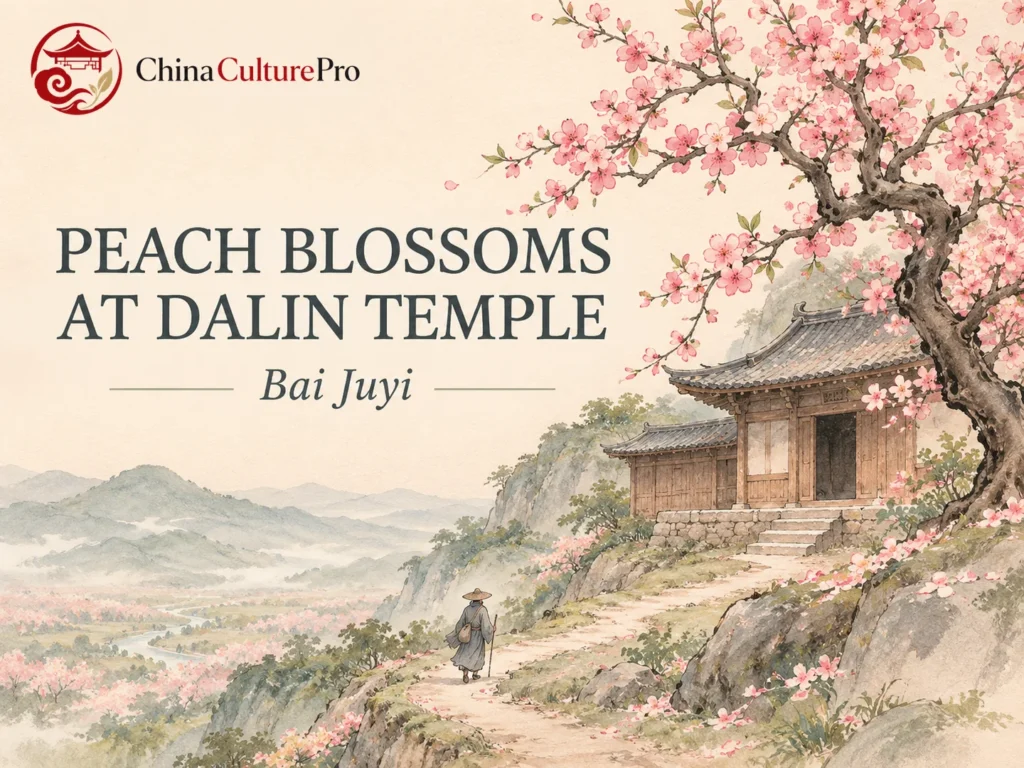

Quick Answer: What Is Peach Blossoms at Dalin Temple About?
Peach Blossoms at Dalin Temple (大林寺桃花, Dàlín Sì Táohuā), by Bai Juyi (白居易, Bái Jūyì), contrasts faded flowers below with peach trees beginning to bloom at Dalin Temple (大林寺, Dàlín Sì). It is a seven-character quatrain (七言絕句, qīyán juéjù): four lines, 28 characters.[1]
- The scene: The traditional fourth month has brought an end to flowering below, while the mountain temple has a different seasonal rhythm.
- The feeling: Regret at spring’s departure turns into surprise at discovering it elsewhere.
- The poetic device: Spring becomes an imagined traveler that has turned into the mountain retreat.
The poem’s fourth month is not a fixed Gregorian April, and its blossoms do not supply a present-day flowering forecast.
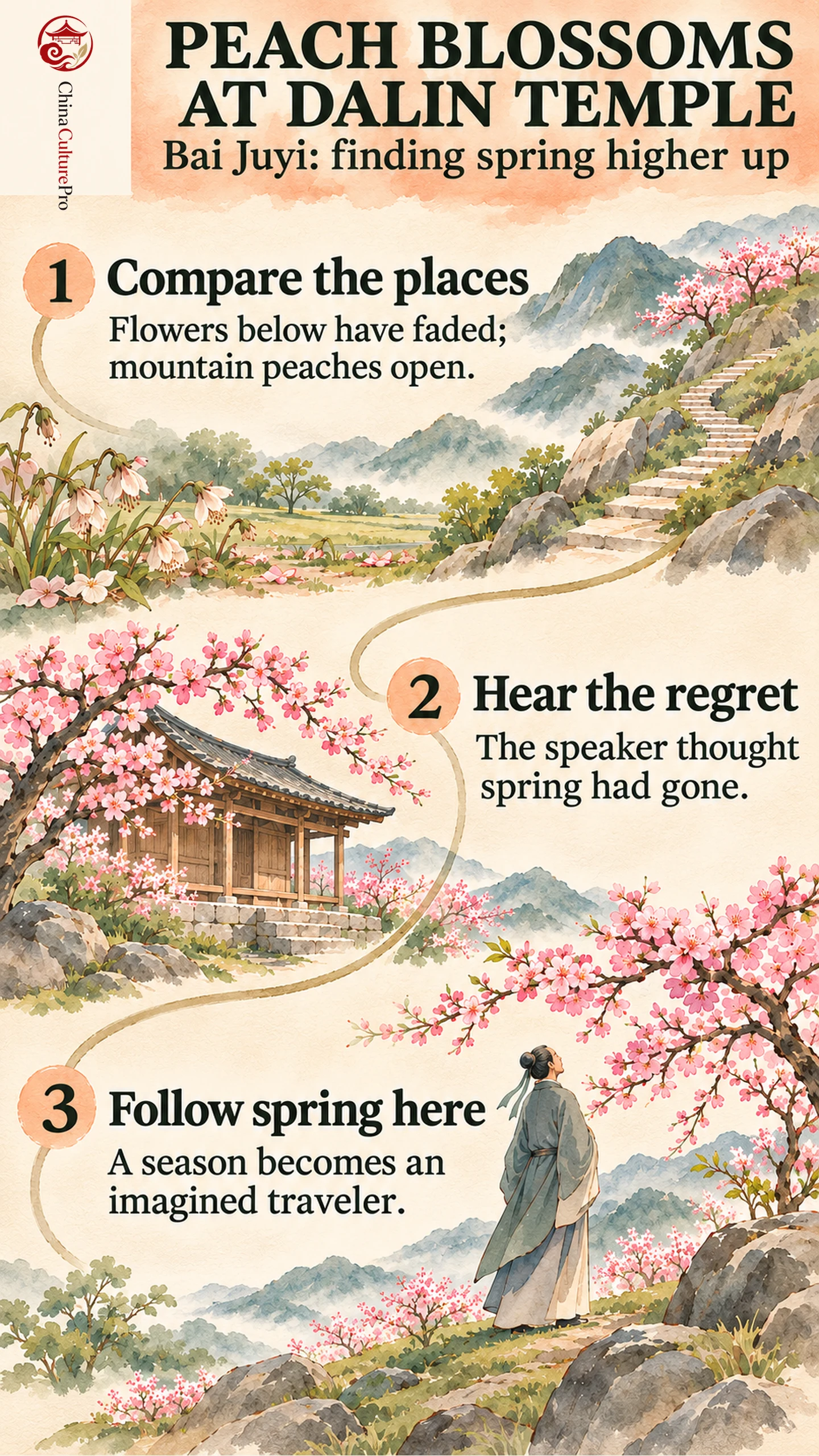
Flowers seem finished until a change of place overturns that judgment. In this brief mountain poem, a late display of peach blossom gives spring somewhere unexpected to go—and gives the disappointed speaker a reason to reconsider what he thought he had lost.
The Complete Poem and an English Sense Translation
This original English rendering follows the complete Chinese text. It keeps the final line’s subject as spring, rather than turning the visitor into someone reborn.[1]
| Chinese line | English sense translation |
|---|---|
| 人間四月芳菲盡, | In the fourth month, the fragrant blossoms of the world below have faded; |
| 山寺桃花始盛開。 | at the mountain temple, peach blossoms are only now opening in profusion. |
| 長恨春歸無覓處, | I have long regretted spring’s departure, finding nowhere to seek it— |
| 不知轉入此中來。 | not knowing it had turned aside and come into this place. |
“Long regretted” conveys the speaker’s lingering sense of loss. The poem does not specify how many days or years that regret has lasted.
A Mountain Visit Recorded by the Poet
Bai’s prose account of visiting the temple records a journey through Mount Lu (廬山, Lú Shān), in present-day Jiangxi (江西, Jiāngxī), with a group of companions. They stayed at Dalin Temple, where clear streams, dark stones, small pines and slender bamboo surrounded the buildings.[2]
The account is dated to the ninth day of the fourth month in the twelfth year of the Yuanhe era (元和, Yuánhé), or 817. That traditional date should not be relabeled April 9. More useful for reading the poem is Bai’s explanation that the high, secluded terrain had an exceptionally late season: early summer there felt like the beginning of spring below.[2]
The prose quotes the quatrain within this visit. It grounds the seasonal surprise in a specific excursion, without requiring an invented account of a solitary walk or a religious revelation.
Two Places, Two Stages of Spring
The first two lines align two places and two stages of flowering. “The world below” faces “the mountain temple”; “have faded” faces “only now opening.” The second line changes the reach of the first. What seemed true everywhere turns out to describe only the places the speaker had already seen.[1]
The mountain’s later season is consistent with Bai’s own prose description. Yet the poem offers an experience of contrast, not measured temperatures, an elevation calculation or a rule that every mountain blooms on the same schedule.
This is one pleasure of Chinese nature poetry: a concrete change in scenery can alter the speaker’s understanding. The flowers remain ordinary peach blossoms; their unexpected timing gives them force.
The Turn from Regret to Discovery
The third line momentarily returns to an earlier disappointment. Spring seemed to have departed, leaving the speaker with nowhere to search. The fourth line recasts the same experience: spring had taken another path and arrived here.[1]
“Turned aside” gives a season the movement of a person. The speaker’s earlier ignorance makes the discovery playful. He does not command spring to return; the landscape corrects his assumption that it has vanished altogether.
Readers may find a broader suggestion that loss can depend on viewpoint. That interpretation grows from this particular contrast. The poem does not promise that every disappointment will be reversed..
How to Read Spring’s Unexpected Arrival
- Locate the two settings: Keep the world below separate from the mountain temple before treating either as a symbol.
- Pair the flowering verbs: Read “have faded” against “only now opening” to hear the seasonal contrast.
- Follow the speaker’s knowledge: Notice how regret precedes the admission that he did not know where spring had gone.
- Reread the final movement: Imagine spring turning into this place, then connect that personification to the actual blossoms.
FAQs About Peach Blossoms at Dalin Temple
Does the fourth month mean April?
It means the fourth month of the traditional calendar. Its correspondence with Gregorian dates varies, so “April” alone can obscure the poem’s seasonal reference.
Is the mountain temple outside the human world?
The wording creates a contrast between the familiar world below and the secluded temple above. It does not establish that the visitor has literally left human existence.
Does every peach blossom refer to an immortal paradise?
No. Taohuayuan (桃花源, Táohuā Yuán), by Tao Yuanming (陶淵明, Táo Yuānmíng), is a separate literary work. Here, the blossoms directly support the contrast in flowering and the rediscovery of spring; a universal immortality code is unnecessary.
Sumber
[1] Bai Juyi. Peach Blossoms at Dalin Temple, complete Chinese text
[2] Bai Juyi. Preface to Visiting Dalin Temple, dated account quoting the poem