
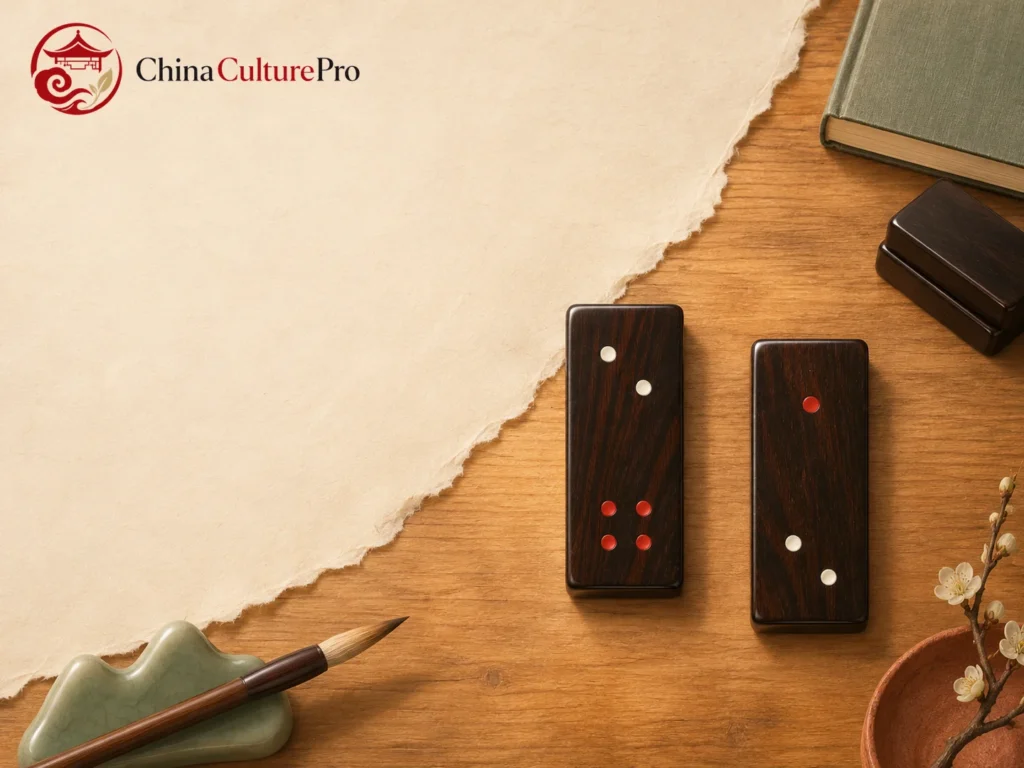

Quick Answer: What Is Pai Gow?
Pai Gow (牌九, páijiǔ in Mandarin) is a Chinese banking game played with 32 domino-like tiles. In the four-tile form discussed here, a player divides the deal into two two-tile hands and compares both with the banker.
- The pack contains 21 face patterns, with eleven patterns duplicated to make 32 tiles.
- Civil and military tile families organize the pack; they do not create a simple numerical ranking.
- Recognized pairs and special combinations can outrank ordinary point hands.
- Pai Gow Poker uses cards and a different hand structure.
The modern rule examples below explain the game’s mechanism. They should not be treated as a complete account of every historical or regional version.[1][2][3]

The older term bone tiles (骨牌, gǔpái) also covers historical wooden sets. The equipment belongs to a wider family of Chinese traditional games; one pack can support more than one named game.[3]
Why the Pack Contains 32 Tiles
The faces represent the unordered combinations of two six-sided dice. Six are doubles; fifteen combine two different numbers. That gives 21 patterns. Eleven patterns occur twice and ten occur once, producing 32 physical tiles.[3]
The arithmetic is 21 + 11 = 32, not 32 different face designs. Two tiles can therefore have the same total number of spots while showing different arrangements.
The standard pack has no blank-ended tiles. A Western double-six set with 28 tiles is not the same inventory: it includes blanks and lacks the required duplicate distribution.[3] Recognizing a few familiar dotted rectangles is insufficient when assembling a complete Pai Gow set.
Civil and Military Names Describe Tile Families
The civil group (文牌, wénpái) contains eleven face patterns, with two identical tiles of each pattern.
The military group (武牌, wǔpái) contains ten individual tiles whose faces are not duplicated.
Thus the civil group supplies 22 tiles and the military group supplies ten. “Civil” does not mean that a player always beats a military tile: the game compares combinations and, where necessary, individual tile ranks.[2][3]
Names also preserve a symbolic vocabulary. The Heaven tile (天牌, tiānpái) has 6–6 spots; the Earth tile (地牌, dìpái) has 1–1. A name is not a numerical ranking rule.[3]
A useful distinction is between a physical duplicate and a recognized pair. Two different nine-spot faces,3–6 and 4–5, form a permitted mixed pair. Conversely, two tiles with an equal total are not automatically interchangeable for every ranking purpose.[2]
What the Historical Evidence Actually Shows
The late-nineteenth-century survey Chinese Games with Dice and Dominoes records the 32-piece equipment, its named families and several ways of using the tiles. Its observations include games reported among Chinese communities in America. It also treats the precise invention history of dominoes as inconclusive.[3]
That evidence supports a history of Chinese domino traditions and their movement across communities. It does not establish that every game now played with those tiles existed at the same early date. A reference to old dominoes is not automatically a reference to modern four-tile Pai Gow.
Keep the equipment, the named game and the particular rulesheet separate. A historical collection can establish what tiles were present; a contemporary game description can establish how a reported version worked. Neither should be stretched into an unsupported story about a single emperor inventing the complete modern game.
Pai Gow’s gambling context is part of its cultural history. Modern casino rules specify dealing, hand comparison and the banker’s role. They document a particular game framework, rather than its date of invention.[2][4]
How Four Tiles Become Two Hands
Each participant receives four tiles and sets a two-tile high hand and a two-tile low hand. The player’s high hand is compared with the banker’s high hand, and the low hand with the banker’s low hand. A player is not trying to beat every other player at the table.[4]
Under the published framework used here:
- Winning both comparisons produces a win.
- Losing both comparisons produces a loss.
- Winning one comparison and losing the other produces a push.
Apply the specified tie rules before deciding those comparisons. Equal ordinary point totals can require comparison of the highest-ranking individual tile. An unresolved copy comparison favors the banker; a zero-versus-zero point comparison also favors the banker in the cited rules.[2][4]
For an illustrative result, suppose a player wins the high-hand comparison but loses the low-hand comparison. That is a push, rather than an overall win based on the stronger hand alone. Merely adding all four tiles’ spots would answer a different question from the one the game asks.
Why Points Do Not Tell the Whole Story
The broad order below places ordinary point hands beneath the recognized special groups. The precise pair order still requires a reference chart.[2][5]
| Kategori | Makna dasar |
|---|---|
| Recognized pairs | Permitted matched or mixed pairs, with Gee Joon (至尊, zhìzūn) highest |
| Wong (王, wáng) | A Heaven or Earth tile combined with a nine-spot tile |
| Gong (杠, gàng) | A Heaven or Earth tile combined with an eight-spot tile |
| Ordinary point hands | Other eligible combinations valued from zero to nine |
The highest pair is Gee Joon: the 2–4 tile and the 1–2 tile. Their combined nine spots do not explain their exceptional rank; the pair has its own place at the top of the hierarchy. When used separately, those two tiles can count as three or six under the cited rules.[2]
For an original ordinary-point example, combine 3–6 with 2–6. The total is 17, so the point value is seven. Neither tile is a Heaven or Earth tile, and this combination is not a recognized pair.
Now compare 3–6 with 4–5. Their total is 18, but they form the recognized mixed-nines pair. Treating that hand as merely eight points would ignore the pair category.
The same caution applies to special Heaven and Earth combinations. Identify the category first, then calculate ordinary points only when that is the relevant rule. Pip arithmetic is useful, but it cannot replace the ranking system.
Pai Gow and Pai Gow Poker Use Different Equipment
The similar names conceal different components and ranking methods.
| Aspek | Pai Gow tiles | Pai Gow Poker |
|---|---|---|
| Equipment | 32 Chinese dominoes | A standard card deck plus one joker in the cited framework |
| Deal and division | Four tiles divided into two hands of two | Seven cards divided into a five-card high hand and a two-card low hand |
| Ranking basis | Tile combinations, point values and individual tile ranks | Poker-hand categories and the rules governing the two-card hand |
The card game retains a two-hand comparison, but the tile hierarchy does not become a poker ranking chart.[2][4][6] Identify which game a source means before applying its instructions.
Pai Gow tiles are also different from mahjong tiles. A rectangular shape and Chinese associations do not establish that two games share an inventory, scoring method or turn structure.
FAQs About Pai Gow Dominoes
Can a standard Western domino set replace Chinese tiles?
No. Its blanks and missing duplicates do not match the required Chinese inventory.[3]
Why can a pair beat an ordinary nine-point hand?
Recognized pairs belong to a higher ranking category. Nine is the highest ordinary point value, not the highest possible hand of every kind.[2]
Do red spots automatically make a tile stronger?
No. Spot color helps identify the tile design. Rank depends on the actual tile and combination, rather than simply on how many red spots are visible.[2]
Was modern Pai Gow invented in the Song dynasty?
Older domino records do not establish a Song-dynasty invention of the modern four-tile game.[3]
Sumber
[1] Ministry of Education, Taiwan. 牌九: Revised Mandarin Chinese Dictionary
[2] Pennsylvania Code. Pai Gow tile rankings and hand values, 58 Pa. Code 621a.3
[3] Stewart Culin. Chinese Games with Dice and Dominoes, Report of the United States National Museum for 1893
[4] Pennsylvania Code. Setting and comparing Pai Gow hands, 58 Pa. Code 621a.8
[5] Ontario Lottery and Gaming Corporation. Pai Gow: Chinese-language rules and combination categories
[6] Pennsylvania Code. Pai Gow Poker: equipment and procedures