
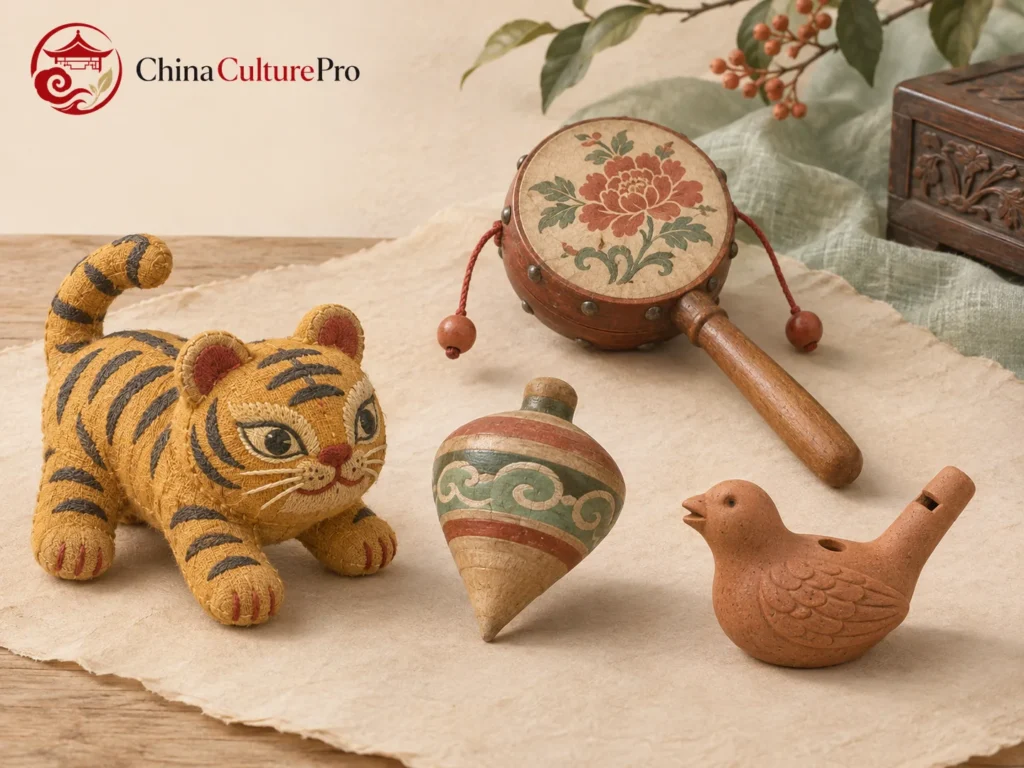

Quick Answer: What Are Chinese Traditional Toys?
Chinese traditional toys are a varied group of playthings and crafted objects, including rattles, tops, cloth animals, kites and puzzles. Materials and actions offer a useful way to tell them apart.[1]
- Sound toys turn shaking, striking or blowing into an audible response.
- Movement toys invite spinning, flying or keeping an object airborne.
- Figures and puzzles combine recognizable shapes with decoration or a challenge.
These are related traditions, not one invention with a single birthday. A historical toy design also does not establish that every modern version is suitable for a young child.

Traditional Chinese toys make familiar materials do surprising things: a handle turns a drum into a rhythm, a wooden cone becomes a spinning blur, and a few shaped pieces become an animal silhouette. They belong to household craft, market life and skilled recreation as much as to childhood.
Nine Toys and the Different Ways They Work
Start with the action, then look at the material. Two objects made from bamboo can require completely different skills, while the same toy form may be made in several materials. The examples below are a starting collection rather than a complete national inventory.
| Toy | Recognizable form and action | Hal yang perlu diperhatikan |
|---|---|---|
| Rattle drum, or bolanggu (拨浪鼓, bōlànggǔ) | A small handled drum with a bead on a short cord at each side; rotating the handle swings the beads against the faces. | The sound comes from the swinging strikers, rather than loose contents inside a sealed rattle.[2] |
| Spinning top, or tuoluo (陀螺, tuóluó) | A familiar wooden type tapers to a point and is kept rotating with a whip. | Painted bands blur together as it spins; the whip-driven form is one type, not the definition of every top.[3] |
| Cloth tiger (布老虎, bùlǎohǔ) | A sewn animal with exaggerated features and tiger markings. | Its bold face can express wishes for a child’s protection and healthy growth.[4] |
| Clay whistle | A hollow clay object, sometimes shaped as a bird or another animal, that sounds when blown. | The sculpted creature and the sound-making cavity give the same object two identities.[5] |
| Kite, or fengzheng (风筝, fēngzhēng) | A light frame covered with paper or cloth, held by a line and lifted by wind. | The decoration is part of an object that must also function in the air.[6] |
| Jianzi (毽子, jiànzi) | A feathered shuttlecock kept airborne with feet and other permitted body surfaces, rather than the hands. | The challenge lies in controlled contacts, alone or with other players.[7] |
| Kongzhu (空竹, kōngzhú) | A diabolo with an axle worked on a string stretched between two handsticks. | It spins on the string; it does not climb a single hand-held string like a conventional yo-yo.[5] |
| Tangram, or qiqiaoban (七巧板, qīqiǎobǎn) | Seven flat pieces arranged into silhouettes without overlap. | The set contains five triangles, a square and a parallelogram.[8] |
| Luban lock (鲁班锁, Lǔbānsuǒ) | Notched pieces interlock into a three-dimensional mechanical puzzle. | The hidden joints determine the release sequence; the familiar name does not prove an inventor.[9] |
The clay-whistle and bamboo-diabolo descriptions above are also recorded in a 1901 account of playthings in Beijing. That gives them a dated local witness, not a complete account of toys everywhere in China.[5]
Family Workshops, Markets and Festival Gifts
Traditional toy-making often grew through family workshops, using materials such as clay, wood, bamboo, fabric and paper. Forms and decoration could borrow from drama, stories and other crafts. The boundary between a plaything and an object made for admiration was therefore flexible: careful workmanship was not reserved for expensive display pieces.[10]
Market scenes offer another kind of evidence. Li Song’s 1211 peddler scroll shows children excited by a travelling seller whose load includes toys alongside household utensils and food. The image places playthings within ordinary exchange and anticipation. It does not establish when each recognizable toy was invented.[11]
Cloth tigers show how a toy could also carry a wish. Gifts for a newborn, and gifts associated with the Dragon Boat Festival, expressed hopes that the tiger would avert harm and help the child grow well. Those are folk meanings, not evidence of an actual protective or medical effect.[4]
A Qing cloth tiger preserved in a palace collection has a large head, painted stripes and a prominent forehead mark; its recorded functions included play and use as a pillow. A surviving specimen tells us about that object and its setting; another cloth tiger may have a different shape, use or finish.[4]
Looking Closely at Sound, Movement and Craft
You can read a toy as a small working object rather than treating it only as a souvenir. These questions provide a useful viewing framework:
- Sound: Which part moves, and what does it strike or vibrate? Compare the drum’s exterior strikers with the hollow body of a whistle.
- Movement: What supplies motion, and what must the player control? A top, kite and string-driven diabolo make different demands.
- Shape: Which features identify an animal, even when its proportions are deliberately exaggerated?
- Puzzle: Are you solving a flat outline or releasing hidden three-dimensional joints? Piece count alone does not explain the task.
For actual play, follow the guide that matches the object: jianzi and its different playing forms, Chinese diabolo, tangram shapes or Luban interlocking puzzles. Broader Chinese traditional games also include activities whose main interest is shared rules rather than a crafted toy.
Choosing Between a Plaything and a Display Piece
Decide what you want the object to do before choosing it. For close looking, a fragile clay animal may be interesting because of its modelling and paint. For repeated handling, the actual construction, intended age and instructions matter more than an antique-looking surface. For a puzzle session, choose a challenge whose pieces and solution format suit the player.
For children, follow the product’s age guidance and safety information, matching it to the child’s abilities. Keep small balls and toys with small parts away from children under three, and discard packaging after opening. These practical checks apply just as much to a traditional-looking purchase as to a modern novelty.[12]
FAQs About Chinese Traditional Toys
Are traditional Chinese toys only for children?
No. Skilled manipulation, puzzle solving and collecting can interest adults too. Historical collections of Chinese playthings include pursuits enjoyed across age groups.[1]
Do all these toys have the same ancient origin?
No. A documented painting, old written description or surviving object establishes a particular historical witness. It does not supply a shared invention date for the entire category.
Why are cloth tigers given as gifts?
They can convey wishes for a child’s wellbeing and protection through the tiger’s folk symbolism. The meaning belongs to gift culture rather than demonstrated protective power.[4]
Is a handmade traditional toy automatically safe for a baby?
No. Check the actual product’s intended age and safety information. A handmade appearance or long history cannot replace those checks, especially where small parts are present.[12]
Sumber
[1] Royal Ontario Museum. Playful Pursuits: Chinese Traditional Toys and Games
[2] Ministry of Education. Revised Mandarin Chinese Dictionary: 波浪鼓
[3] Capital Museum. 陀螺
[4] Wan Xiufeng, Palace Museum. 布老虎
[5] Isaac Taylor Headland. The Chinese Boy and Girl, Chapter 5: The Toys Children Play With (1901)
[6] Ministry of Education. Concise Mandarin Chinese Dictionary: 風箏
[7] International Shuttlecock Federation. Shuttlecock
[8] ChinesePuzzles.org. Tangram Puzzle
[9] ChinesePuzzles.org. Interlocking Burr Puzzles
[10] Academy of Chinese Studies. Traditional Chinese Toys and Curios
[11] Nie Hui, Palace Museum. 李嵩货郎图卷
[12] U.S. Consumer Product Safety Commission. Toys