
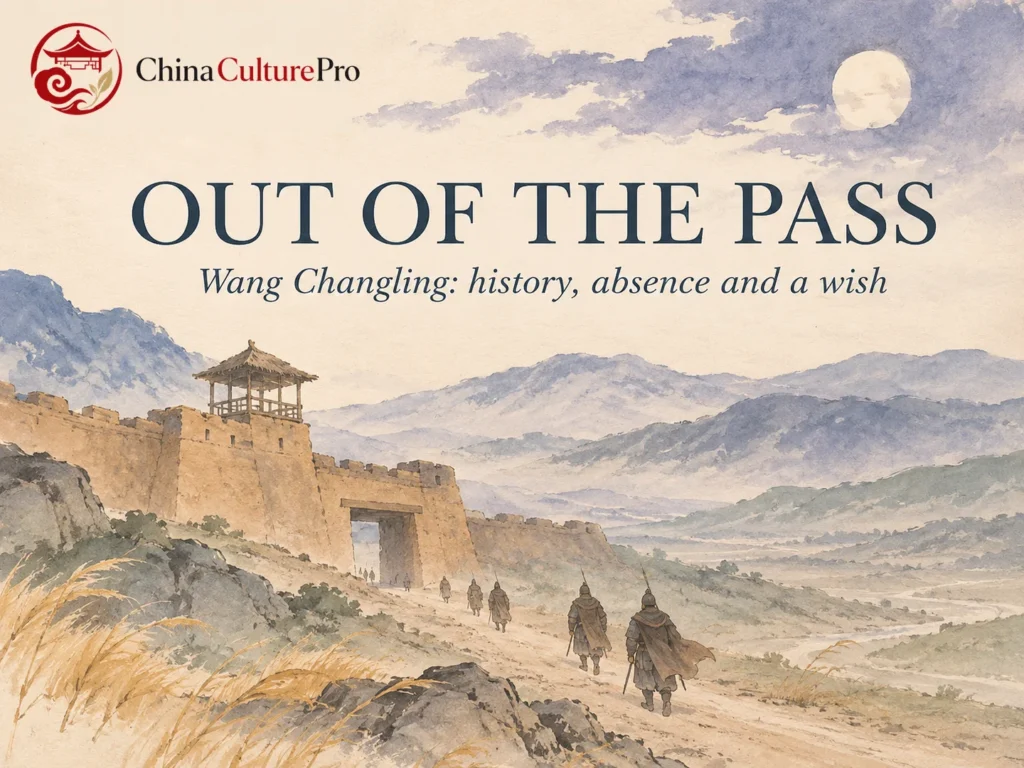

Quick Answer: What Is Out of the Pass About?
Out of the Pass (出塞, Chū Sài), by Wang Changling (王昌齡, Wáng Chānglíng), joins the long history of frontier warfare with concern for people who cannot come home. This guide reads the familiar first poem under that title.[1]
- Form: A seven-character quatrain (七言絕句, qīyán juéjù), containing four lines and twenty-eight Chinese characters.
- Historical opening: Qin (秦, Qín) and Han (漢, Hàn) place the moon and guarded passes within a shared past.
- Closing wish: The Flying General of Longcheng (龍城飛將, Lóngchéng Fēijiàng) would prevent enemy cavalry from crossing the Yin Mountains (陰山, Yīn Shān).
The last pair imagines what a capable commander could do; it does not report a battle that has just been won.

An old moon shines over an old frontier, but the people sent far away have still not returned. The poem’s scale is enormous—dynasties, distant campaigns and a mountain barrier—yet its pressure comes from that human absence. Its final wish for a capable commander should be heard against the cost established in the opening pair.
The Complete Poem and an English Sense Translation
The Chinese below uses the familiar 人未還 wording and 度 in the last line. This original English sense translation brings the overlapping dynasties together and keeps the final pair conditional.[1]
| Chinese text | Makna dalam bahasa Indonesia |
|---|---|
| 秦時明月漢時關 | The moon and passes endure from Qin and Han times; |
| 萬里長征人未還 | On far-ranging campaigns of ten thousand li, the men have not come home. |
| 但使龍城飛將在 | Were the Flying General of Longcheng present, |
| 不教胡馬度陰山 | He would not allow enemy cavalry across the Yin Mountains. |
The general’s name is not supplied in the Chinese line. Understanding its allusion requires separating a familiar historical nickname from the different associations of the place name.
The Moon and Pass across Qin and Han
The first line places one dynasty beside the moon and another beside the pass. It does not mean that the moon belongs exclusively to the Qin dynasty while frontier defenses began only in the Han dynasty. The terms work across the phrase: moon and pass together evoke the frontier of those earlier ages.[1][4]
This compression lets historical time enter a scene that could otherwise be described simply as a moon over a fortified boundary. The landscape seems to persist while successive generations face the same burden of distant service. The poem does not need to narrate each dynasty’s campaigns to make that recurrence felt.[1]
Nor does “pass” identify one particular surviving fort or a section of today’s Great Wall. It supplies a guarded frontier setting, not enough information to plot a precise itinerary.
The Human Weight of Not Returning
The second line changes the center of attention from things that remain to people who are missing. Its “ten thousand li” enlarges the separation from home rather than providing a measured campaign route. The crucial ending is not the distance itself but the failure to return.[1]
That wording can carry grief for losses as well as the strain of prolonged service. It should not become a claim that every soldier in an identified army has died: “not yet returned” leaves more than one kind of absence possible. The line is emotionally forceful precisely because it does not reduce the people to a casualty total.[1]
Read this before treating the closing commander as a simple heroic ornament. The wish answers a world where the burden of guarding the frontier keeps men from home.
Who Is the Flying General of Longcheng?
The usual identification is Li Guang (李廣, Lǐ Guǎng), a Han general. His early biography records that the Xiongnu (匈奴, Xiōngnú) called him the Han “Flying General” and avoided the district he defended for several years. This supports the nickname’s association with him; “flying” does not describe literal flight.[2]
The place name introduces a complication. The Han history records Wei Qing (衛青, Wèi Qīng) reaching Longcheng, written 籠城 in that passage, in a campaign separate from Li Guang’s force. The two men’s deeds should not be merged into a statement that Li Guang led that particular attack.[3]
Interpretations consequently differ. Some connect the whole expression with Li Guang and read the place name less literally; others emphasize Wei Qing’s victory or a composite evocation of successful Han commanders. Li Guang remains the common explanation because the nickname is firmly attached to him. The poem’s immediate point—a wished-for commander who could secure the frontier—does not require one undisputed modern map location for Longcheng.[2][4]
The Conditional Hope in the Last Line
The last pair sets up a condition and its imagined result. A capable commander would stop hostile cavalry at the mountain barrier. The Yin Mountains are a range in what is now Inner Mongolia (內蒙古, Nèi Měnggǔ), giving the closing image a northern frontier setting.[1][4]
The wording “Hu horses” (胡馬, hú mǎ) uses horses for the cavalry riding them. “Hu” is a broad historical label used for peoples beyond the northern and western frontier; it should not be translated into one fixed modern national or ethnic identity. Here the phrase names the force the speaker wants kept from crossing.[5]
The contrast with a capable commander of the past invites criticism of inadequate leadership in the present. That is a reading of the historical comparison, not evidence that the four lines identify a particular failed officer. Concern for the soldiers and admiration for effective defense coexist: neither requires the poem to be only a victory song or only a rejection of all military action.[1][4]
How to Read the Poem’s Historical Layers
- Join the opening terms: Read the moon and pass across both ancient dynasties rather than assigning each object exclusively to one.
- Pause on the missing people: Keep their lack of return at the center, without converting it into a casualty count.
- Separate nickname from campaign: Connect the familiar general with his recorded title, while recognizing the place-name problem.
- Preserve the condition: Hear the last line as the outcome of a wish, not an announcement of a completed victory.
For a wider introduction to the poet’s subjects and work, continue with the Wang Changling reading guide.
FAQs About Out of the Pass
Does not returning mean that every soldier has died?
No. The line establishes absence from home. It can suggest the losses of warfare and long separation, but it gives no total proving that every man is dead.[1]
Is ten thousand li an exact campaign distance?
It expresses great distance in a compressed poetic line. The poem does not provide the starting point, route or measurements needed to treat it as a precise travel record.[1]
Does the poem identify a particular Tang battle?
The four lines do not name one. Their historical references and wish for a strong commander create a frontier argument without specifying a dated battle or a single contemporary general.[1]
Sumber
[1] Wang Changling. 出塞: the complete first poem
[2] Sima Qian. Records of the Grand Historian, chapter 109: Li Guang’s biography
[3] Book of Han. Chapter 55: Wei Qing’s campaign
[4] 謝向榮, Hong Kong Education Bureau. Recommended passages lecture: 出塞, historical allusions and readings
[5] Taiwan Ministry of Education. 胡: dictionary entry