

Quick Answer: What Is Nüshu?
Nüshu (女书, nǚshū), literally “women’s writing,” is a script associated with women’s texts and performances in Jiangyong county, Hunan. It records local Chinese speech rather than a separate language that only women could speak. Its cultural significance extends beyond the shapes of its characters.[1][2][3]
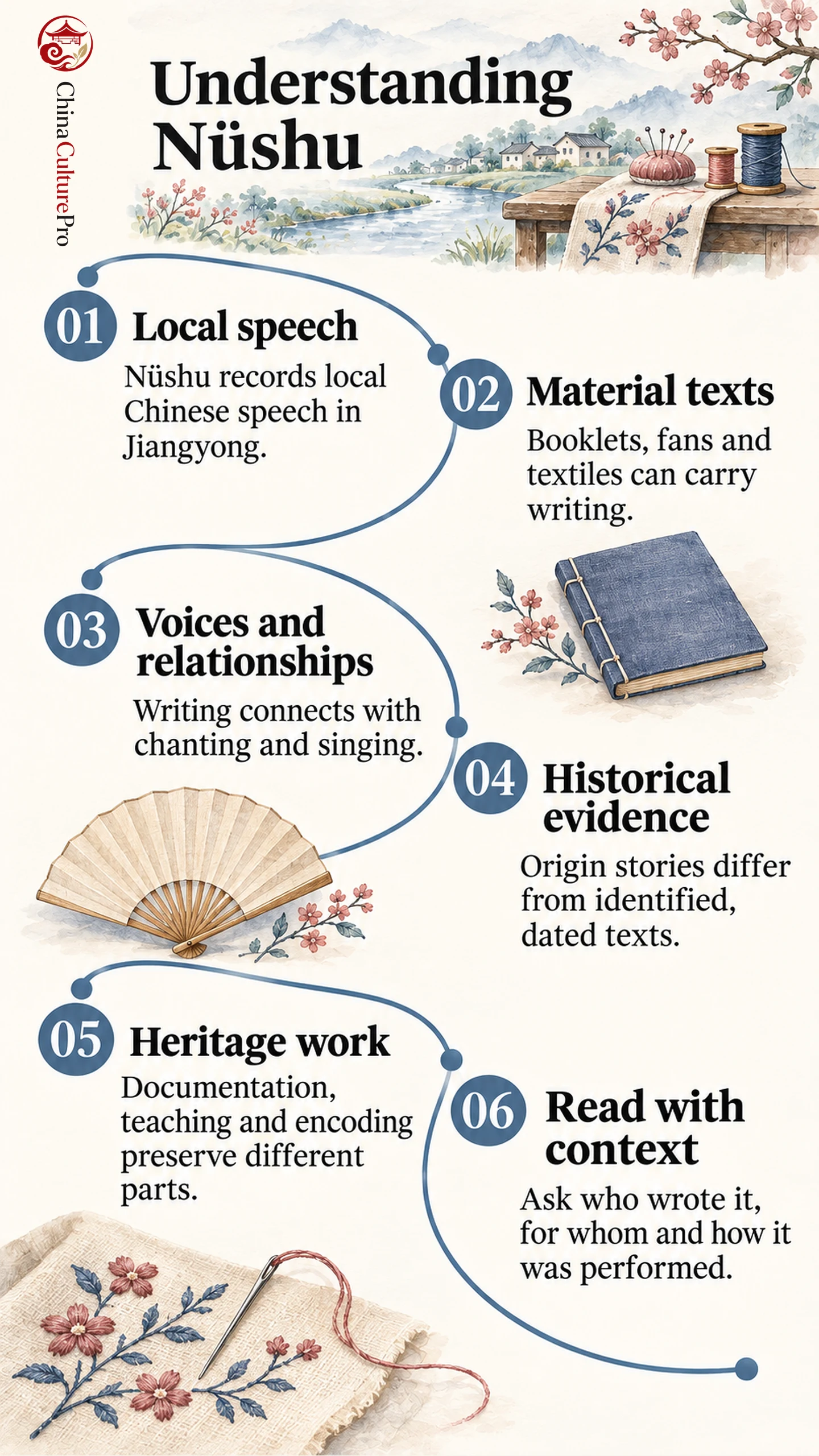
- Writing: Characters largely represent syllable sounds, with signs sometimes serving several words that sound alike.
- Objects: Texts appear in booklets, on fans and in embroidery.
- Performance: Chanting and singing are central to understanding the texts and their social use.
- Heritage: Documentation, teaching and new communities can preserve or reshape different parts of the tradition.
Nüshu belongs to a specific regional history. It should not be treated as the everyday writing system of all women in China, or as a collection of decorative symbols detached from language.[1][3][4]
A fan bearing Nüshu is more than a visually unusual object. To understand it, you need to know what its words say, who made or used it, and how a text might have been voiced. That combination of script, material and social practice gives Nüshu a distinctive place within Chinese language and writing diversity.
A Script for Local Speech, Not a Separate Secret Language
Nüshu developed for local speech in the Jiangyong area. Although many signs have relationships with Chinese characters, its system largely represents the phonetic values of syllables.[1]
This makes “a language only women could understand” a misleading shortcut. A script is a way to represent language. Not knowing its signs is different from being unable to understand the spoken language behind them.
Vertical columns progress right to left. Writing direction is separate from pronunciation and interpretation.[1]
Likewise, words sharing sounds do not necessarily share meanings. Recognizing a sign’s approximate sound value is not enough to translate an entire Nüshu poem.
Books, Fans and Thread: Where Texts Appear
Different materials reveal different ways writing entered social life. They should be studied as texts with a setting, not simply as examples of an attractive visual style.[4]
| Jenis bahan | What it could carry | A useful question |
|---|---|---|
| Paper booklets | Texts could include poems, songs and wedding messages. | Who wrote it, and for whom? |
| Fans | Writing could be carried on an everyday object. | Is the text identified and translated? |
| Embroidered cloth | Thread could carry writing on garments or smaller textiles. | How does the writing relate to the object’s use? |
A well-known format is the sanzhaoshu (三朝书, sānzhāoshū), often described as a “third-day letter” or wedding booklet. Friends could present it to a newly married woman three days after her wedding. The occasion helps explain why writing, friendship and the experience of marriage appear together.[4]
This is a local practice, not a rule for every Chinese wedding. Read it within the wider history of marriage and family institutions. Similarly, an embroidered text belongs within the material world of Chinese embroidery, while still requiring attention to its actual wording.
Songs, Sisterhood and Social Expression
Nüshu should not be reduced to silent reading. Ethnographic work connects it with nüge (女歌, nǚgē), women’s singing traditions. Writing, singing and oral narration worked together in expressing personal experience and maintaining relationships.[3]
The texts could articulate distress, offer support or tell stories. Research based on women’s life histories shows why neither “pure resistance” nor “passive suffering” captures every use. Writers and performers expressed their experiences within the social relationships available to them.[3]
The “secret script” label also needs care. An ethnographic study explains that Nüshu performances could be visible and audible: texts were shared through chanting or singing, while men often paid little attention to them. Limited male literacy in the script did not mean that every performance was a deliberately concealed message.[2]
Studies of verse narratives also connect Nüshu with oral formulae and women’s lines of transmission. The relationship to folk song is therefore substantive, not merely background music added to handwriting. It also broadens the sources available for studying women’s historical experience.[5]
What the Evidence Says About Origins
An exact origin date should not be presented as settled. China’s national heritage record cites a lack of ancient artefacts and clear historical documentation as obstacles to securely determining the script’s beginning. Stories of a single inventor or a particular distant dynasty require a different evidentiary standard from an identified surviving text.[6]
This distinction does not make oral traditions unimportant. It asks the reader to identify what kind of claim a source makes: an origin story, a dated object, a remembered practice or a researcher’s interpretation. The guide to history and legend develops that approach.
Nor should the date when outside researchers became interested be mistaken for the date women began using the script. Documentation and a tradition’s own history are different timelines.[2][5]
Heritage Work and New Communities
Nüshu customs entered China’s first national intangible cultural heritage list in 2006. The listed heritage includes transmission and cultural practices, not just a chart of characters. This wider scope matters when discussing what preservation is meant to sustain.[6]
Unicode encoding helps represent and exchange written characters digitally. It does not by itself preserve a singer’s voice, a manuscript’s history or a performance’s social relationships.[1]
New participation also deserves specific evidence. A study posted in 2026 combined interviews with 32 women enthusiasts and a year of participant observation in a learning community. It examined connections with identity and sisterhood among those participants. That is evidence of a particular new social setting, not a measure of everyone’s fluency or proof that earlier everyday practices have returned unchanged.[7]
The wider discussion of intangible heritage helps distinguish recording objects, teaching skills and maintaining social practice. Those activities can support each other without being identical.
Reading Nüshu With Context
For an unfamiliar example, look for an identified object or manuscript, a transcription, an explained reading and a translation. Ask whether a recording preserves its performance. A modern artwork inspired by Nüshu may have a different purpose from a historical letter.
Keep visual appreciation and textual understanding together. The distinction between calligraphy and ordinary writing is useful here, but an attractive shape alone does not verify a word’s meaning. Describing the source and setting gives the women’s words more attention than calling them mysterious.
FAQs About Nüshu
Is Nüshu simply decorative Chinese handwriting?
No. It is a distinct script that largely represents syllable sounds in local speech. A visual relationship with Chinese characters does not make its signs interchangeable with ordinary Chinese handwriting.[1]
Was all Nüshu communication deliberately hidden?
No. Ethnographic accounts describe shared, visible and audible performances. The script’s association with women and men’s limited engagement do not establish that every text was a secret message.[2]
Does digital encoding preserve the whole tradition?
No. It helps represent written characters. Preserving texts, spoken or sung performances, and the knowledge of their contexts requires additional documentation and transmission.[1][3]
Sumber
[1] Unicode Consortium. The Unicode Standard: Section 18.8, Nüshu
[2] Liu, American Ethnologist. From Being to Becoming: Nüshu and Sentiments in a Chinese Rural Community
[3] Liu, Oxford University Press. Gendered Words: Sentiments and Expression in Changing Rural China
[4] Chen, UNESCO Courier. Nüshu: From Tears to Sunshine
[5] McLaren, Intersections. Crossing Gender Boundaries in China: Nüshu Narratives
[6] Chinese Intangible Cultural Heritage Digital Museum. Nüshu Customs: National Heritage Entry
[7] Zhang, Zou, Zhou and Yang, Wuhan University. How Nüshu Culture Returns to Everyday Life: A Study of Women Enthusiasts