


Quick Answer: What Was the Battle of Ningyuan?
The Battle of Ningyuan (宁远之战, Níngyuǎn Zhī Zhàn) was a Ming victory in February 1626 at present-day Xingcheng in Liaoning. The garrison under Yuan Chonghuan (袁崇焕, Yuán Chónghuàn) held its walls against Nurhaci (努尔哈赤, Nǔ’ěrhāchì), ruler of Later Jin (后金, Hòu Jīn). Heavy cannon helped break up assaults on the fort. [1][2][3][4]
- Defense: Ming troops fired from recently strengthened walls rather than meeting the besiegers in open country.
- Cost: Later Jin took a nearby island used for Ming supplies even though it failed to take the fort.
- Aftermath: Nurhaci died later in 1626. Fighting resumed under his successor. [1][2][3][6]
The siege ended with the garrison still in the city. The loss of its island stores shows the narrower limits of that success. [2][3]
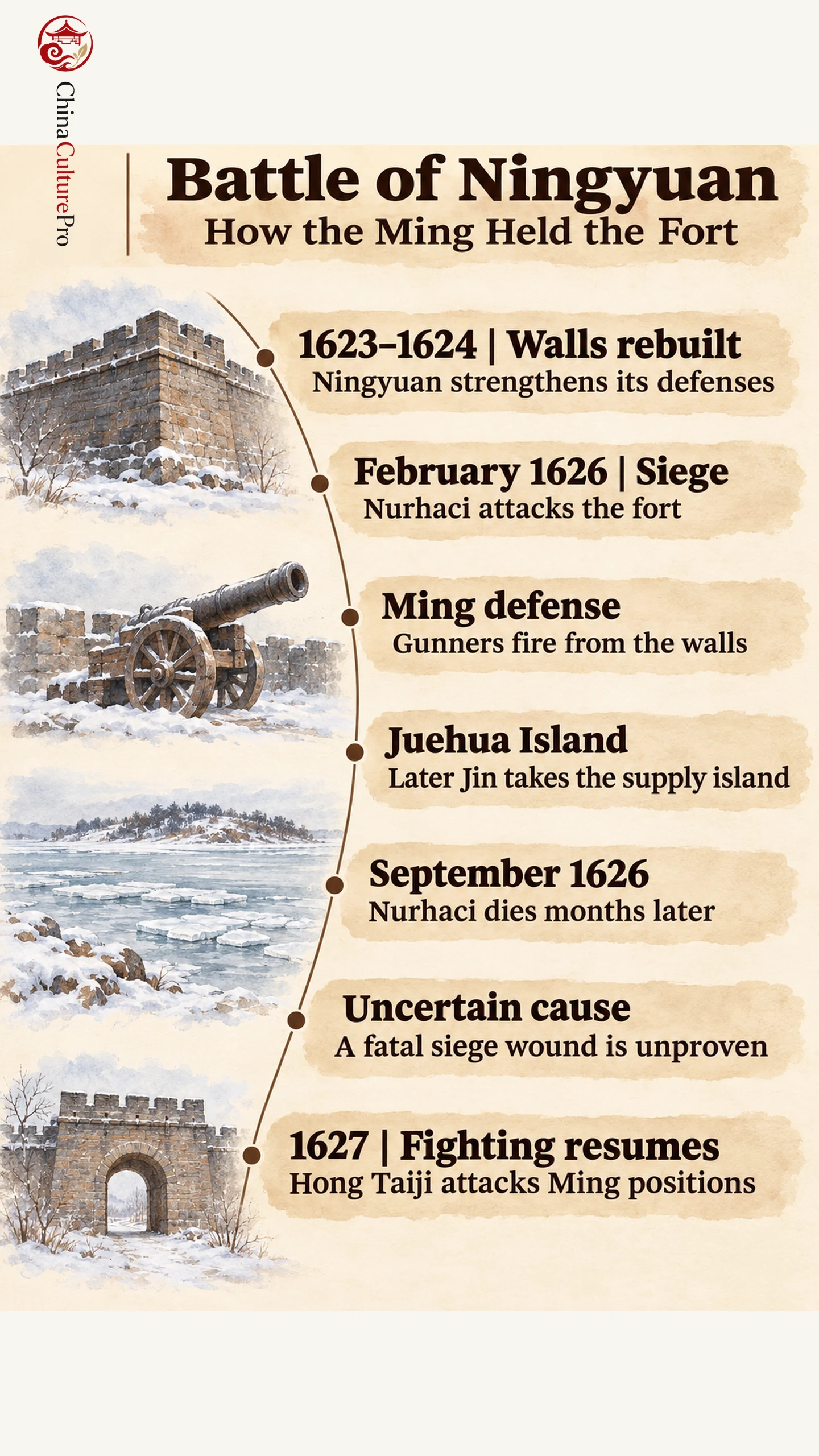
At Ningyuan, two armies fighting over the same stretch of coast faced two very different obstacles. A thick wall protected the Ming garrison, but the sea ice around its supply island could be crossed.
Why the Ming Held a Fort Beyond Shanhai Pass
Shanhai Pass guarded the approach to the North China Plain. Ningyuan lay northeast of the pass along the corridor between the mountains and the coast. During the early 1620s, officials of the Ming dynasty debated whether to defend positions beyond the pass or withdraw to a shorter line. A garrison there kept the fighting farther from the pass, but every outpost had to be supplied and could be isolated. [1][2][4]
Sun Chengzong backed a defense beyond the pass. The Liaoning heritage account dates work on Ningyuan’s inner walls under Yuan and the commander Man Gui to 1623–1624. After Sun left his post, his replacement Gao Di ordered the withdrawal of troops and supplies from several positions further east. Yuan refused to abandon Ningyuan. His biography also credits local officers and commanders with preparing the defense. [2][4]
The surviving walls at Xingcheng help explain the defensive choices. They have a stone base, an earthen core, a brick exterior and projecting corner platforms. The Liaoning heritage account identifies those platforms as positions for heavy guns. Qing repairs and later restoration also shaped the walls visible today. [4]
How the Walls and Cannon Stopped the Assaults
Nurhaci’s troops closed on Ningyuan and attacked on successive days. The two dynastic accounts agree on the broad outline. The garrison stayed behind the walls and repelled repeated assaults. The Ming history identifies an artilleryman named Luo Li who fired large Western-style cannon. The Manchu court account describes the attackers advancing with siege carts and being met by gunfire, explosives and falling stones. [2][3]
The heavy pieces are often called hongyi cannon. Their advantage depended partly on where they were used. On a prepared wall, crews could fire from cover at troops who had to approach the defenses. The garrison also had small arms, projectiles and a position from which it could keep firing after an assault stalled. [1][2][3][5]
After failing to take the fort, Later Jin attacked Juehua Island (觉华岛, Juéhuá Dǎo), where the Ming stored grain and other supplies. The Manchu court account describes troops crossing ice and burning ships and provisions. The island’s defenders had cut stretches of the ice. The attackers reported reaching them by crossing a section that was still intact. [2][3]
What the Records Say About Nurhaci’s Death
Nurhaci died months after the battle, in September 1626. Peter Lorge treats a wound during the siege as possible. The account in the History of the Ming describes cannon fire injuring the army outside the walls without establishing that Nurhaci was struck. The Manchu court’s battle narrative records the retreat and losses but gives no such account of a wound to its ruler. [1][2][3][6]
The sources are clearer about the outcome at Ningyuan than about the cause of his death. Both accounts reached their surviving form under the Qing. One follows the career of a Ming official, while the other records the founder’s campaigns. They converge on the failed assaults. Neither establishes a fatal injury. [1][2][3][6]
What the Ming Victory Changed
Holding Ningyuan gave the Ming time to retain a position beyond Shanhai Pass. Nurhaci’s successor Hong Taiji (皇太极, Huáng Tàijí) explored talks with Yuan in 1627. They produced no lasting settlement, and Later Jin attacked Ming positions at Ningyuan and Jinzhou during the Ning–Jin campaign that year. [1][2][5]
Ningyuan showed that Ming troops could still hold a fortified position on this frontier. The loss of the island’s provisions and renewed fighting in 1627 show what holding one city could achieve. Hong Taiji’s state went on to adopt the dynastic name Qing in 1636, a decade after the siege. [1][3][6]
FAQs About the Battle of Ningyuan
Where was the Battle of Ningyuan fought?
The siege took place at Ningyuan, now the old city of Xingcheng in Liaoning. The historic city walls survive, with fabric from the Ming and Qing periods and later restoration. [2][4]
Did European soldiers defend Ningyuan?
The cannon were of European design, but the History of the Ming names Luo Li, a soldier from Fujian, among the men firing them. The design of the weapons and the identity of the crews are separate questions. [2][5]
Was the Ningyuan battle the same as the Ning–Jin campaign?
The Battle of Ningyuan took place in 1626, when Nurhaci attacked the fort. The Ning–Jin campaign came in 1627 under Hong Taiji and involved both Ningyuan and Jinzhou. [1][2][5]
Sumber
[1] Peter Lorge. War, Politics and Society in Early Modern China, 900–1795, chapter 7
[2] Zhang Tingyu and other Qing court compilers. History of the Ming, chapter 259
[3] Qing court compilers. Manchu Veritable Records, volume 8
[4] Liaoning Department of Culture and Tourism. Xingcheng Old City
[5] Hong Kong Education Bureau. The Battle of Ningyuan and the Power of the European-Style Cannon
[6] Arthur W. Hummel Sr., ed.. Eminent Chinese of the Ch’ing Period: Nurhaci