

Quick Answer: Who Were the Ningbo Merchants?
Ningbo merchants (寧波商幫, Níngbō shāngbāng) were businesspeople associated with Ningbo and its surrounding counties in coastal Zhejiang. In the late Qing and early Republican period, Ningbo natives built businesses and community institutions in Shanghai while keeping connections to their places of origin.[1][2][3][4]
- Migration: People from the Ningbo region found work or started businesses away from home.[1][3][4]
- Association: Shanghai’s Siming Gongsuo (四明公所, Sìmíng Gōngsuǒ) helped organize services for people connected by place of origin.[1][2][3]
- Commerce: Ningbo merchants took part in trade and finance, with some entering new industries or investing in shipping and property.[4][5]
The merchant group was a network of people and enterprises. The association was one institution that served parts of the wider migrant community.[1][2][3]

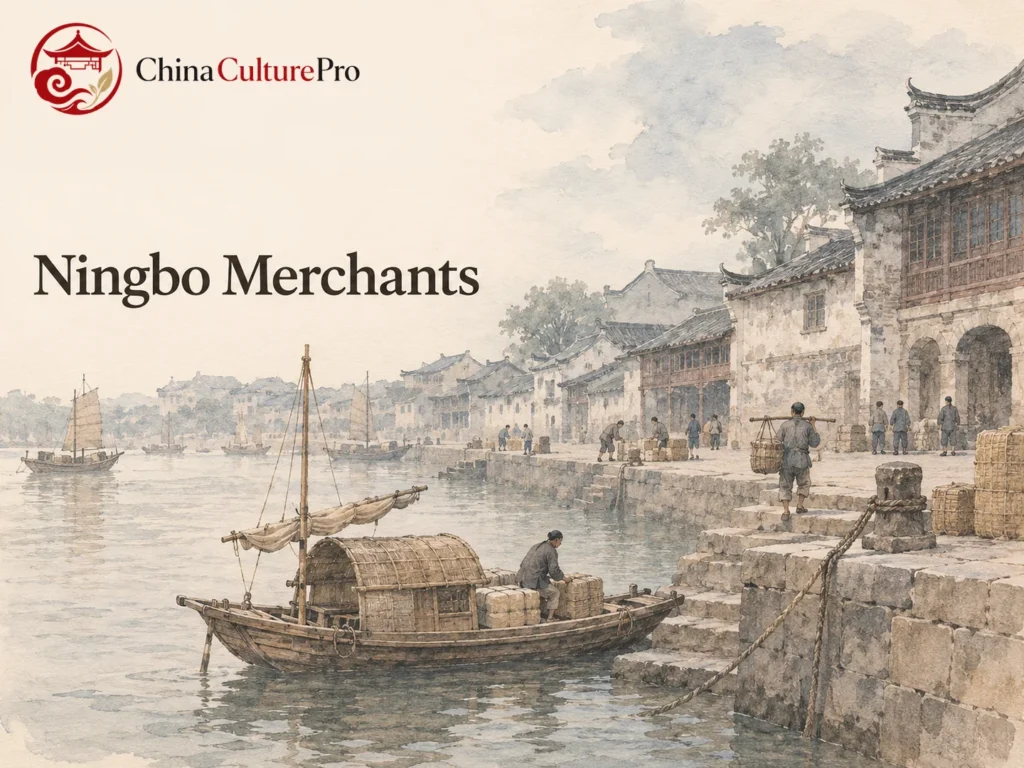
At the Shanghai waterfront, a Ningbo native could find a market for goods. Within the city, the same place of origin could connect a worker to an association and services his family needed. Those links show up in different records.[1][4]
Why Ningbo Merchants Were Active in Shanghai
Someone arriving in Shanghai could draw on connections to employers and workers from the Ningbo area. The network depended on repeated contact between migrants, existing businesses and their home region. Ningbo’s connection with Shanghai joined coastal commerce to a growing urban market. The history of Chinese maritime customs gives context for the changing institutions around port trade.[1][3][4]
The geographic label therefore identifies more than a place of business. Like the label Huizhou merchants, it can refer to origin and ties even when a person earns a living elsewhere. Those ties had to be maintained through particular enterprises, funds and associations.[1][3][4]
What the Siming Gongsuo Did
The Ningbo Museum dates the completion of the Shanghai association’s premises to 1803. Its account describes an organization of Ningbo merchants and artisans. Over time, the group helped arrange services including storage of coffins and shipment of remains back to home areas. Storing a coffin required space in Shanghai. Sending it home required transport and arrangements at the destination. Both tasks depended on an institution that could collect and spend funds.[1][2][3]
Native-place institutions also worked with smaller occupational associations. Bryna Goodman describes Ningbo carpenters who made a formal arrangement with the Siming Gongsuo in 1879 to secure burial and related services. The carpenters made regular contributions to their own fund.[1] A surviving photograph of the Siming Gongsuo board from 1934 shows that the larger association continued into the Republican period.[2]
In 1898, French Concession authorities sought to take over burial and coffin storage land held by the association. The dispute concerned physical property as well as burial practices. It shows how migrants’ connections to their home region became a question of authority and land use in Shanghai itself.[1]
Trade, Credit and the Case of Ye Chengzhong
One entrepreneur, Ye Chengzhong (葉澄衷, Yè Chéngzhōng), came from Zhenhai and established himself in Shanghai’s hardware trade. Research on Ningbo documents his later investment in banking, property and shipping. He also supported projects in the home region, including education and hospitals. His career shows that a person could move between sectors while keeping commercial and philanthropic ties in different cities.[4]
Shanghai’s financial business included qianzhuang (錢莊, qiánzhuāng), local commercial banks that worked with traders. These institutions had a different emphasis from the Shanxi piaohao banks, which were especially associated with long-distance remittance. The study of banks in Shanghai and Hankow also describes remittance houses lending funds to local banks. Different financial institutions could therefore do business with one another while serving different clients.[4][5]
FAQs About Ningbo Merchants
Did Ningbo merchants all live in Ningbo?
Many did business elsewhere. In Shanghai, people from Ningbo maintained native-place institutions and economic links with their home region.[1][2][3]
Was the Siming Gongsuo a bank?
It was a native-place association. It brought together people with ties to the Ningbo region and organized community services such as burial arrangements.[1][2][3]
Did Ningbo merchants only work in finance?
Some were involved in banking, but individual merchants and firms also worked in trade, hardware and other businesses. Ye Chengzhong’s career crossed several sectors.[4][5]
Sumber
[1] Bryna Goodman, University of California Press. Native Place, City, and Nation: Regional Networks and Identities in Shanghai
[2] Ningbo Museum. 1934 photograph of the Siming Gongsuo board
[3] Socio-Economic History. The Formation of the Coffin Sending Network of Siming Gongsuo in Late Qing Shanghai
[4] Robin Bowen Sun, University of Nottingham Ningbo China. The Peaceful Wave: A Study of the History of Ningbo
[5] Modern Asian Studies. The Foreign and Native Banks in China: Chop Loans in Shanghai and Hankow before 1914