
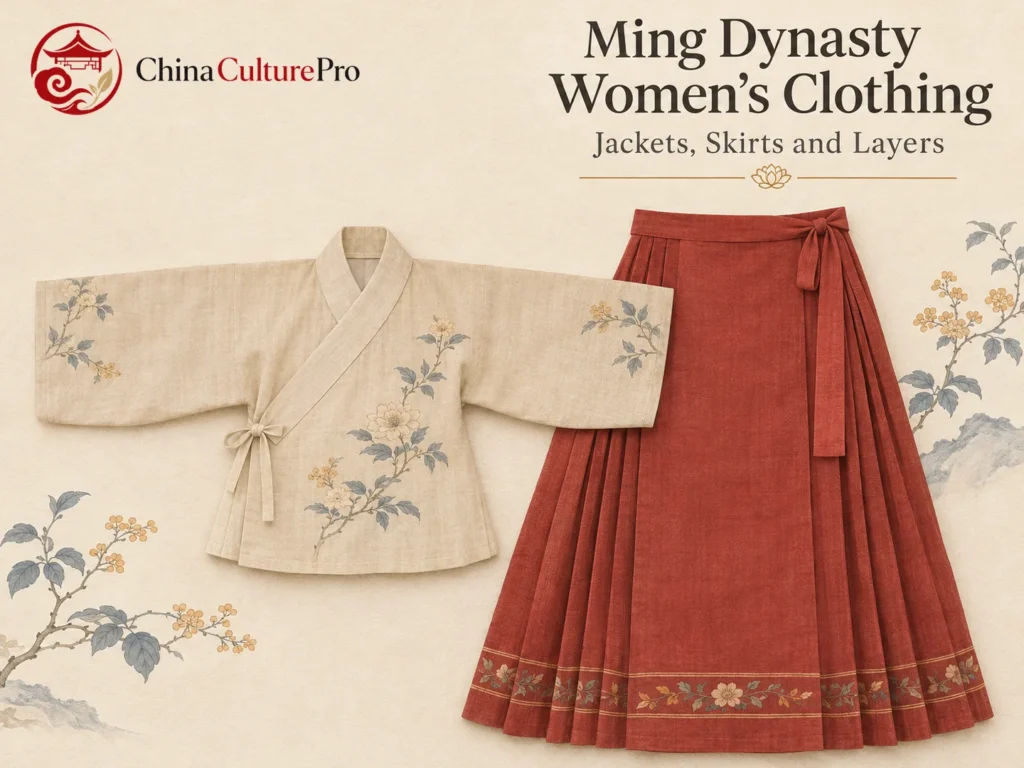

Quick Answer: What Did Women Wear in the Ming Dynasty?
Ming women could wear an upper garment and separate skirt, a combination often described as aoqun (袄裙, ǎoqún) when the upper garment was a jacket. The surviving skirts and robes described in the Confucius family collection are examples of how the layers varied with the occasion.[2][7]
- Upper garment: A shan (衫, shān) was commonly unlined, while an ao (袄, ǎo) could be lined.[1]
- Skirt: A surviving Ming mamianqun (马面裙, mǎmiànqún) shows how flat front and back sections work with pleats at the sides.[1]
- Outer layer: The bijia (比甲, bǐjiǎ) was a sleeveless garment. Surviving examples vary in collar and decoration.[4]
Start with the parts of a dated outfit before interpreting it as everyday or formal dress.

Look at where the upper garment ends and the skirt begins. In a portrait, a large sleeve can cover the join. A surviving skirt laid flat makes the construction easier to read. The collar, pleats and outer layer add evidence about what kind of outfit you are seeing.
How the Upper Garments and Skirts Fit Together
The Ming dynasty garments preserved by the Confucius family show several ways to dress the upper body. A long women’s gauze garment in Shandong Museum has a standing collar added above a round neckline, a front that fastens to the right and broad sleeves. The label shan can describe such a long garment as well as a shorter top.[1]
Collar shape matters independently of length and lining. Crossed fronts and standing collars are useful features to compare in dated garments. One dress study notes an increase in standing collars on women’s clothing from the middle and later Ming. A guide to cross-collar jacket and skirt ensembles gives context for the fold of a crossed front.[4]
Check the inside of a garment when you have access to a collection image or a modern piece. The edge of the lining and the seams are easier to assess there than in a portrait. Sheerness is a clue to look more closely at the weave. The catalog or an enlarged textile image can identify the structure. The luo gauze guide explains the relevance of structure when a description uses a broad fabric name.
The Wenzhou Museum identifies a long center-opening top worn over a skirt on a Ming maid figurine. The figure supplies a different kind of evidence from the robes in an elite household collection.[7]
How to Read the Skirt Panels and Pleats
The mamianqun can be read from front, side and back. In a surviving white skirt, the front and back areas are flat and the material is gathered into broader folds at the sides. The Shandong record describes two large sections assembled from several widths of cloth, with embroidery lower down. The smooth section makes a vertical panel down the front while the folds give the sides more room to move.[1][2]
An embroidered band also helps you read the finished garment’s orientation. In the white Shandong skirt, the upper section is comparatively plain and much of the bird and flower decoration sits near the hem.[2] When a museum has repaired a fragile waistband, the visible backing can be modern conservation material. The China National Silk Museum describes adding support to a damaged gauze skirt from the Confucius family collection.[3]
What Changed With Layer, Date and Occasion
A sleeveless bijia adds an outer layer without covering the sleeves below. A piece from the Confucius family collection has a round neck, center opening and side vents. Research also describes a more ornate square-necked example from Dingling. A straight-collared pifeng (披风, pīfēng) is a separate outer garment reconstructed by researchers from dated paintings and other evidence.[4][6]
A mingfu (命妇, mìngfù) was a woman with a conferred title. For certain ceremonial settings, a titled woman’s outfit could include a large-sleeved upper garment and a xiapei (霞帔, xiápèi), a pair of long decorated bands worn with the outfit. Head ornaments and motifs also mattered. For comparison with bridal interpretations, see the guide to historical phoenix crowns.[5]
Keep surviving objects within their evidence. A red robe in the Shandong collection carries round bird badges, and one study argues from its construction, insignia and family connections that a particular Ming prince’s wife wore it. The attribution is a researcher’s proposal. It depends on evidence specific to one garment in a prominent household’s collection.[5]
How to Assemble a Ming-Inspired Outfit
Choose an approximate period and a reference for each layer. Begin with the skirt. Check whether its flat sections stay in place while you walk and sit, and whether there is enough overlap over the base layer. Add the top and check that its closure lies smoothly and its hem sits where you want it over the skirt.
If you add an outer garment, check arm movement and the amount of cloth under the arm. A modern fit may use lighter lining or adjust the sleeve length. Record those choices alongside the dated reference when presenting the outfit.
FAQs About Ming Dynasty Women’s Clothing
Did Ming women wear only standing collars?
Ming garments show several collar forms. Studies document the greater use of standing collars in the middle and later Ming alongside other necklines.[4]
Is every pleated skirt a horse-face skirt?
Look for flat sections at the front and back and folds toward the sides. Pleating alone does not identify this construction.[1]
What does an elite garment tell us about ordinary wear?
It shows the cut, cloth and construction of that piece. A well-documented owner tells you whose clothing survives. To describe ordinary dress, compare sources that record ordinary wearers.[5]
Sumber
[1] China Cultural Relics News. Ming Clothing Preserved in the Confucius Family Mansion
[2] Shandong Local Gazetteer Archive. Clothing Preserved at the Confucius Family Mansion
[3] China National Silk Museum. Conservation of Ming Garments From the Confucius Family Collection
[4] Beijing Wenbo. Dress and Adornment in Ming Material Evidence
[5] Palace Museum Research Journal. A Study of a Ming Woman’s Robe With Round Bird Badges
[6] Design Research. Reconstructing Ming and Qing Straight-Collared Pifeng
[7] Wenzhou Museum. Dress on Ming Ceramic Figures