


Quick Answer: Who Was Ma Lianliang?
Ma Lianliang (马连良, Mǎ Liánliáng, 1901–1966) was a Peking opera (京剧, Jīngjù) performer known for laosheng (老生, lǎoshēng), the mature male role. He founded the Ma school (马派, Mǎpài), a performance lineage that younger singers carried forward.[1][5]
- Role: Listen for how a mature male character develops a thought through song.[1][2]
- Sound: Ma could move from a hesitant repeated sound to a sudden leap in pitch.[2]
- Credits: Some programs use Ma’s voice with a later performer on screen.[3][4]
Listen to one sung phrase in the orphan scene, then read the program’s separate sound and picture credits.
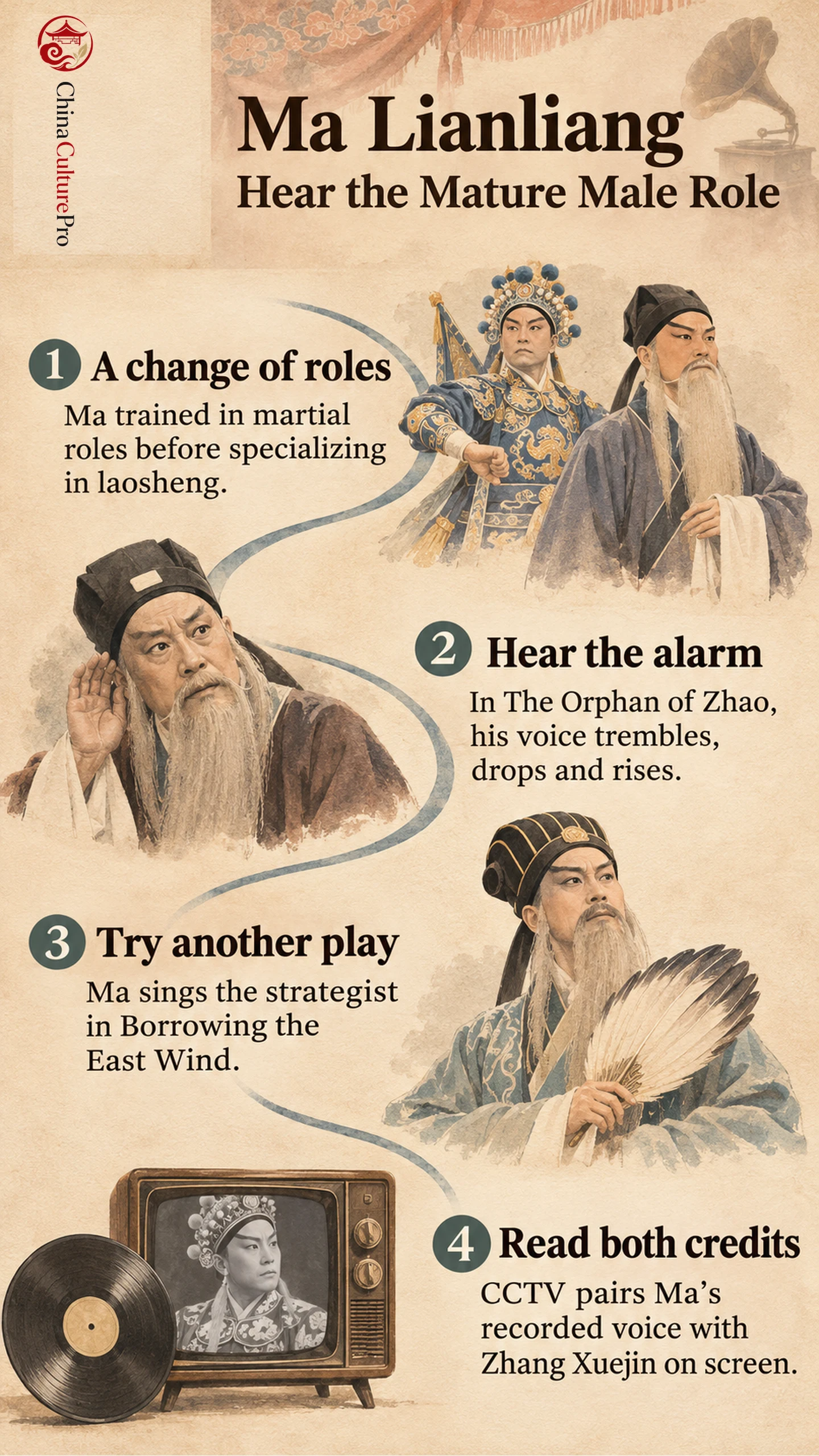
The infant’s cry gives Cheng Ying away if anyone hears it. Ma sings the character’s fear in a phrase that trembles, drops and rises again.
How the Ma School Took Shape
Ma trained first in martial roles and moved into mature male roles. He learned plays including Four Upright Scholars (四进士, Sì Jìnshì) from Sun Juxian (孙菊仙, Sūn Júxiān). Ma also carried Sun’s wide changes in pitch into roles he developed in other plays.[1][2]
A guide to Chinese opera role types helps explain what a mature male part asks of a singer. Ma made the weight and pace of his singing respond to the character’s situation, giving the same stage type room for very different characters.[1][2]
Listen to the Voice in The Orphan of Zhao
In The Orphan of Zhao (赵氏孤儿, Zhào Shì Gū’ér), Ma sings Cheng Ying, the man trying to save an infant. A study of early opera recordings and scores singles out the moment he hears the child cry. Ma repeats a sound in a trembling voice, takes a later syllable low and then moves sharply upward. Listen to how those shifts register the character’s alarm.[2][3]
Try Borrowing the East Wind (借东风, Jiè Dōngfēng) next. Ma plays the strategist Zhuge Liang. Compare how he phrases the strategist’s words with the interruptions and pitch changes in Cheng Ying’s line.[1][4]
How to Read the Recording Credits
Some CCTV programs pair archival audio with footage made later. The 2023 broadcast of the orphan play identifies Ma as the recorded voice of Cheng Ying and Zhang Xuejin (张学津, Zhāng Xuéjīn) as the actor in the picture. Look for 录音 (lùyīn) for the sound credit and 配像 (pèixiàng) for the performer who supplies the image.[3]
Zhang became Ma’s student in 1961. The pairing lets you hear Ma’s phrasing while watching how Zhang times the role to the older recording.[3][5]
FAQs About Ma Lianliang
Is Ma Lianliang’s Ma school the same as Ma Jinfeng’s?
Each genre has a distinct lineage. Ma Lianliang’s school is associated with mature male roles in Peking opera. Ma Jinfeng developed a separate Ma school for female roles in Henan Yu opera theater.[1][6]
Does laosheng mean the character is elderly?
The term identifies a mature male stage type. The repertoire includes Cheng Ying and Zhuge Liang, characters whose age and circumstances depend on the story.[1][3][4]
Sumber
[1] People’s Daily Overseas Edition. Laosheng Schools of Peking Opera
[2] China Intangible Cultural Heritage Network (Jaringan Warisan Budaya Takbenda Tiongkok). Early Laosheng Singing in Recordings and Scores
[3] CCTV. The Orphan of Zhao
[4] CCTV. Ma School Special
[5] China Intangible Cultural Heritage Network. Zhang Xuejin
[6] China Intangible Cultural Heritage Network. Ma Jinfeng