


Quick Answer: Who Was Xun Huisheng?
Xun Huisheng (荀慧生, Xún Huìshēng, 1900–1968) was a Peking opera (京剧, Jīngjù) performer known for huadan (花旦, huādàn), a female-role category that can call for lively speech and movement. The Xun school (荀派, Xúnpài) is the lineage associated with his repertory and performance choices.[1][2][3][4]
- Training: Xun learned bangzi theater before becoming known in Peking opera.[1][2]
- Movement: Watch where a character looks before a quick reply.[2][4]
- Recording: Archive programs sometimes pair his recorded voice with a later actor.[5][6]
Start with a scene where a servant helps two people meet and has to keep track of what each knows.
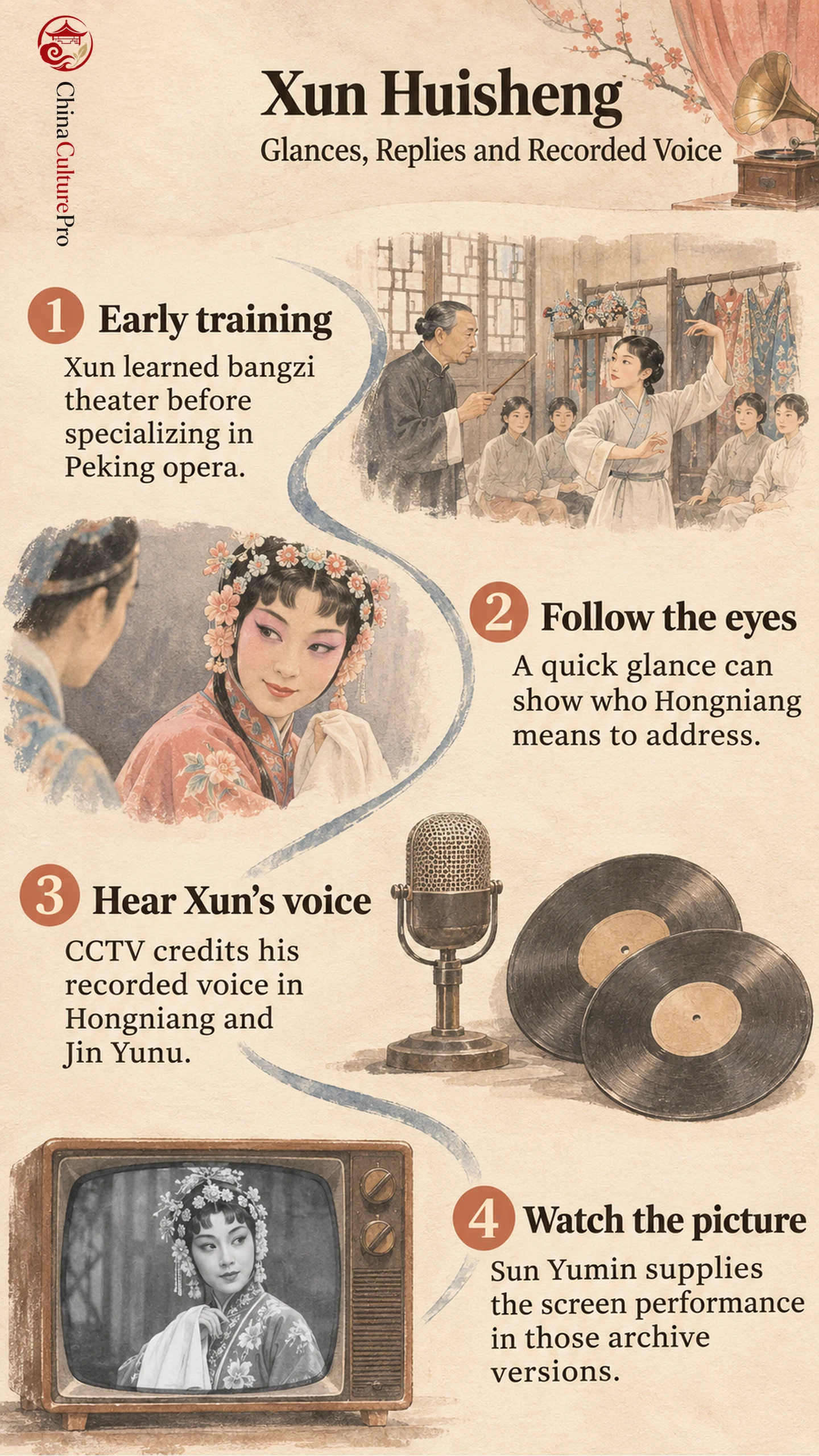
A maid trying to arrange a meeting has to watch two people at once. A glance can tell the audience which one she means to address before the next line begins.
From Bangzi Training to Female Roles
Xun began by learning bangzi theater in northern China, before taking on Peking opera roles. Wang Yaoqing (王瑶卿, Wáng Yáoqīng) later helped him develop repertory and an approach suited to his own abilities. His training in Chinese opera role types gave him conventions he could adapt to individual characters.[1][2][4]
How a Glance Carries a Reply
In Hongniang (红娘, Hóngniáng), the maid helps two lovers overcome obstacles to meeting. Watch which character she looks at before she delivers a reply. A shift in her gaze can show her redirecting the conversation before the next line is spoken.[2][4][5]
The heritage account of the school emphasizes a sense of everyday behavior within stylized performance. Look for the familiar intention in the movement, such as checking whether a remark has been overheard.[4][5]
What the Archive Recordings Preserve
CCTV lists Xun as the recorded voice and Sun Yumin (孙毓敏, Sūn Yùmǐn) as the screen performer in one version of the maid’s story. The same actors are credited for sound and picture, respectively, in Jin Yunu (金玉奴, Jīn Yùnǔ), where the central character confronts betrayal within a marriage. The pairing allows you to hear Xun’s phrasing while watching Sun’s timing and movements.[5][6]
FAQs About Xun Huisheng
Was Xun one of the Four Great Dan performers?
Yes. A 1927 newspaper selection recognized Xun alongside Mei Lanfang, Shang Xiaoyun and Cheng Yanqiu. Each was associated with a distinct female-role lineage.[3]
Who carried on the Xun school?
Song Changrong (宋长荣, Sòng Chángróng) studied with Xun from 1961 and performed both the maid’s story and the story of Jin Yunu. A credit for the school can refer to a later artist performing the same repertoire.[4][7]
Sumber
[1] CCTV. Xun Huisheng, One of the Four Great Dan
[2] CCTV. Peking Opera Huadan Performance
[3] ChinaCulture.org. Four Famous Dan Actors
[4] China Intangible Cultural Heritage Network. Peking Opera and the Xun School
[5] CCTV. Hongniang
[6] CCTV. Jin Yunu
[7] China Intangible Cultural Heritage Network (Jaringan Warisan Budaya Takbenda Tiongkok). Song Changrong