


Quick Answer: Who Is Liu Zhenyun?
Liu Zhenyun (刘震云, Liú Zhènyún), born in Henan in 1958, is a Chinese novelist whose work attends to ordinary people, social pressures and understated humor. His fiction belongs within modern and contemporary Chinese literature.[1]
- For loneliness and connection: Begin with the intergenerational search for a confidant.
- For bureaucratic absurdity: Choose the novel centered on a disputed divorce.
- For a tangled urban chase: Follow a cook whose lost possessions lead into a larger struggle.
The guide below distinguishes original Chinese publication dates, English editions and screen adaptations.
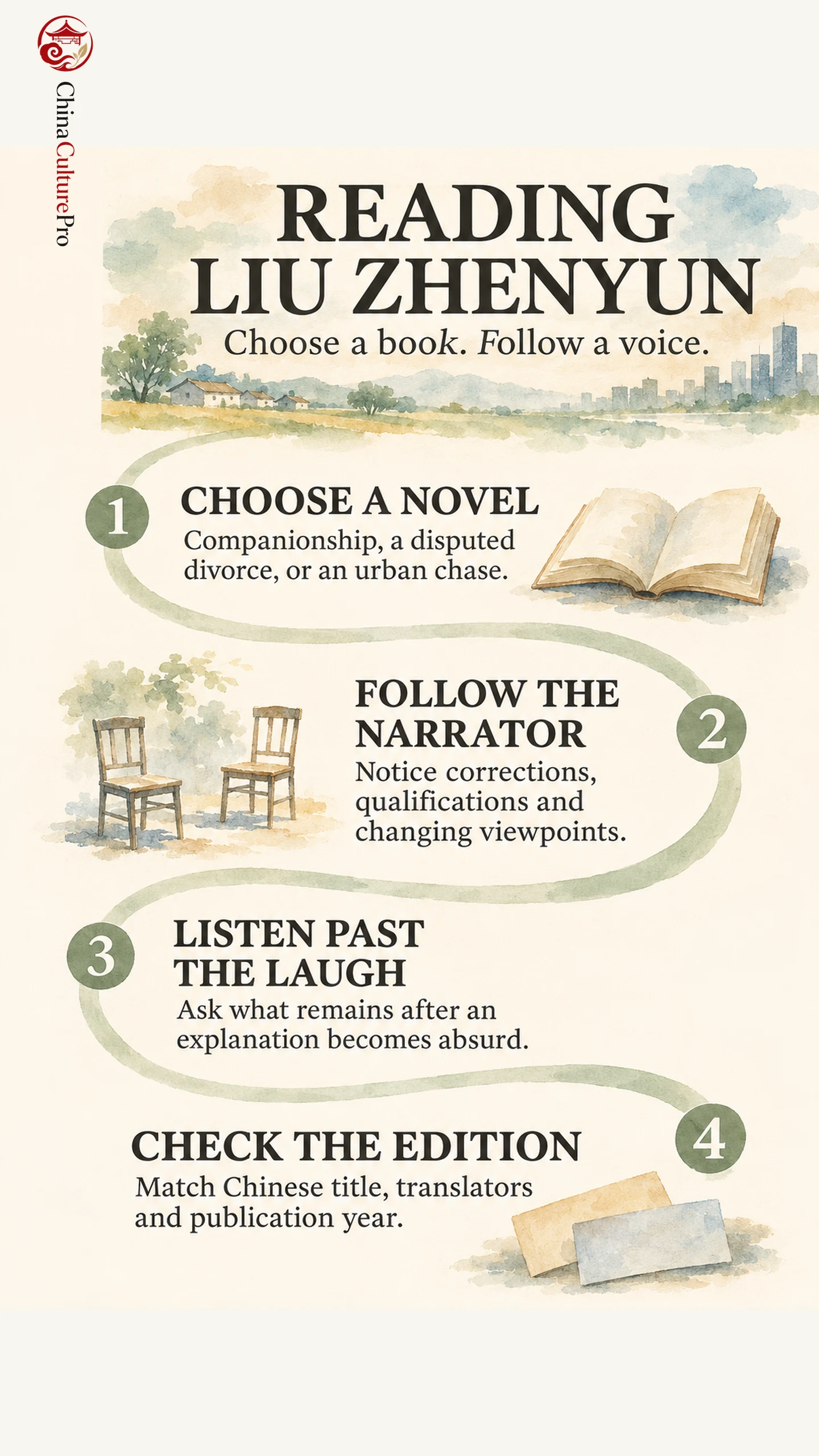
Choosing a first book is easier when you know what kind of attention it asks of you. Rather than collecting dramatic incidents, follow a conversation, a misunderstanding or a change in whose story occupies the foreground. Keep a short note of names and relationships as you read.
Three Novels to Choose From
These three entry points have identifiable English editions. The dates in this table are for the Chinese originals listed on the author’s website.[2]
| Novel | A reason to choose it |
|---|---|
| Someone to Talk To (一句顶一万句, Yī Jù Dǐng Yī Wàn Jù), 2009. | Two connected lives, separated by seventy years, open a sustained exploration of companionship and loneliness.[3] |
| I Did Not Kill My Husband (我不是潘金莲, Wǒ Bú Shì Pān Jīnlián), 2012. | A woman’s attempt to undo a supposedly sham divorce turns into an absurd struggle for recognition.[4] |
| The Cook, the Crook, and the Real Estate Tycoon (我叫刘跃进, Wǒ Jiào Liú Yuèjìn), 2007. | A migrant cook’s stolen bag leads to another bag, a flash drive and a chase involving powerful interests.[5] |
The table is a choice of starting points, not a ranking. Pick the central situation that makes you curious, then let the novel complicate the expectation you brought to it.
What Happens in the Opening of Someone to Talk To?
The official English sample begins with the father of the central character, a tofu seller, and his supposed friend, a carter. The relationship is unequal: one counts the other as a friend, while the other does not reciprocate that description. The narrator carefully rules out obvious forms of mistreatment before identifying the quieter problem of being held in low regard.[6]
This passage is more revealing than a general statement that the novel concerns communication. Ask who gets to name the relationship. Is companionship measured by time spent together, mutual regard or the use one person makes of another? Notice how each qualification revises your first impression.
Read a paragraph twice: once for the event, then for the narrator’s adjustments. Mark the point at which an apparently simple description becomes difficult to accept at face value. You do not need a plot summary of the whole book to begin noticing that movement.
Humor, Listening and Narrative Detours
In an interview, Liu distinguishes literary humor from simply telling jokes. He locates it in the friction between events and the reasoning applied to them. He also recalls a stranger’s warm welcome during research travel as important to the narrative tone of Someone to Talk To.[8]
That combination discourages a reading in which every character is merely a target of ridicule. When you laugh, ask whether the passage exposes a person’s vanity, a social arrangement or an explanation that makes sense locally but produces an unreasonable result. Then ask what feeling remains after the joke has passed.
Carlos Rojas’s preface compares the novel’s intersecting stories with the linked narratives of classics such as Water Margin, while emphasizing Liu’s more complicated chains of interaction. The two parts are organized around leaving and returning to Yanjin (延津, Yánjīn).[7]
For a practical reading aid, draw a small relationship map. Record a new person when the narrative turns toward them; add a line only when you can explain the connection.
Finding the Right English Edition
Howard Goldblatt and Sylvia Li-chun Lin translated Someone to Talk To, published by Duke University Press in 2018. Both are also credited on Arcade’s I Did Not Kill My Husband, published in 2014, and The Cook, the Crook, and the Real Estate Tycoon, published in 2015.[3][4][5]
When two catalogue entries appear to describe different books, compare the original Chinese title and translator credits. Keep the original publication year separate from the year of the translation. For a reading group, agree on one edition before assigning page numbers; record chapter divisions as well as pages so that participants can find the same passage.
For a broader reading path, use the Chinese literature guide to place this novelist alongside other periods and forms, then return to the specific language of the book you chose.
FAQs About Liu Zhenyun
Which novel won the 2011 Mao Dun Prize?
Someone to Talk To won the 2011 Mao Dun Prize. Paper Republic also identifies the work under the English rendering A Word Is Worth Ten Thousand Words; the Chinese title helps you recognize it as the same novel.[1]
Is the English title a literal translation of the Chinese?
Not necessarily. The Chinese title of Someone to Talk To means that one sentence is worth ten thousand sentences, as Rojas explains in his preface. The published English title makes a different choice.[7]
Can a film adaptation stand in for the novel?
No. Cell Phone (手机, Shǒujī) is a 2003 novel as well as a screen-associated title. Liu has specifically objected to readers treating films as though they were his novels. Compare the two forms, but identify which one supports your interpretation.[2][8]
Sumber
[1] Paper Republic. Liu Zhenyun: Biography and Bibliography
[2] Liu Zhenyun’s official website. Books
[3] Duke University Press. Someone to Talk To
[4] Arcade Publishing. I Did Not Kill My Husband
[5] Arcade Publishing. The Cook, the Crook, and the Real Estate Tycoon
[6] Liu Zhenyun, translated by Howard Goldblatt and Sylvia Li-chun Lin. Someone to Talk To: Official Sample, Opening Chapter
[7] Carlos Rojas. Series Editor’s Preface and Contents
[8] Liu Zhenyun and Zhang Ying, via China Writers. Writing Toward the Other Shore: Interview