


Quick Answer: Who Was Liu Changqing?
Liu Changqing (刘长卿, Liú Zhǎngqīng) was an eighth-century Tang poet whose work gained prominence after the An Lushan rebellion. His official career included imprisonment and exile, and his poems connect landscapes with separation, displacement and political disappointment.[1]
- Start small: Read a short poem about parting, music or an overnight stay.
- Follow the change: Notice how a sound, movement or final judgment alters the scene.
- Compare translations: Different English titles may lead to the same Chinese poem.
A quiet surface does not mean that nothing difficult is happening.
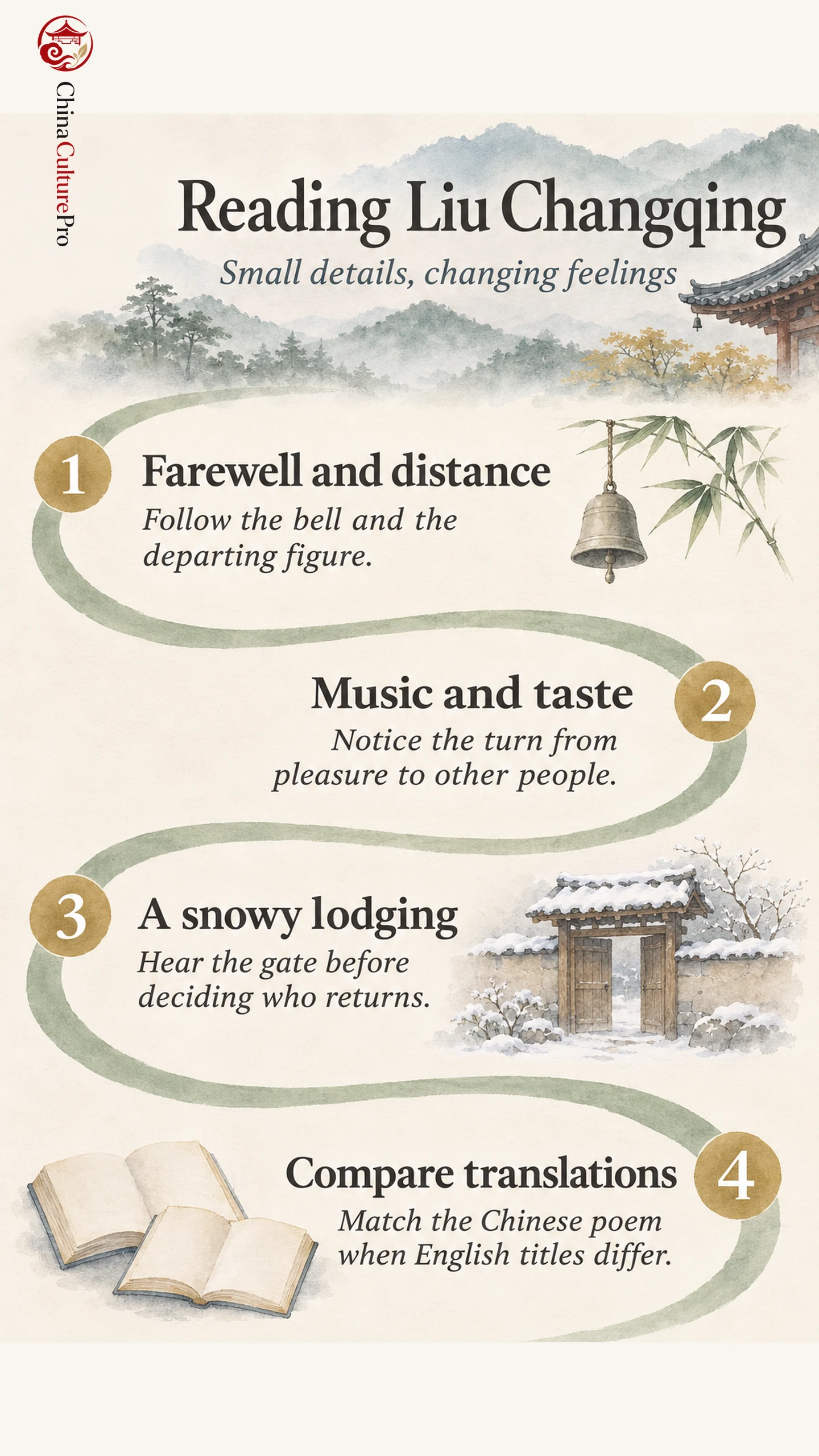
Liu Changqing rewards a slower look at ordinary details. Instead of assigning a fixed meaning to every mountain or evening, ask how the poem directs your attention. What becomes distant? What can be heard but not seen? What does the ending make you reconsider?
A Tang Poet Beyond a Peaceful Landscape
Liu’s writing belongs to the Tang dynasty, particularly the unsettled world after the rebellion of 755–763. The Chinese University of Hong Kong’s biographical note connects his political grievances with poems about exile and the beauty of nature.[1]
That context gives landscape an emotional and social setting. It does not turn each small poem into a coded record of one particular dismissal. Begin with what a poem actually names, then use biographical information where it clarifies the encounter.
His precise birth year is uncertain; even reference works offer differing estimates. An eighth-century setting is a firmer starting point than building an interpretation around an exact age.[1][9]
The short poems below are useful entries into Tang poetry, but they should not be mistaken for the whole range of his writing.
Three Short Poems to Begin With
The English titles here are identifying glosses; translations may use other wording.
| Poem | A question for the first reading |
|---|---|
| Farewell to the Monk Lingche (送灵澈上人, Sòng Língchè Shàngrén). | How do an evening bell and a retreating figure make parting felt?[2] |
| Listening to the Qin (听弹琴, Tīng Tán Qín). | How does enjoyment of a melody turn into a judgment about present tastes?[3] |
| Lodging with the Host of Furong Mountain in Snow (逢雪宿芙蓉山主人, Féng Xuě Sù Fúróng Shān Zhǔrén). | What changes when the distant landscape gives way to a sound at the gate?[4] |
The five-character quatrain (五言绝句, Wǔyán Juéjù) has four lines of five Chinese characters, totaling just twenty characters.[8]
Shortness leaves room for relationships that an English translation may need extra words to express.
Read the Shift, Not Just the Scenery
In the farewell poem, a temple bell prepares the destination before the monk recedes into the mountains. Distance carries the feeling of parting.[2]
In the music poem, pleasure gives way to a contrast: the old melody remains beloved, yet few people play it. Listening becomes a question of companionship.[3]
The snowy lodging poem moves from mountains and a poor dwelling to barking at a gate and a person returning through snow. Sound turns a view into an inhabited place.[4]
On a second reading, identify the smallest turn that matters. Is it a change in distance, an unexpected human sound or a statement about other people? Compare what you know at the beginning with what the last line adds. This approach is more useful than deciding in advance that every quiet landscape must express perfect serenity.
What Earlier Readers Noticed
Praise for Liu’s craftsmanship has a critical history. In Ji Yougong’s Records of Events Concerning Tang Poetry, an assessment attributed to Gao Zhongwu admires his refined language while also finding recurrent ideas and similar endings across a larger group of poems.[5]
That is a useful invitation to read beyond a favorite anthology piece. Put two short poems beside a longer one and test the criticism yourself. Do the repeated settings feel interchangeable, or does a particular verb, sound or relationship make each scene different?
The point is not to accept an early critic’s verdict automatically. It is to ask a more precise question than whether the poet is simply “good at nature.”
English Translations and Changing Titles
Witter Bynner’s The Jade Mountain, first published in 1929 from texts by Kiang Kang-hu, offers an older English route. Its “On Hearing a Lute-player” corresponds to the music poem above.[6]
The instrument is the guqin (古琴, Gǔqín), a Chinese zither; the older English title should not make you picture a European lute.[10]
Bynner’s ending emphasizes a lack of interest in the old songs. Compare that effect with the Chinese wording about people no longer playing the old tune. A translation can make an implied attitude more explicit. His farewell translation appears under the title “On Parting with the Buddhist Pilgrim Ling-ch’ê.”[6]
For another route, CUHK’s Renditions index identifies Mark Stevenson’s translation of a Yangzhou pagoda poem in issue 66, pages 45–46, and Geoffrey R. Waters’s translation of a palace poem in issue 64, page 19. These are specific places to look beyond the three opening choices.[7]
FAQs About Liu Changqing
Do five-character poems have five English syllables per line?
No. The description counts characters in the Chinese original. English translators make separate choices about line length and rhythm.
Is the person returning through the snow certainly the host?
The final line does not explicitly name the returning person. Read the title and the sequence together, while recognizing that an English translation may make an interpretive choice.[4]
Can the temple in the farewell poem be located with certainty?
No secure identification is established. Gu Nong’s discussion notes competing locations and argues that the uncertain geography need not prevent a close reading of the farewell.[8]
Sumber
[1] Chinese University of Hong Kong, Renditions. Liu Changqing: Biographical Note
[2] Liu Changqing, via Wikisource. Farewell to the Monk Lingche
[3] Liu Changqing, via Wikisource. Listening to the Qin
[4] Liu Changqing, via Wikisource. Lodging with the Host of Furong Mountain in Snow
[5] Ji Yougong, via Shidian Guji. Records of Events Concerning Tang Poetry: Liu Changqing
[6] Witter Bynner and Kiang Kang-hu, via Wikisource. The Jade Mountain
[7] Chinese University of Hong Kong, Research Centre for Translation. Renditions Authors and Translators Index
[8] Gu Nong, China Writers Network. Reading Liu Changqing’s Farewell to the Monk Lingche
[9] Ministry of Education, Revised Mandarin Chinese Dictionary. Liu Changqing
[10] UNESCO Intangible Cultural Heritage. Guqin and Its Music