

Quick Answer: What Was the Lijia System?
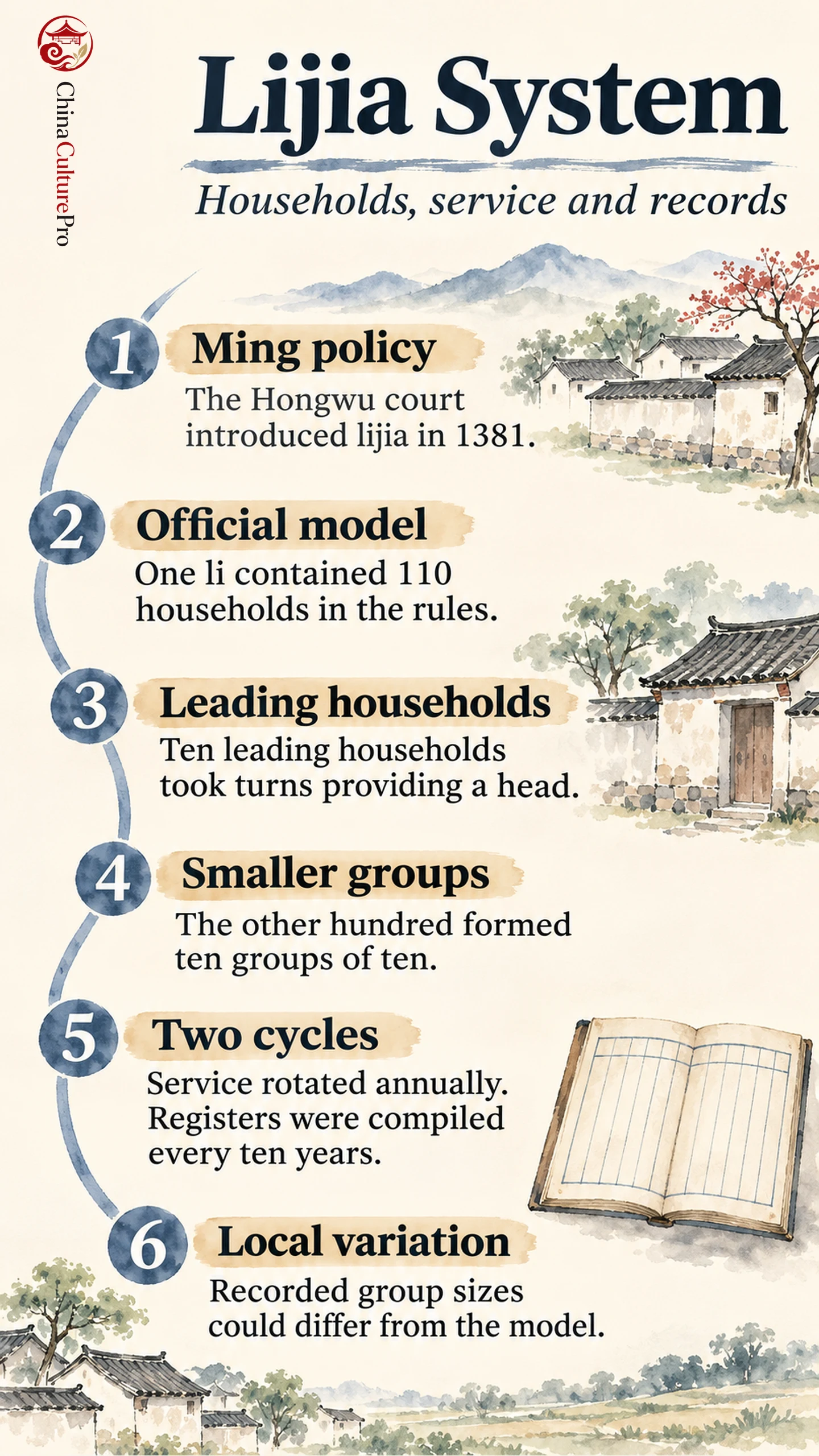
The lijia system (里甲制, lǐjiǎzhì) organized registered Ming households for tax collection and public service. The Hongwu court introduced it in 1381. A li (里, lǐ) was the larger unit. A jia (甲, jiǎ) was a group within it. Responsibilities passed among households over a rotation.[1][2][3]
- Standard group: The Ming model put 110 households in one li.[1][3]
- Rotation: Ten leading households were designated to provide leadership in turn.[1][2][3]
- Records: Yellow Registers (黃冊, huángcè) helped officials assign taxes and service.[2][3]
The 110-household figure describes the prescribed model. Surviving local records show groups of other sizes and arrangements that changed over time.[1]
A county could ask one household to coordinate duties in a given year, then call on another the next year. The Ming system put that changing responsibility inside a group whose membership officials tried to track over a longer cycle.[1][2][3]
How the 110-Household Model Worked
The Ming design set apart ten leading households from the 110 in a li. Officials considered resources such as taxable adult males and grain holdings when identifying them. The other hundred households formed ten groups of ten. In the prescribed rotation, one leading household took its turn as li head (里長, lǐzhǎng), while the relevant household group served with its own jia head (甲首, jiǎshǒu).[1][2][3]
The arrangement gave the county identifiable intermediaries. They helped organize collection and service duties in their units. The prescribed sequence put better-resourced households earlier in the cycle. Taking turns distributed the work across years while allowing officials to assign different positions to households with different resources. The system helps explain how Chinese magistrates reached beyond the staff in a county office.[1][3][4]
What the Yellow Registers Did
The Yellow Registers recorded households and information used in assessing taxes and service. The Ming collected statutes describe a ten-year compilation cycle. That cycle concerns when the registers were made or revised. The annual change in the group that served was a separate rhythm.[1][2][3]
A register could preserve the official arrangement even when families, property or labor resources changed. To understand how a county managed the system, compare the household registration rules with documents from a particular locality. A formal unit may describe who owed a duty without fully describing who lived together at a given time.[1][3]
What Yingtian Records Show About Local Practice
Historian Huang Ch’ing-lien compared local records from Yingtian (應天, Yìngtiān) Prefecture, the area around Ming Nanjing. Average sizes above 110 households were common in the prefecture, while some county figures fell below that standard. In Shangyuan, the 1391 records yielded an average of about 101 households per li. That average characterizes the recorded units for one place and date. The count of any individual group could differ.[1]
The locality also mattered to the names in a document. Records can use the label fang (坊, fāng) for an urban unit and xiang (廂, xiāng) for one in a suburban area. A reader should identify where a term was used and which larger unit it described before treating it as a village of a fixed size.[1][4]
How Lijia Differed From Baojia
The label baojia (保甲, bǎojiǎ) also described grouping households. In the regulations discussed here, its principal focus was local policing and mutual oversight. The Ming lijia arrangement emphasized taxes and service. The work of such units could overlap in practice, so the institutional name and the duties listed in a local source both matter.[3][4]
Over time, changes in fiscal administration reduced the usefulness of the early Ming model. Some names and groupings continued after their original duties had changed. A later reference to a li or jia is therefore evidence of a local administrative term. The surrounding document helps identify its actual role.[1][3][4]
FAQs About the Lijia System
Did a li always contain 110 households?
That was the official model. Huang’s Yingtian research found county averages above and below 110, depending on place and date.[1]
Did every household serve in the same year?
The model rotated service. Leading households supplied the li head in turn, with groups of other households taking their own turns.[1][2][3]
Was lijia still used unchanged under the Qing?
Local units and names could survive. Qing tax reforms changed what officials needed from household groups and shifted important levies onto land.[3][4]
Sumber
[1] Huang Ch’ing-lien, Academia Sinica. The Li-Chia System in Ming Times and Its Operation in Ying-t’ien Prefecture
[2] Collected Statutes of the Ming Dynasty, translated by Leif Littrup. Population and the Yellow Registers
[3] Richard von Glahn, in Registration and Recognition. Household Registration, Property Rights, and Social Obligations in Imperial China
[4] National Chi Nan University, Ming history research site. The extension of Ming state power into local society