


Quick Answer: Who Was Hua Tuo?
Hua Tuo (华佗, Huà Tuó) was a physician of the late Eastern Han (东汉, Dōng Hàn), the final period of the Han dynasty. Early histories describe his work with medicines, acupuncture and operations.[3]
- Mafeisan: Historical biographies say he used a preparation called Mafeisan (麻沸散, Máfèisǎn) before certain operations.[1][2]
- Five animals: The Five Animal Exercises (五禽戏, Wǔqínxì) are traditionally attributed to him.[5]
- Cao Cao: Hua treated the warlord Cao Cao (曹操, Cáo Cāo), who later had him imprisoned and killed.[1]
His place in the history of Chinese medicine rests partly on biographies that also helped inspire much later stories.
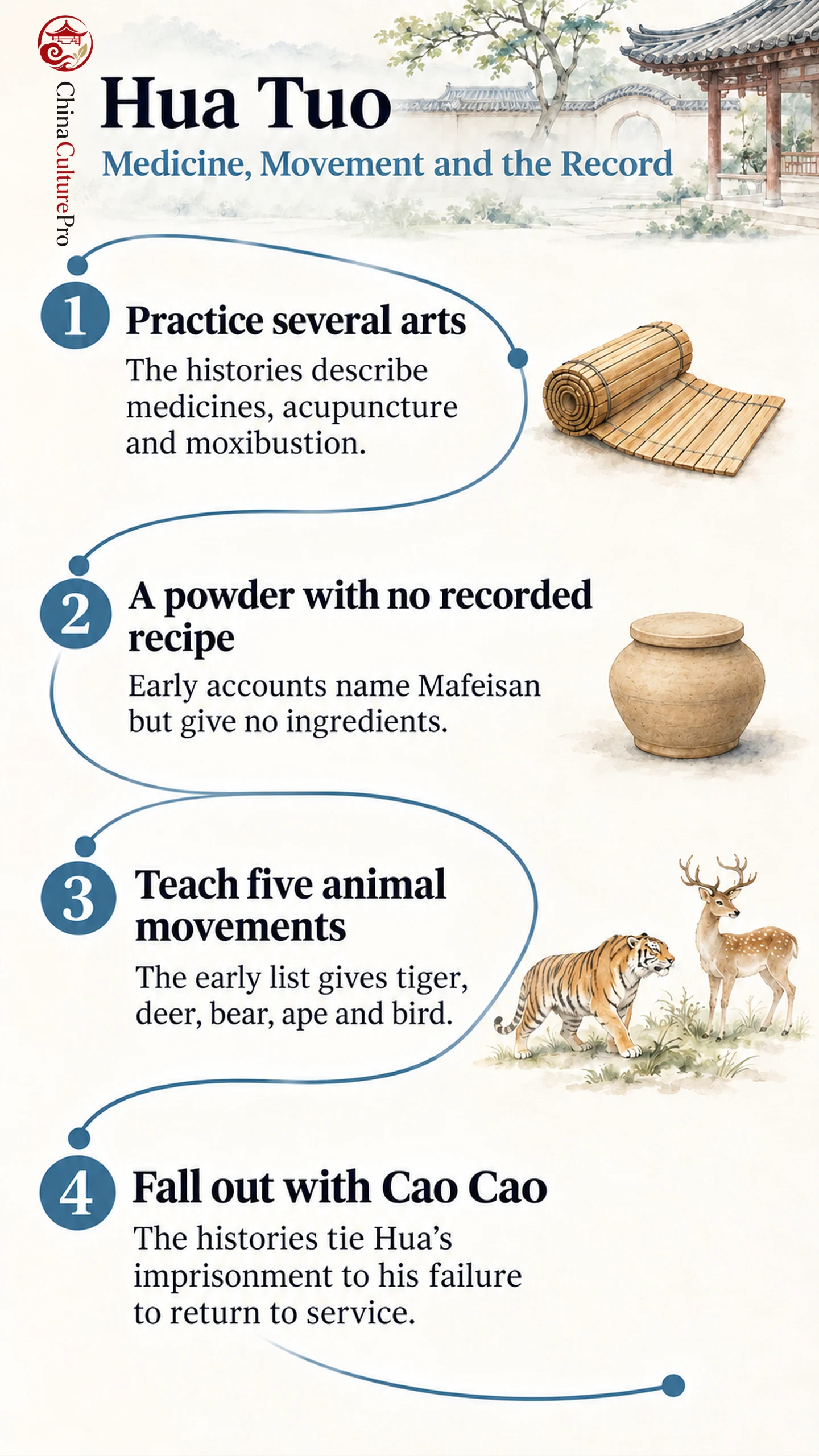
A powdered preparation, movements based on five animals and a falling-out with a warlord all appear in Hua Tuo’s biographies. The details belong to accounts compiled after his lifetime, and the way they were told changed over the centuries.
What the Early Histories Record
The third-century Records of the Three Kingdoms (三国志, Sānguózhì) places Hua in Qiao (谯, Qiáo), in the area of present-day Bozhou (亳州, Bózhōu). It says he had studied classical books and declined invitations to serve as an official.[1][4][5]
The fifth-century Book of the Later Han (后汉书, Hòu Hànshū) also presents him as skilled in prescriptions, acupuncture and moxibustion (灸, jiǔ), the application of heat in a treatment.[2][4]
Medical historian Fan Ka Wai highlights Hua’s knowledge of medicinal preparations and his use of medicine together with acupuncture.[3]
Mafeisan and the Limits of the Record
The earlier biography describes a patient becoming insensible after taking Mafeisan before a procedure.[1]
The later account also mentions wine and describes abdominal operations with sutured wounds.[2]
The biographies give no ingredients. Modern scholars have debated how to read the reports, and later recipes with a similar purpose cannot establish what Hua used. The records provide too little detail to assess the effects of the preparation or the outcomes of the operations.[4]
The Five Animal Exercises
The biography says Hua taught a pupil, Wu Pu (吴普, Wú Pǔ), a set of movements drawing on the tiger, deer, bear, ape and bird. It connects them to daoyin (导引, dǎoyǐn), a tradition of guided bodily movement. In the account, Hua compares regular movement to the use of a door hinge that is kept working by being turned.[2]
The early passage describes the five animals and Hua’s reasons for moving the body. It gives no full sequence of postures.[2]
The Bozhou tradition was added to China’s national intangible cultural heritage list in 2011.[5]
Cao Cao and the Physician’s Death
In the Book of the Later Han, Hua treated Cao Cao’s recurring head pain with acupuncture. He later went home and repeatedly failed to return, citing his wife’s illness. Cao Cao had the explanation investigated and ordered Hua imprisoned. Hua was killed despite an appeal on his behalf.[2]
Chen Shou’s account also says Hua burned a manuscript after a jailer declined to accept it. The passage leaves its contents unspecified.[1]
The later novel Romance of the Three Kingdoms (三国演义, Sānguó Yǎnyì) tells a different story. In it, Cao Cao suspects that a proposed operation on his head is an attempt to kill him.[6]
FAQs About Hua Tuo
Did Hua Tuo treat Guan Yu’s arrow wound?
The novel names Hua Tuo as the physician who scrapes the wounded arm bone of Guan Yu (关羽, Guān Yǔ). The earlier historical biography of Guan Yu describes a similar treatment and leaves the physician unnamed.[7][8]
Do we know the original Mafeisan formula?
No original ingredient list has been identified. Researchers discuss later formulas that may resemble it, but the original mixture remains unknown.[4]
What animals appear in the earliest account?
The earlier biography lists tiger, deer, bear, ape and bird. The word for the last animal is the general term for a bird, so the early list leaves the species open.[1]
Sumber
[1] Chen Shou. Records of the Three Kingdoms, chapter 29, Hua Tuo biography
[2] Fan Ye. Book of the Later Han, chapter 82, Hua Tuo biography
[3] Fan Ka Wai. On Hua Tuo’s Position in the History of Chinese Medicine
[4] P. Zhao, X. Yu and Y. Kagemoto. Was Mafeisan an Anesthetic in Ancient China?
[5] China Intangible Cultural Heritage Digital Museum. Hua Tuo’s Five Animal Exercises, national inventory
[6] Luo Guanzhong, attributed. Romance of the Three Kingdoms, chapter 78
[7] Luo Guanzhong, attributed. Romance of the Three Kingdoms, chapter 75
[8] Chen Shou. Records of the Three Kingdoms, Shu Book 6, Guan Yu biography