


Quick Answer: Who Was Hu Shi?
Hu Shi (胡适, Hú Shì, 1891–1962) was a writer, scholar and diplomat of the New Culture Movement (新文化运动, Xīn Wénhuà Yùndòng) generation. He helped establish vernacular Chinese (白话, báihuà) as a language for modern literature and scholarship.[1][10]
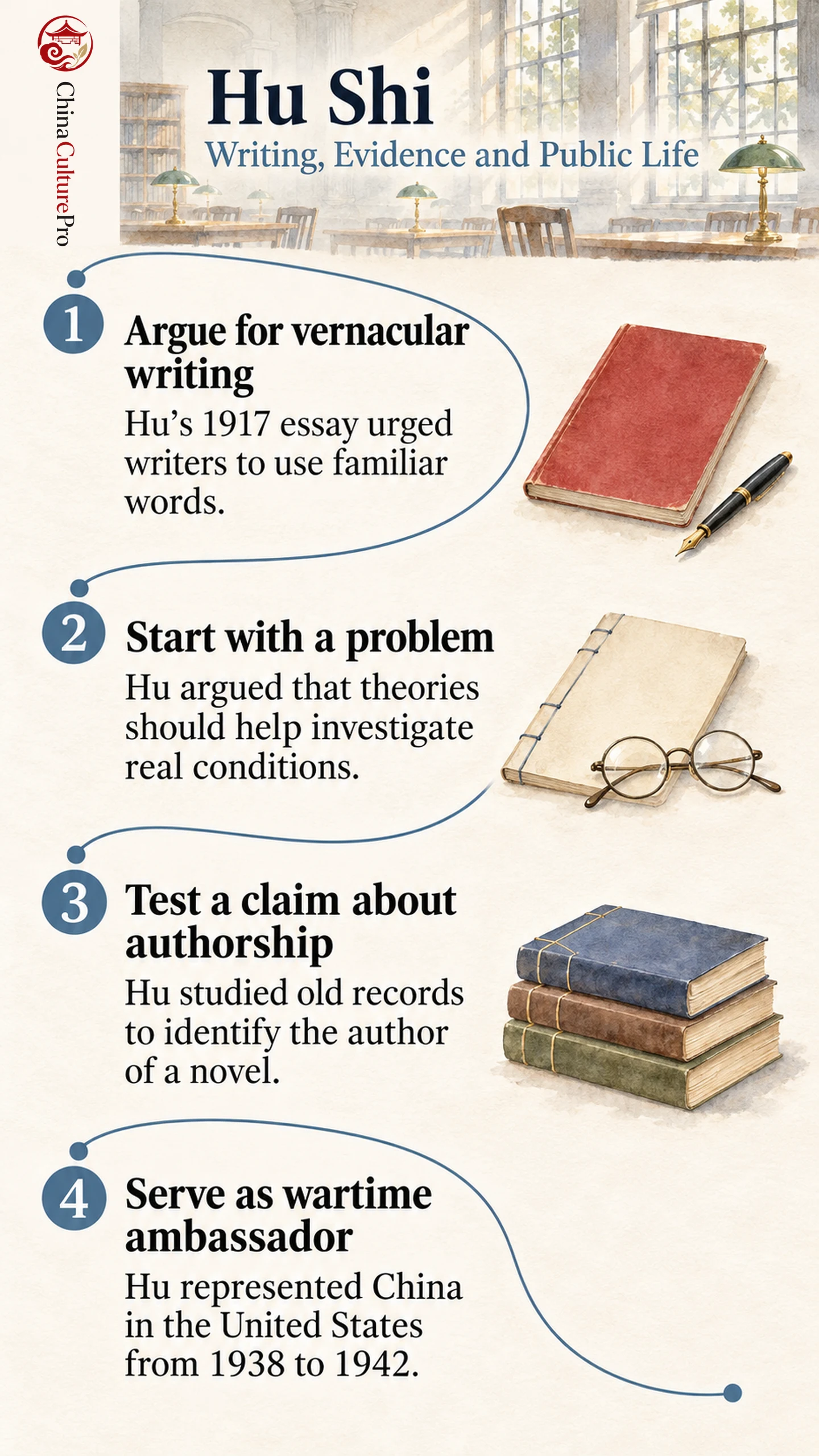
- Writing: His 1917 essay in New Youth (新青年, Xīn Qīngnián) argued that writers could use everyday language and should avoid imitation and stale formulas.[2]
- Research: Hu used historical documents to investigate the authorship of a classical Chinese novel.[7]
- Public service: He was China’s ambassador to the United States from 1938 to 1942 and later led Academia Sinica in Taiwan.[1]
The reform essay makes a case for a new kind of writing. Hu’s studies of older works show what he did with the evidence they left behind.
Hu studied at Cornell University and then studied philosophy with John Dewey at Columbia University. He returned to China in 1917 to teach the history of Chinese philosophy at Peking University (北京大学, Běijīng Dàxué).[1][3]
What Hu Shi Wanted Writers to Change
In January 1917 New Youth published A Preliminary Discussion of Literary Reform (文学改良刍议, Wénxué Gǎiliáng Chúyì). Its eight proposals included attention to grammar, using familiar words, and dropping stock allusions and obligatory parallel phrasing. He wanted a work to convey ideas or genuine feeling, a standard he applied even to poetry about sorrow.[2][3]
Hu challenged writers who treated classical literary Chinese (文言, wényán) as the only suitable medium for serious work. He pointed to Water Margin (水浒传, Shuǐhǔ Zhuàn) as part of a long tradition of using familiar language in Chinese literature.[2]
Hu tested some of those principles in verse. His 1920 collection Experiments (尝试集, Chángshì Jí) gave readers examples of the changes underway in Chinese poetry.[4]
Problems, Isms and the Work of Evidence
Dewey’s pragmatism (实用主义, shíyòng zhǔyì) encouraged Hu to treat inquiry as a process of testing ideas.[8] In July 1919, he argued in the Weekly Review (每周评论, Měizhōu Pínglùn) that a theory was useful when it helped people examine a specific social problem. He compared the uncritical use of an imported doctrine to a doctor reciting remedies before examining a patient.[5]
Li Dazhao (李大钊, Lǐ Dàzhāo) replied in August that people needed a shared ideal against which to judge their circumstances. A grievance could then become a collective issue with enough support to act on.[6]
Hu’s 1921 study of Dream of the Red Chamber (红楼梦, Hónglóu Mèng) gives a literary example of his approach. He read eighteenth-century memoirs and worked with other researchers who examined local records. Their work helped him make the case that Cao Xueqin (曹雪芹, Cáo Xuěqín) wrote the novel’s first eighty chapters.[7]
From Professor to Diplomat and Institute President
As the Republic of China’s ambassador to the United States from 1938 to 1942, Hu sought American support during the war with Japan.[8] He returned to Peking University as its president from 1946 to 1948. In 1958 he took over as president of Academia Sinica in Taiwan, a post he held until his death in 1962.[1]
FAQs About Hu Shi
Did Hu Shi invent vernacular Chinese?
Earlier fiction already used it. Hu drew on that tradition and argued that familiar written language should have a larger place in modern literature.[2]
How did his 1917 essay relate to May Fourth?
The essay preceded the student protests that began on May 4, 1919, over the treatment of former German rights in Shandong. The broader May Fourth Movement (五四运动, Wǔsì Yùndòng) also included cultural debates about language and education.[9][10]
Why is he also called Hu Shih?
Hu Shih is the spelling used in older English-language accounts and by some of his own institutions. Hu Shi is the modern Pinyin form of the same name.[8][10]
Sumber
[1] Academia Sinica. Hu Shih Memorial Hall, Introduction
[2] Hu Shi. A Preliminary Discussion of Literary Reform, original New Youth text
[3] Hu Shi. A Preliminary Discussion of Literary Reform, translated excerpts
[4] National Institute of Informatics. Experiments, 1920 edition, CiNii Books
[5] Hu Shi. Study More Problems and Talk Less About Isms, Weekly Review
[6] Li Dazhao. Further Discussion of Problems and Isms, Weekly Review
[7] Frederic Wakeman Jr. The Genius of the Red Chamber
[8] Columbia University. Hu Shih, Remarkable Columbians
[9] The National Archives, United Kingdom. May Fourth Movement 1919
[10] Research Centre for Translation, Chinese University of Hong Kong. Hu Shi, Renditions