

Quick Answer: What Is Hong Oolong?
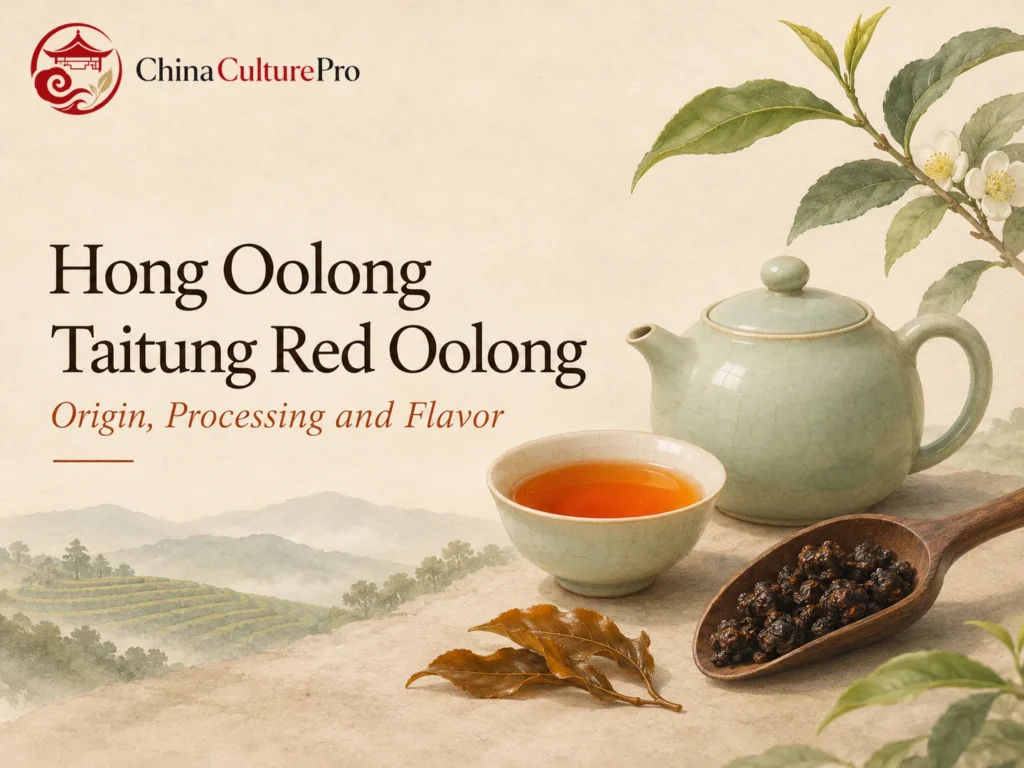
Hong Oolong(红乌龙,hóng wūlóng), or red oolong, is a heavily oxidized, roasted oolong style developed in Luye, Taitung, and introduced in 2008.[1]
- Asal: Closely associated with eastern Taiwan’s Luye tea district.
- Processing: Combines extensive oxidation with heat fixation, ball rolling and roasting.
- Character: Dark, tightly rolled leaves produce amber to orange-red liquor and rounded, ripe-fruit flavors.
- Drinking: Suitable for hot infusion or refrigerated cold brewing.[1][3][4]
The name identifies a tea style, not a single cultivar or a mixture of finished black and oolong teas.

A red cup can be misleading. To understand this tea, look beyond its color to the leaf material, processing sequence and roast.
Luye, Taitung and the Development of Red Oolong
Red oolong emerged from a modern effort to give Taitung’s low- and middle-elevation tea districts a distinctive product. Summer and autumn leaf grew readily, but turning it into the lightly processed styles then favored by the market could produce unwanted bitterness. A different processing approach offered a use for that seasonal material.[1]
The development involved the local tea research team working with farmers and tea makers. At its 2008 introduction, redder liquor was not immediately attractive to producers accustomed to greener styles. Demonstrations of cold-brewed tea at Luye’s balloon events helped introduce the flavor to drinkers. This is a documented account of product development and adoption, not an ancient origin legend.[6]
Jin Xuan(金萱,jīnxuān), or Taiwan Tea No. 12, is an important local raw material, but other cultivars are suitable too. Distinguishing tea cultivar from tea type separates the plant’s identity from the processing style.[3]
How Oxidation, Rolling and Roasting Shape the Tea
In tea-making descriptions, “fermentation” often refers to oxidation within the leaf. Withering and agitation prepare the material; rolling damages leaf tissue and encourages further reactions. Heat fixation subsequently reduces enzyme activity. These operations are distinct from the later roast.[2]
Substantial withering and agitation lead into rolling and further oxidation before heat fixation. Shaping, drying and roasting follow. This draws on black-tea and oolong processing practices without mixing two finished teas.[3]
Roasting adds aroma after the earlier leaf reactions. Ask separately about oxidation and roast: one does not specify the other. The distinction is also useful when reading about Tieguanyin roasting levels.[2]
What Hong Oolong Looks and Tastes Like
Dry leaves are generally tightly curled into small, dark, glossy balls or half-balls. Once infused, the liquor may be amber, orange-red or deeper red while remaining clear. The appearance can resemble black tea. A gentle roasted note is expected, rather than a burnt finish.[1]
Ripe fruit, floral notes, honey-like impressions and nutty or roasted tones are useful tasting vocabulary. They are not a compulsory checklist for every packet. Even one producer offers distinct fruit-and-nut, floral, honeyed and fuller-bodied expressions, showing why a style name cannot promise one identical flavor.[5]
Separate aroma from mouthfeel when tasting. Notice whether the fragrance suggests fruit or roast, then consider the liquor’s weight, smoothness and finish. Letting a small amount cool can make it easier to compare the sweetness and texture with the first hot sip.[4][5]
Choosing and Brewing Hong Oolong
Start with the producer, growing location and batch information. For a tea sold specifically as Luye or Taitung red oolong, those details should explain the place claim. A cultivar name and a roast description add different information. The broader guide to tea origin labels explains why these labels should be read separately.
Choose a brewing method to match the cup you want. These are regional guide starting points, not a rule that every harvest or vessel must follow.[4]
| Metode | Titik awal | Hal yang perlu diperhatikan |
|---|---|---|
| Hot teapot infusion | 3 g of leaf, 150 ml water at 100°C, about 3–4 minutes. | Roasted layers and a fuller body; pour the infusion off the leaves. |
| Refrigerated cold brew | 1 g of leaf per 100 ml water; refrigerate for about 8–12 hours. | A softer cup emphasizing fruit and honey-like sweetness.[4] |
- Prepare: Warm the teapot, then add the measured leaves.
- Infuse: Add hot water and use the initial steep as a reference.
- Pour: Decant into cups so the leaves do not continue steeping.
- Adjust: Change the next infusion to suit the leaf and your taste.[4]
Keep the leaf quantity, vessel and brewing water consistent when comparing batches; preparation changes can obscure the differences you are trying to notice.
FAQs About Hong Oolong
Is Hong Oolong Black Tea?
No. It borrows black-tea processing techniques but remains an oolong style with heat fixation, shaping and roasting. A reddish infusion does not determine the category.[3]
Is Hong Oolong the Same as Hongshui Oolong?
No. Hongshui oolong(红水乌龙,hóngshuǐ wūlóng)is a different traditional style. “Red” in both names does not make their processing, leaf appearance or flavor identical.[1]
Does the Sweet Flavor Mean Sugar or Honey Was Added?
Not necessarily. Plain red oolong can have sweet, honey-like or ripe-fruit impressions. Check the ingredient list if buying a flavored product or ready-to-drink beverage.[5]
Is Hong Oolong a Tea Cultivar?
No. It is a processing style. Jin Xuan is one cultivar used to make it, alongside other suitable tea plants.[3]
Sumber
[1] 吳聲舜 / 農業部. 台灣新興特色茶-紅烏龍介紹
[2] 茶及飲料作物改良場. 臺灣特色茶分類及加工製程簡介
[3] 臺東區農業改良場. 特用作物:認識茶的品種及採茶體驗
[4] Red Oolong Taitung. Pleasure of Brewing
[5] Buoyatea. What Is Red Oolong Tea?
[6] 韓國棟 / 台灣紅烏龍茶推廣協會. 〈人物專訪〉臺灣紅烏龍之父吳聲舜