


Quick Answer: What Is GABA Oolong Processing?
GABA oolong processing incorporates an oxygen-limited treatment that encourages tea leaves to accumulate gamma-aminobutyric acid, abbreviated GABA. The leaves are then finished as an oolong rather than becoming a separate plant variety.
- Manufacturing: Nitrogen atmospheres or other controlled low-oxygen arrangements change the leaf’s conditions.
- Tea identity: Cultivar, growing region and finished style remain separate information.
- Cup character: Processing can produce distinctive flavor, but no single taste proves a measured GABA content.
The name does not mean caffeine-free. A laboratory figure for dry leaves also does not state how much GABA is in your prepared cup.
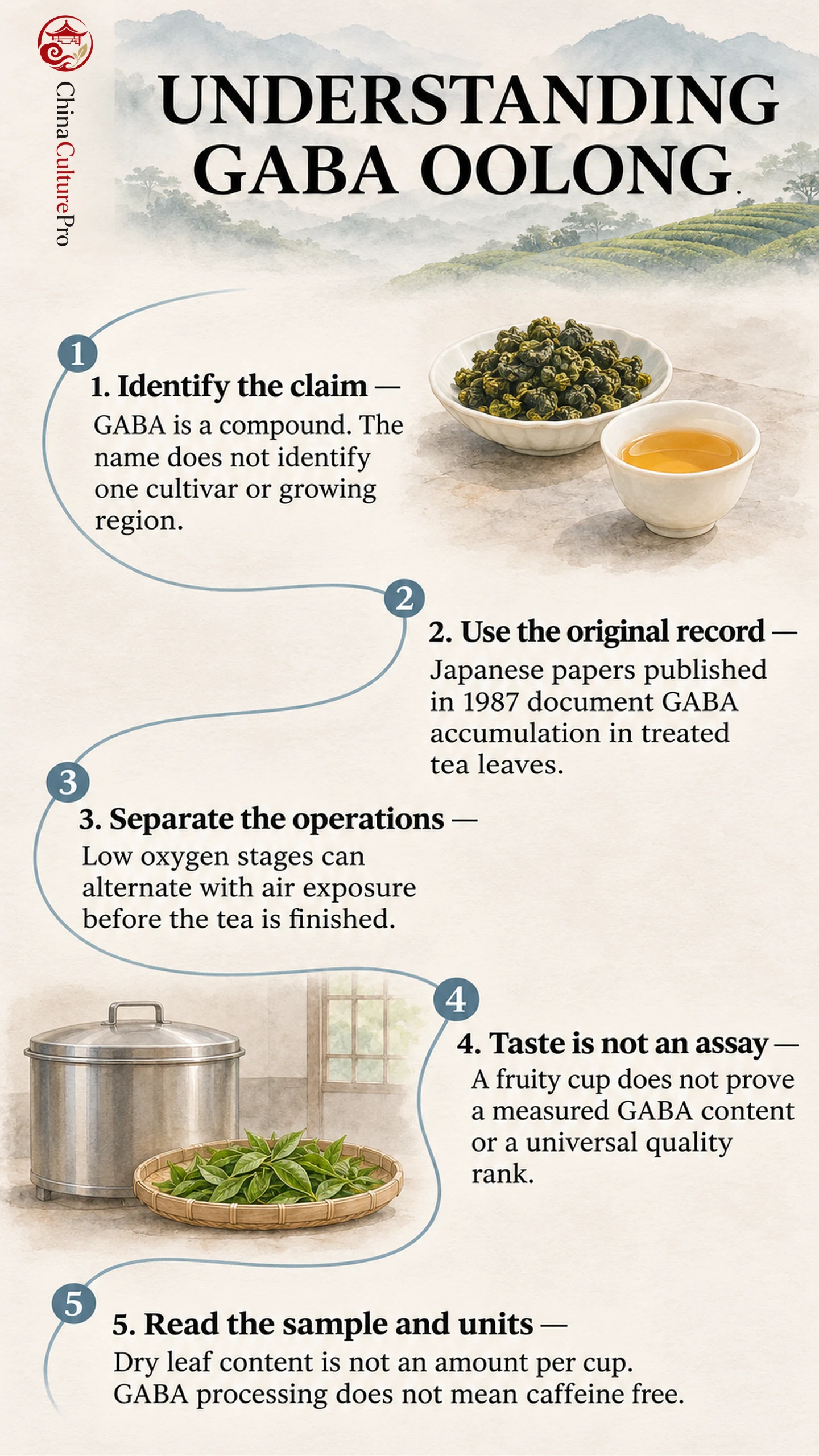
A cup with a fruity, tangy impression may introduce you to GABA oolong, but the name points to processing and composition rather than a fruit ingredient. Its story becomes clearer when the low-oxygen treatment, ordinary oolong manufacture and the finished product’s laboratory claims are considered separately.
GABA Names a Compound, Not a Tea Cultivar
GABA is an amino acid, not the name of a tea tree. Original work on tea leaves investigated its accumulation under low-oxygen conditions and the conversion of glutamate to GABA through the enzyme glutamate decarboxylase.[1]
That makes the basic intervention different from adding a flavoring to finished dry tea. The leaf’s own metabolism is involved. It does not establish the ingredients of every product sold under the name, so a blended or supplemented product still needs its own ingredient information.
A GABA label therefore leaves several questions open. Which cultivar supplied the leaves? Where were they grown? Which final tea category and finishing style did the maker choose? The distinction in tea cultivars is useful because plant identity alone cannot answer those processing questions.
What the 1987 Research Actually Documents
A Japanese research paper published in July 1987 reported increased GABA in leaves held in nitrogen or carbon dioxide. It investigated green, oolong and black teas, and found that the placement of the treatment relative to withering affected the result for oolong and black tea.[2]
This documents an early research basis for GABA tea beyond oolong alone. It does not support a story about one ancient mountain cultivar, nor does it establish that every present-day producer follows the experiment’s exact conditions.
Publication date and web availability also need separating. A later date when a journal placed the article online is not the invention date of the treatment. The original paper provides a firmer historical reference than an undated retail account of a chance discovery.
Low Oxygen Treatment Within Oolong Manufacture
Anaerobic treatment(厭氧處理,yànyǎng chǔlǐ)describes processing with little or no available oxygen. It may be alternated with exposure to air rather than applied as one uninterrupted sealed hold. A tea research station report, for example, describes repeated low-oxygen and aerobic stages in work with Taiwan Tea No 24.[3]
The number of cycles is not a universal quality scale. A study published in 2018 examined sequential treatments across four cultivars and found that GABA accumulation could increase or decrease during the second low-oxygen stage, depending on the cultivar. It also identified contributions from more than one metabolic pathway.[4]
Low oxygen should not be described as ordinary oxygen-dependent tea oxidation simply happening faster inside a sealed vessel. Its role in GABA accumulation differs from the oxidation and aroma development managed elsewhere in an oolong route.
The broader oolong process still involves withering and handling, fixation, rolling and drying, with finishing choices such as roasting affecting the result.[5] Pelayuan, fixation and rolling have their own purposes; the low-oxygen intervention does not replace all of them.
Flavor and Measured Content Are Different Questions
One March 2026 product account describes rolled leaves and a tangy, fruity infusion with currant and sultana impressions and a woody finish.[6] That is a description of the particular product, not a compulsory flavor profile for every GABA oolong.
A 2023 investigation examined 220 Taiwanese GABA tea samples collected from 2016 to 2021, including oolong and other tea categories. Its measurements varied between products, including within the oolong group.[7] The name on the packet did not make every sample chemically identical.
The sample variation makes product-specific testing relevant when content matters. A fruity taste, dark liquor or strong aroma cannot establish a GABA measurement, and the survey does not supply a universal quality ranking.
Use aroma vocabulary to describe the sensory result and keep the analytical claim in a separate note. Record any stated roasting difference before attributing every contrast between two teas to GABA processing alone.
Reading Product Claims and Laboratory Units
Check what was tested and how the result is expressed. Milligrams per 100 grams of dry tea is a leaf-composition figure, not milligrams per cup or per 100 milliliters of brewed tea. A cup needs its own extraction or infusion information before those quantities can be compared.
The original 1987 production experiment reported little change in caffeine under its treatments.[2] GABA processing should therefore not be treated as a decaffeination method. The tea-caffeine guide addresses that separate question without inferring a fixed amount from the tea’s category.
Likewise, a processing or composition study is not a demonstration that a particular cup treats anxiety, insomnia or another condition. Judge a health claim by evidence about that claim, rather than by the presence of a named compound.
For a product comparison, record cultivar and origin, manufacture, tasting notes and laboratory information separately. Each answers a different question.
FAQs About GABA Oolong Processing
Is GABA oolong a particular tea cultivar?
No. GABA processing can be applied to different plant material; confirm the product’s cultivar separately.
Is GABA oolong caffeine-free?
No. The processing name does not establish decaffeination or a zero-caffeine product.
Is GABA necessarily added to the leaves?
No. The documented processing encourages accumulation within the leaf; check ingredients for a particular product.
Does a dry-leaf GABA figure tell you the amount in your cup?
No. Leaf composition and the quantity extracted into a prepared infusion are different measurements.
Sumber
[1] Tojiro Tsushida and Toshinobu Murai. Conversion of Glutamic Acid to GABA in Tea Leaves under Anaerobic Conditions, 1987
[2] Tojiro Tsushida and colleagues. Production of a New Type Tea Containing a High Level of GABA, 1987
[3] Tea and Beverage Research Station. GABA oolong processing research using Taiwan Tea No 24
[4] Qin Yan Wu and colleagues. Accumulating pathways of GABA during sequential incubations in fresh tea leaves, 2018
[5] Tea and Beverage Research Station. Tea classification and processing
[6] Curious Tea. GABA Oolong: March 2026 product and tasting record
[7] Standards. Investigation on the Quality of Commercially Available GABA Tea in Taiwan, 2023