


Quick Answer: How Are the Two Rice Flours Different?
Glutinous rice flour(糯米粉,nuòmǐfěn), also called sweet rice flour, is milled from sticky rice. Regular rice flour(粘米粉,zhānmǐfěn)in this Chinese pantry comparison is made from non-glutinous rice. Both may look like fine white powder, but they serve different texture goals. [1][2][8]
- Glutinous flour: Useful for cohesive, sticky and chewy rice doughs.
- Regular flour: Used in rice noodles, rolled sheets and cakes that need a different bite.
- “Glutinous”: Refers to the sticky rice type, not wheat gluten.
- “Sweet”: Is a name for the rice, not proof that sugar has been added. [1][2][4]
Rice type is the first distinction. Milling and added starches can further change the product, so the two names do not support a universal one-for-one swap.
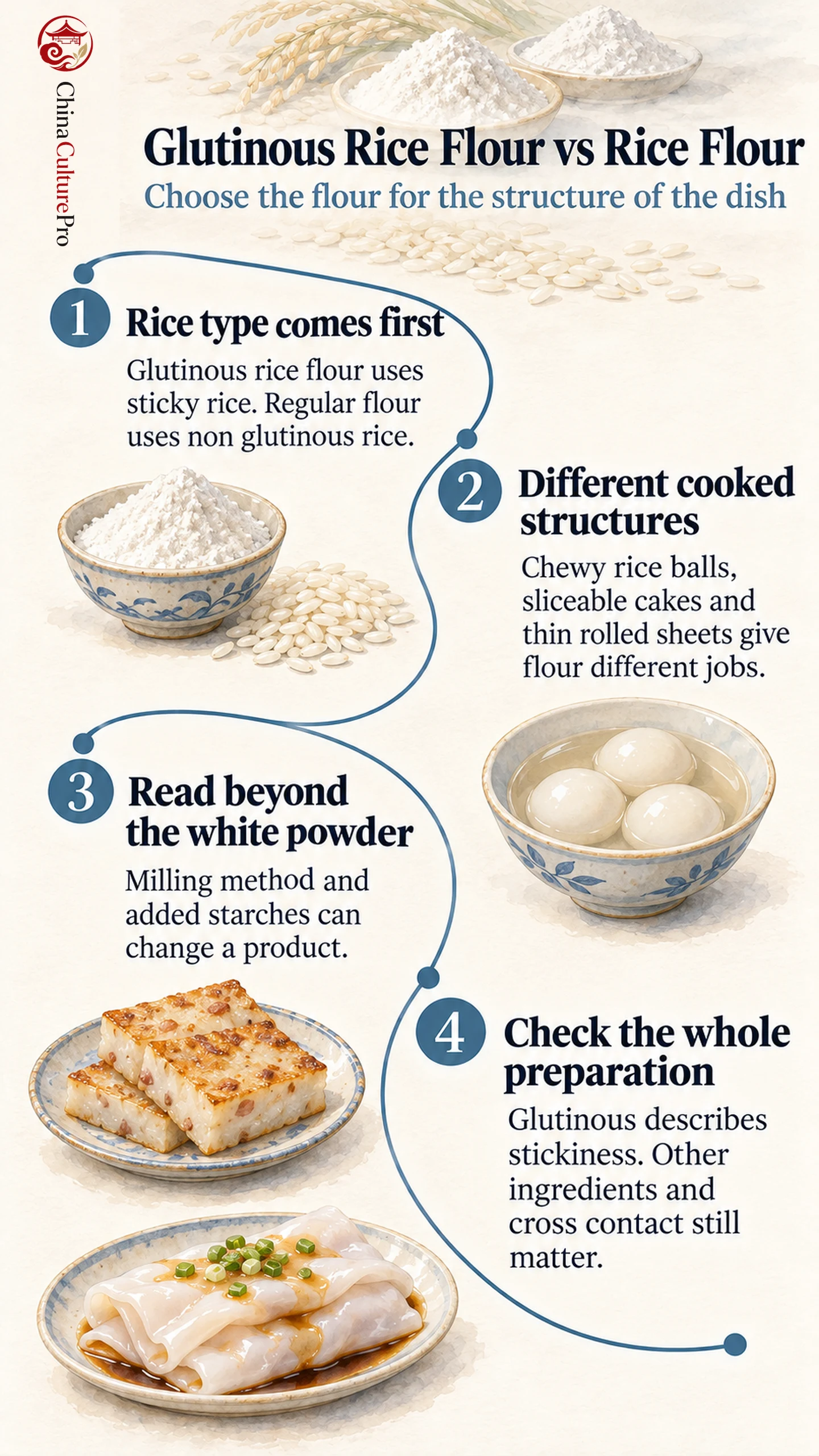
Two nearly identical white powders can produce very different Chinese foods. One can form a soft, chewy rice-ball wrapper; the other can help a savory cake hold a sliceable shape. Check the rice type before assuming that a bag labeled “rice flour” suits every rice-based dish.
Rice Type and Starch Structure Explain the Difference
Glutinous flour begins with sticky rice. The grain’s length is a separate characteristic: commercial glutinous flour can be milled from long- or medium-grain sticky rice as well as products associated with shorter-grain rice. “Short grain” alone is therefore not a sufficient identification rule. [1][2]
The starch balance helps explain why different rice flours behave differently. Glutinous rice has little amylose compared with many non-glutinous types. Controlled comparisons of rice-flour gels show that amylose content changes the structure and strength of the resulting network. This is more specific than saying that one flour is simply “stickier” or “stronger” in every possible food. [3]
The rice type and the preparation together determine the finished structure. A chewy rice-ball shell, a steamed sheet and a cooled cake are different structures. Water, heating, cooling and other ingredients affect what the flour becomes, so the rice type predicts a useful tendency rather than the entire final texture. [3][4][5]
Chinese Dishes Show Why the Choice Matters
These familiar examples give the flour a clear job. They describe particular preparations, rather than a rule that every version of a dish must use an identical formula.
| Chinese food | Flour’s role in the preparation |
|---|---|
| Tangyuan(汤圆,tāngyuán) | Glutinous rice flour forms a cohesive dough wrapped around filling and boiled into smooth, chewy balls. [4] |
| Turnip cake(萝卜糕,luóbogāo) | Regular rice flour can help form a firmer cake with radish, which is steamed, cooled and sliced. [5] |
| Cheung fun(肠粉,chángfěn) | Rice flour is used for steamed rolled sheets; added starches and the particular batter affect their texture. [1][6] |
In tangyuan, the wrapper and filling are separate components. A peanut filling supplies sweetness, nuts and fat, while the rice-flour dough supplies the enclosing shell. Calling the flour “sweet” does not mean that it replaces the filling’s sugar. [4]
A turnip cake example uses regular rice flour specifically for a firmer result. Radish, dried shrimp and sausage contribute the savory character, and slices can be pan-fried after steaming and cooling. That preference concerns this cake’s intended firmness; other formulas may target a different texture. [5]
Cheung fun illustrates another role: a thin rice sheet that rolls or folds around ingredients. Its smoothness should not be mistaken for the sticky chew of a filled rice ball. Similar pale appearances on the plate do not make the two flours equivalent.
Milling, Starch Blends and Packet Labels
Rice type and milling method answer different questions. A rice-flour producer may offer water-milled and dry-milled options. The words “rice flour” identify a broad material, while the milling specification and intended application help explain differences between packets or commercial products. [6]
Rice flour is also different from isolated rice starch. Milling a grain produces flour; extracting starch removes other components to produce a separate starch ingredient. A recipe or product can combine flour with additional starches to obtain a particular texture. Treat that blend as a formulation, not as proof that plain flour and extracted starch are two names for the same thing. [6]
Read the complete product name and ingredients. A packet that says “glutinous,” “sticky” or “sweet rice” is identifying the sticky-rice family. A premixed dumpling or cake flour may contain more than that one ingredient. Do not rely on bag color, a brand’s package design or an unlabeled bowl of white powder to settle the distinction. [1][2]
Substitution and Gluten Checks
Choose by the structure the dish needs. Replacing the glutinous flour in a rice-ball wrapper with regular flour changes the dough’s behavior. Replacing regular flour in a firm cake can move it toward a different eating texture. A tested recipe that deliberately blends flours is a different decision from an unplanned substitution. [1][4][5]
For more examples of how cake structure changes, see rice flour in Chinese cakes.
Plain rice is not a gluten-containing grain, including the glutinous type. But that fact does not certify every flour packet, premix or finished dish. Other ingredients and cross-contact still matter. Check the product’s gluten-free information and the complete preparation when that distinction is important. [7]
FAQs About Glutinous Rice Flour and Rice Flour
Does Glutinous Rice Flour Contain Gluten?
Plain glutinous rice flour is made from rice; “glutinous” describes stickiness. Check packaged products and finished dishes separately for other ingredients and cross-contact. [1][7]
Is Sweet Rice Flour Already Sweetened?
The name identifies flour from sticky rice, not an added-sugar mixture. A plain product and a sweetened premix are different things, so read the ingredient list. [2][4]
Can You Replace One Rice Flour with the Other?
Expect a changed texture rather than an equivalent result. Select the flour specified for the dish, or use a preparation developed for the alternative type. [1][5]
Sumber
[1] The Woks of Life Editorial Team. Rice Grains Flours and Starches: Rice Flour Sections
[2] Burapa Prosper. Glutinous Rice Flour: Soft and Sticky
[3] Jinmu Tian and colleagues. The Role of Amylose in Gel Forming of Rice Flour
[4] Maggie Zhu. Tang Yuan: Sweet Rice Balls with Peanut Butter Filling
[5] Daddy Lau. Chinese Turnip Cake
[6] Thai Flour Industry. Flour and Starch: Original Product Types
[7] US Food and Drug Administration. Questions and Answers on Gluten Free Food Labeling
[8] Choina BV. Rice Flour: Wholesale Product Identity