


Quick Answer: Who Was Dong Qichang?
Dong Qichang (董其昌, Dǒng Qíchāng; 1555–1636) was a painter, calligrapher, connoisseur and theorist of the late Ming dynasty (明朝, Míng Cháo). He advocated a creative engagement with older art: studying earlier masters could become a means of developing a new brush language rather than producing a literal replica.[1][2]
- Works: Landscapes and calligraphy reveal different ways of interpreting inherited models.
- Gaya: Brush movement, ink contrasts and the arrangement of forms shape the image.
- Theory: His historical classification of painting helped establish an influential artistic canon.[1][2][7]
His theory expresses historical preferences; it is not a neutral ranking of every kind of Chinese painting.
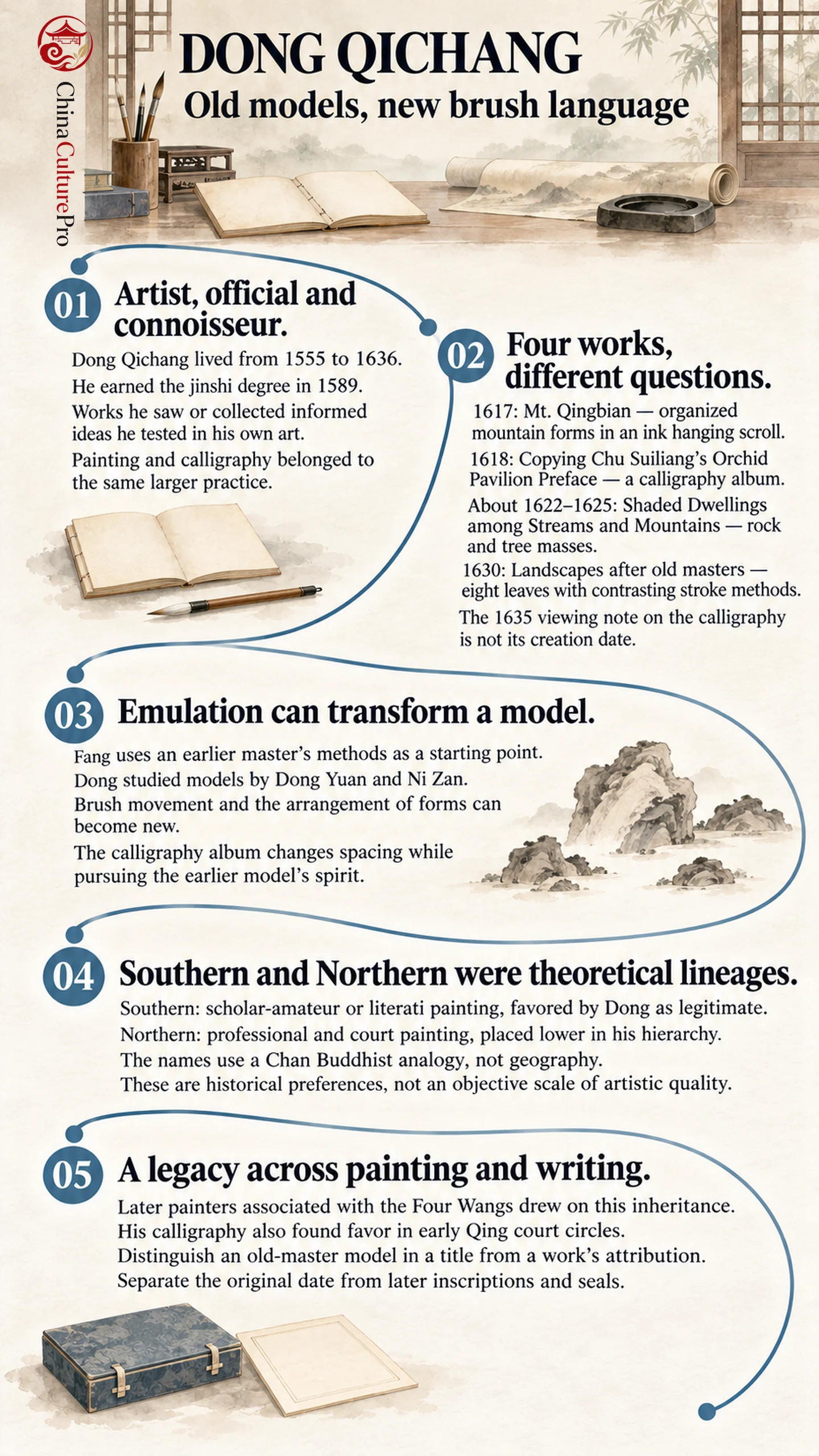
Dong Qichang’s mountains can seem as carefully arranged as a page of writing. Looking at individual works makes that relationship clearer. His paintings and calligraphy also explain how studying old models could support innovation, while his writings shaped which models later artists valued.
A Scholar-Official and Connoisseur
He came from Huating (华亭, Huátíng), in the Songjiang (松江, Sōngjiāng) area of modern Shanghai (上海, Shànghǎi). He earned the jinshi (进士, jìnshì) degree in 1589 and served as an official. Collecting and examining earlier works accompanied his own painting and calligraphy.[1]
Studying works he saw or owned helped him turn connoisseurship into ideas he could test through painting and writing.[1]
Four Works in Painting and Calligraphy
These works let you compare a date, a format and a particular artistic problem.[2][3][4][5]
| Work | Date and format | Aspek perbandingan |
|---|---|---|
| Mt. Qingbian (青弁图, Qīngbiàn Tú) | 1617; hanging scroll (立轴, lìzhóu), ink on paper. | Mountain forms become a strongly organized pictorial structure. |
| Copying Chu Suiliang’s Orchid Pavilion Preface (临褚遂良兰亭叙, Lín Chǔ Suìliáng Lántíng Xù) | 1618; calligraphy album (册页, cèyè). | An earlier calligraphic model is interpreted through a new arrangement. |
| Shaded Dwellings among Streams and Mountains (溪山樾馆图, Xīshān Yuèguǎn Tú) | About 1622–1625; hanging scroll, ink on paper. | Rock and tree masses carry a calligraphic rhythm. |
| Landscapes after old masters (山水图, Shānshuǐ Tú) | 1630; an album of eight leaves, ink on paper. | Contrasting stroke methods evoke different earlier styles. |
The 1618 calligraphy album also bears a later viewing inscription from 1635. That annotation records another encounter with the work; it should not replace the creation date. Likewise, an approximate range such as 1622–1625 should remain a range.[2][5]
Emulating Old Masters through Brush and Structure
Fang (仿, fǎng), or creative emulation, uses an earlier master’s methods as a starting point for a new work. The title Landscapes after old masters describes this engagement; the catalogue still identifies Dong as its artist. Its first leaves explore contrasting approaches associated with Ni Zan (倪瓒, Ní Zàn): rounded, parallel marks and more angular, oblique ones.[1][3]
Shaded Dwellings takes a work by Dong Yuan (董源, Dǒng Yuán) as a model. Its arrangement of rock and tree masses makes landscape a field of brush movement and structural relationships. Mt. Qingbian similarly emphasizes the organization and momentum of mountain forms, rather than offering a continuous descriptive view.[2][4]
The 1618 album interprets a Chu Suiliang version of Wang Xizhi (王羲之, Wáng Xīzhī)’s preface. Its line spacing changes while the brush handling pursues the model’s spirit. This connects calligraphy and painting through the reorganization of inherited forms.[5]
What the Southern and Northern Schools Meant
The Southern and Northern Schools (南北宗, nánběi zōng) describe lineages in a theory of painting. The terms use an analogy with Chan Buddhism (禅宗, Chánzōng), rather than a geographical division.[6]
| Category in Dong’s theory | Associated tradition | His valuation |
|---|---|---|
| Southern School (南宗, nánzōng) | Scholar-amateur or literati painting (文人画, wénrénhuà). | Favored as the legitimate lineage. |
| Northern School (北宗, běizōng) | Professional and court-academy painting. | Placed lower within his hierarchy. |
These were historical value judgments, not an objective scale of quality or a map of artistic exchange.[6]
Influence on Later Painting and Calligraphy
His ideas became important to later painters, including those associated with the Four Wangs (四王, Sì Wáng) in the Qing dynasty (清朝, Qīng Cháo). His influence reached beyond a single group or one way of using ink. His calligraphy also found favor in early Qing court circles.[1][7]
His legacy joins making, collecting and explaining art. When reading a work, distinguish its title’s reference to an earlier model from its attribution, and separate its creation date from later inscriptions and seals. These distinctions help preserve both his inventive practice and the evidence for a particular object.[1][5][7]
FAQs About Dong Qichang
Does “after old masters” mean a forgery?
Here the title signals creative engagement with earlier models, not automatically a forgery.[3]
Were the Southern and Northern Schools geographical?
No. They are theoretical lineages, using a Chan analogy, rather than divisions based on artists’ addresses.[6]
Was Dong Qichang also a calligrapher?
Yes. The 1618 album after the Orchid Pavilion Preface is one example of his calligraphic practice.[5]
Are Dong Qichang and Dong Yuan the same painter?
No. Dong Yuan was a much earlier master whose work Dong Qichang studied. They are different artists.[2]
Sumber
[1] National Palace Museum. Synthesis and Departure in Tradition: Introduction
[2] Metropolitan Museum of Art. Shaded Dwellings among Streams and Mountains
[3] Metropolitan Museum of Art. Landscapes after old masters
[4] Cleveland Museum of Art. Mt. Qingbian
[5] National Palace Museum. Copying Chu Suiliang’s Orchid Pavilion Preface
[6] National Gallery of Victoria, Mae Anna Pang. An Orthodox Master and an Individualist: Wang Yuanqi and Daoji
[7] Shanghai Museum. The Ferryman of Ink World: Dong Qichang’s Calligraphy and Painting Art