
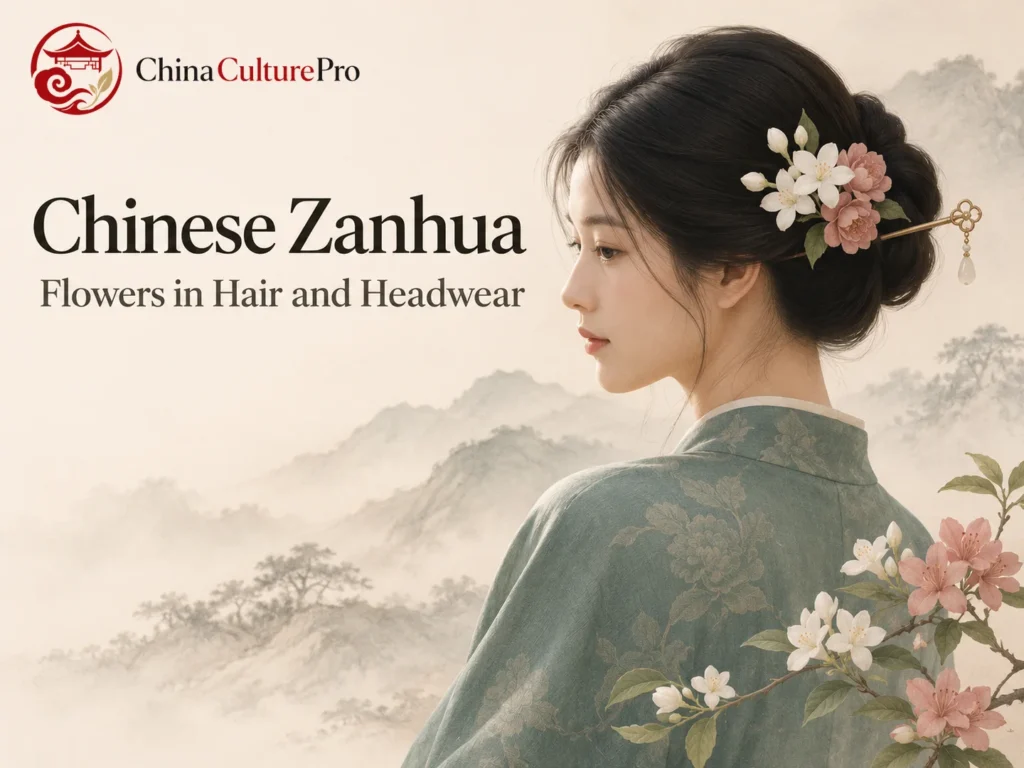

Quick Answer: What Is Zanhua?
Zanhua (簪花, zānhuā) means wearing flowers in the hair or on headwear. A person might tuck a fresh flower into a bun, pin on a silk imitation or wear flowers on a crown. A flower ring (簪花围, zānhuāwéi) around a bun is a distinctive form associated with Xunpu in Fujian.[1][2][3][4]
- Materials: Historical accounts document real blossoms and flowers made from silk and other materials.[3]
- Placement: Flowers can sit in the hair, on a cap or on a crown-like support.[1][3]
- Occasions: Song court flower wearing could mark imperial favor. Xunpu’s flower rings form part of a regional custom.[3][4]
The setting matters when interpreting why a person wore a particular arrangement.

A flower above an ear, a flower pinned to a cap and several rows of blossoms around a bun look quite different. The setting and support can help identify a court ornament, a regional hairstyle or an arrangement made for a modern portrait.
Fresh Flowers, Silk Flowers and Their Supports
A fresh bloom has a stem and changes as it wilts. Crafted petals can be attached to a support, and makers can combine flowers that would bloom in different seasons. Accounts of Song dress describe flowers made from different kinds of silk cloth. They also describe headdresses that brought the flowers of several seasons together.[1][3]
A single bloom can be held in gathered hair. With a cap or built headpiece, the base supports the decoration. In a picture, look for flowers beside a pin, along the edge of a cap or around the hair itself. The guide to Chinese traditional hairstyles shows the different forms a bun and its support can take.
Flower Wearing in Paintings and Song Records
The Liaoning Provincial Museum holds the handscroll known as Court Ladies Wearing Flowers (簪花仕女图, Zānhuā Shìnǚ Tú), traditionally attributed to the Tang painter Zhou Fang. Women in the picture wear prominent blossoms high on their hair. The painted petals show the size and placement of the decoration without establishing what the blossoms were made from.[2]
Song court officials could receive flowers at an imperial banquet, wear them and formally give thanks. The History of Song distinguishes flowers made of Chinese silk gauze, distributed to court officials, from flowers of plain silk for military officers at and below a specified rank. The written dress rules tell us something a portrait cannot, namely who was meant to receive each type. Palace attendants placed flowers on the ruler, princes and senior officials, while other officials put on their own. The rules also expected recipients to keep the flower on as they left. Who placed the flower, what it was made of and when it was worn all helped communicate rank and participation in the ceremony.[3]
Flower wearing was also seasonal. A Zhejiang account describes jasmine at the Dragon Boat Festival and flower coronets with blossoms representing all four seasons. On a four-seasons coronet, a spring blossom and an autumn chrysanthemum could appear side by side because the flowers were crafted from materials such as silk, paper and plant pith.[3]
Xunpu Flower Rings in Quanzhou
In Xunpu and nearby communities in Quanzhou’s Fengze District, women have worn strings of flowers around a round bun. A Quanzhou consultation draft describes gathering hair at the back, fixing the round bun with a pin and wearing the flower strands in concentric rings. That is a description of a local construction, useful when a front portrait shows flowers but hides the bun. The number of strands varies with the season, local custom and personal preference. Seen from behind, the loops sit around a center formed by the hair. That shape explains why the arrangement has its own name within the broader practice of wearing flowers.[4][5]
The customs of Xunpu women entered China’s national intangible cultural heritage list in 2008. The listed practice covers dress and other aspects of local life. Studios today offer arrangements for visitor photographs. For the local arrangement and the role of the bun, see Xunpu flower headdresses. For the different work head ornaments do during weddings, see Quanzhou bridal headdresses.[4][6]
FAQs About Chinese Zanhua
Does zanhua have to use real flowers?
Both fresh and crafted flowers are documented. A historical account or catalog description may identify the material more precisely than a photograph can.[1][3]
Did men wear flowers in historical China?
Yes. At Song imperial banquets, male officials received and wore flowers as part of court practice.[3]
Is every zanhua arrangement called zanhuawei?
Zanhua refers broadly to wearing flowers. In Xunpu, zanhuawei names an arrangement in rings around a bun.[1][4][5]
Sumber
[1] Beijing Art Museum. A Lecture on Flower Wearing
[2] Liaoning Provincial Museum via Google Arts & Culture. Court Ladies Wearing Flowers
[3] Zhejiang Federation of Humanities and Social Sciences. Flower Wearing in the Song Dynasty
[4] China Intangible Cultural Heritage Digital Museum. Customs of Xunpu Women
[5] Quanzhou Municipal Government. Xunpu Flower Headdress Craft, Consultation Draft
[6] China Daily. Popularity of Zanhua Lifts Incomes of Local Residents in Quanzhou