


Quick Answer: Who Shaped Chinese Archaeology?
Women helped build Chinese archaeology through field surveys, excavation, museum work, conservation and laboratory research. Their contributions are visible in reports on buried sites, records of monuments and studies of tiny traces preserved on artifacts.[1][2][3][4][5]
- Museums: Zeng Zhaoyu (曾昭燏, Zēng Zhāoyù) helped connect archaeological excavations to museum research and exhibitions.[1][2]
- Fieldwork: Zheng Zhenxiang (鄭振香, Zhèng Zhènxiāng) helped establish the site chronology at Anyang and led work at the tomb of Fu Hao (婦好, Fù Hǎo).[1][3]
- Conservation and science: Fan Jinshi (樊錦詩, Fán Jǐnshī) advanced cave documentation, and Liu Li (劉莉, Liú Lì) helped apply residue analysis to ancient pottery.[4][5][6]
These careers show several routes into archaeological research. A project’s institutional byline may name the organization even when individual contributions can be traced.[1]
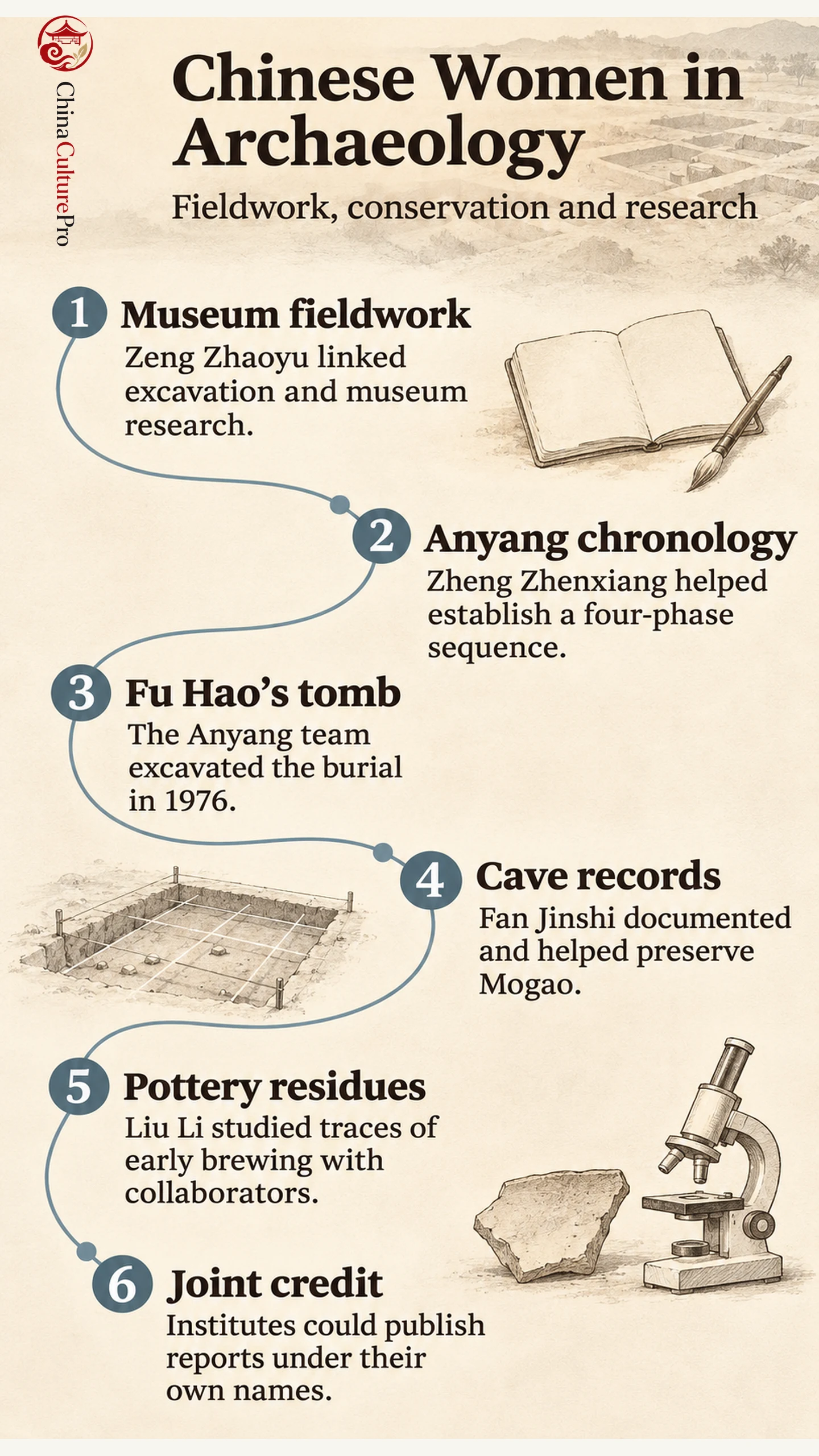
An excavated tomb, a numbered cave and a pottery fragment leave different records. Following the work behind each makes it easier to see who contributed and what the evidence established.
Zeng Zhaoyu and Museum-Led Excavation
Zeng studied at Nanjing Central University and University College London, where she trained in excavation methods. On returning to China, she took part in early archaeological work in the southwest. A 1942 report on research around Cangshan and Erhai in Yunnan lists her alongside fellow excavators Wu Jinding and Wang Jiechen. She went on to hold senior posts at the Nanjing Museum.[1]
A joint investigation by the museum and Nanjing’s municipal cultural relics committee identified two Southern Tang royal tombs in 1950. The team identified them as the tombs of rulers Li Bian and Li Jing. Zeng worked with the museum’s team during the excavations, which extended into early 1951. The museum also exhibited objects from the project. Field investigation, publication and the display of finds formed different parts of the same institutional work.[1][2]
Zheng Zhenxiang and the Anyang Excavations
After completing graduate study in 1959, Zheng joined the Institute of Archaeology. At Wangwan near Luoyang, she helped train students while leading fieldwork. She joined the Anyang team in 1962 and helped organize the archaeological evidence at Yinxu (殷墟, Yīnxū) into a four-phase sequence. This kind of local chronology groups material remains into successive periods at a site. It complements the reigns and dynasties used in Chinese historical chronology.[1]
In 1976, the Anyang team excavated Fu Hao’s tomb. The intact burial preserved a group of objects whose associations could be studied together. In a published study, Zheng recorded 190 inscribed bronze vessels, including 109 with an inscription she classified under Fu Hao’s name. The count of 109 represents a single inscription group. The 190 is the count of inscribed vessels, a subset of the full assemblage. The study shows the interpretive work that followed the excavation.[1][3]
Fan Jinshi and Recording the Mogao Grottoes
Fan trained in archaeology at Peking University before working at Dunhuang in Gansu. Her work included a report on caves 266 through 275 of the Mogao Grottoes (莫高窟, Mògāokū). A numbered cave report records individual structures and the artworks they contain as parts of an existing complex.[1][4]
Fan also advanced the Digital Dunhuang project, which made cave imagery available for research and public access. A digital record lets people examine the paintings away from the physical site. The academy’s preservation work addresses the physical caves alongside their documentation.[1][4]
Liu Li and Evidence from Pottery Residues
Liu’s research includes archaeological evidence preserved as tiny residues on tools and vessels. A 2024 paper with Liu as first author examined residues on pottery at Shangshan (上山, Shàngshān), Zhejiang. The collaborative study reported evidence of rice-based brewing in material dated to about 10,000 to 9,000 years ago. The researchers compared starch, microscopic silica bodies from plants and traces of fungi from pottery and related samples.[5][6][7]
The interpretation depends on the relationship between residues, pottery use and context. A single fragment’s shape can suggest a possible use. Microscopic traces provide another line of evidence about the activities that took place there.[5][6]
Why Fieldwork and Authorship Tell Different Stories
Some excavation reports appeared under a museum or institute’s name. The 1980 report on Fu Hao’s tomb is an example. The institutional credit records responsibility for a joint project, while other records can identify what team members did. In this case, Zheng and her colleague Chen Zhida helped write the report.[1]
A scholarly review of the profession also distinguishes women’s participation in training from access to field leadership and senior posts. The record of who gained a post, led a team or signed a paper answers a different question from the record of who participated. Reading the project report alongside biographies and later studies makes it possible to recognize specific work without assigning a joint discovery to one person.[1]
FAQs About Chinese Women in Archaeology
Was Zeng Zhaoyu the First Woman Archaeologist in China?
She was an early professionally trained archaeologist and museum leader. Other women contributed to surveys, fieldwork and the study of inscriptions, so a claim of first depends on which kind of work and which credentials are being counted.[1]
Who Excavated the Tomb of Fu Hao?
The Anyang archaeological team excavated it in 1976, with Zheng Zhenxiang in a leading role. Zheng and Chen Zhida also worked on the excavation report issued under their institute’s name.[1][3]
Why Do Excavation Reports Sometimes List an Institution?
An institution may publish a report on a collective excavation. To trace individual roles, look for the project’s personnel record, the report’s credits and separate papers analyzing its finds.[1][3]
Sumber
[1] Anke Hein, Jade d’Alpoim Guedes, Kuei-chen Lin and Mingyu Teng. Female Scholars and Their Contributions to Chinese Archaeology
[2] Nanjing University Alumni Association. 怀想曾昭燏
[3] Zheng Zhenxiang. The Si-Tu (“Qiao”)-Mu Inscriptions Excavated from the Fu Hao Tomb
[4] Peking University. Fan Jinshi: The Daughter of Dunhuang
[5] Chinese Academy of Sciences. Traces of 10,000-Year-Old Ancient Rice Beer Discovered in Neolithic Site in Eastern China
[6] Henan Museum. 刘莉教授
[7] Liu Li and colleagues. Identification of 10,000-Year-Old Rice Beer at Shangshan in the Lower Yangzi River Valley of China