


Quick Answer: What Were Chinese Village Granaries?
Chinese village granaries held grain close to the households that grew or used it. A store could serve one family, contain separate compartments for several families or hold grain managed for a wider community. The building’s location tells you how it fits the village, while its divisions and records can help explain who used it.[1][2][3][4]
- At the edge: Some Dong villages placed grain stores apart from wooden houses.[1][2]
- Inside: A shared building can contain distinct compartments.[2]
- In the records: Some village reserves lent grain before the next harvest.[3][4]
A cluster of small buildings can contain separately held grain. The doors and partitions help distinguish individual stores within it.[1][2][4]
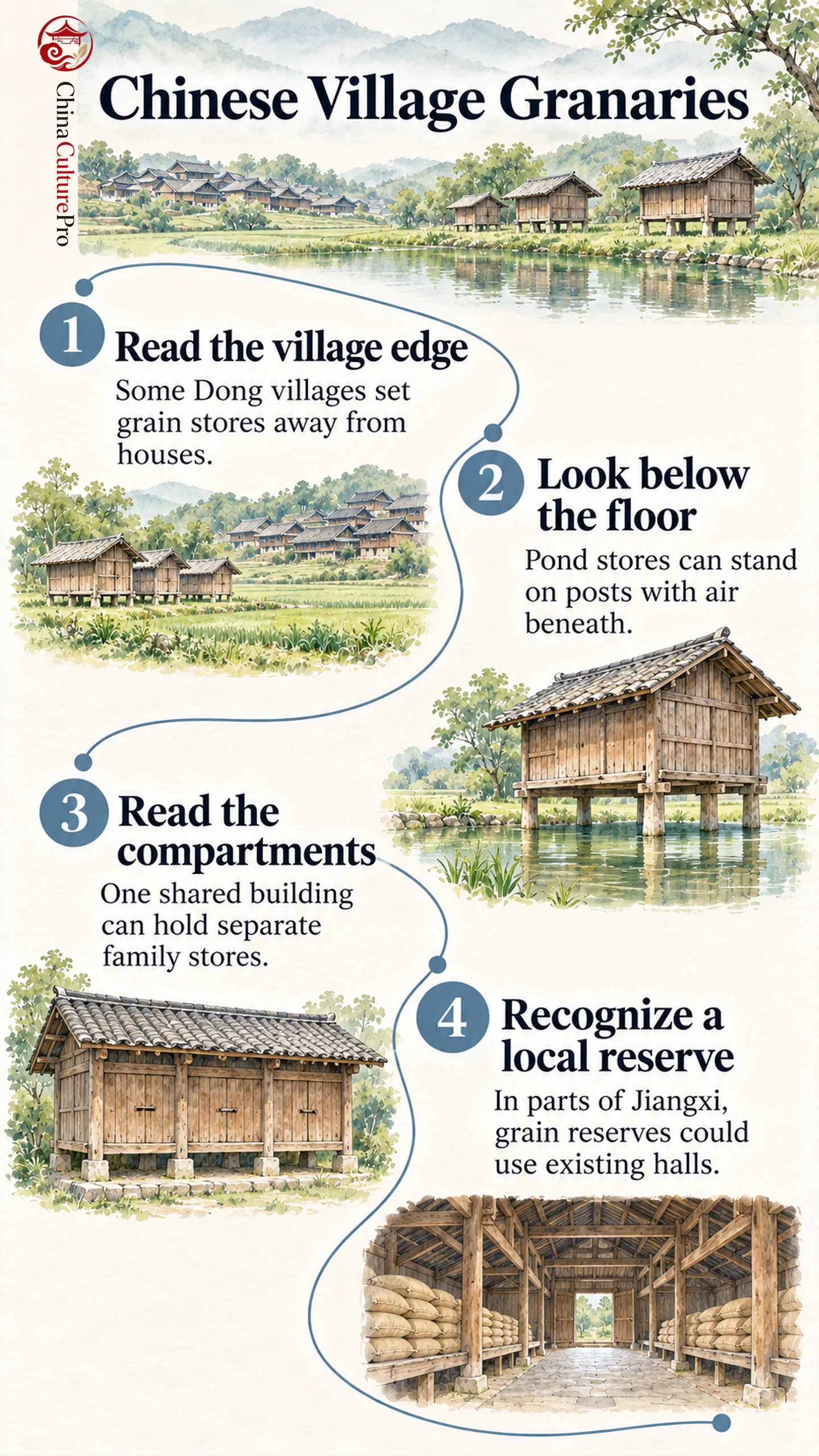
At Dimen and Dengcen in Guizhou, the relationship of houses, ponds and fields helps explain where grain was kept. In Jiangxi, records of lending explain what some village stores were for.[1][2][3][4]
Why Some Stores Stand at the Village Edge
A study of Dimen in Guizhou describes small timber granaries with gabled roofs near the village fringe and rice fields. Some stores stand raised above ponds. The raised position leaves air beneath the floor, while distance from houses separates the grain from the densely built residential area.[1][2]
In Dengcen, a study documents granaries on ponds formed from a creek in a small valley north of the houses. Residents understood the separation as a way to reduce the risk of a house fire reaching the stored grain. The creek passes through the ponds in succession. The ponds and raised stores form a group apart from the houses.[2]
One Building Can Hold Several Family Stores
The research on Dimen describes family ownership as common. A study of Dengcen also records a two-storey granary divided into seven storage units and shared by seven families at the time of the survey. Internal partitions separate the units within one outer frame and roof. A shared structure can therefore keep each family’s grain separate.[1][2]
The same Dengcen study records granaries with and without attached racks. Hanging glutinous rice to dry was a separate job from storing it. A rack on the side of a store shows how the building could support both stages.[2]
Community Reserves and Reused Buildings
A community granary (社仓, shècāng) served a different purpose from a cluster of household stores. A study of Jiangxi village granaries cites a 1930 investigation in Xingguo County that documented grain loans to poorer households before harvest. The stored grain provided a local reserve that could be accessed under an established arrangement.[3][4]
A survey of the middle and lower Fu River region describes some rural reserves using space in ancestral buildings. An existing hall could accommodate grain without a separate storehouse, making historical use important when identifying a building’s role in Chinese architecture.[3]
FAQs About Chinese Village Granaries
Why are some Dong granaries built over ponds?
In the documented Guizhou villages, raised floors allow air underneath and pond locations separate the stores from many timber dwellings.[1][2]
Did a shared building mean the grain was pooled?
A shared structure can contain separate family stores. A granary documented at Dengcen had seven units used by seven families.[2]
How did a community reserve help before harvest?
One recorded use was lending grain to poorer households before the new crop was ready.[4]
Sumber
[1] Nikolaus Punzengruber, TU Wien. The Contemporary Vernacular in Flux
[2] Shuyin Dong, TU Wien. Wooden Granaries of South China
[3] Journal of Asian Architecture and Building Engineering. Traditional Granaries in the Middle and Lower Reaches of the Fu River
[4] CiNii Research. A Survey of Community and Charitable Granaries in Jiangxi Villages