


Quick Answer: What Is a Taiwanese Street House?
A Taiwanese street house, or jiewu (街屋, jiēwū), is a building that faces the street and can extend well behind a narrow front. In the historic Dadaocheng (大稻埕, Dàdàochéng) district of Taipei, some street houses had shops toward the street and living rooms farther back or upstairs.[1][2][3]
- Front: A shop opens toward the street. Some buildings have a covered arcade outside the shopfront.[1][2]
- Depth: Rooms can extend through successive building sections on the same plot.[2][4]
- Openings: A small internal court can separate parts of a deep house and bring daylight inside.[1][4]
The examples below reflect commercial neighborhoods within the wider building history of Taiwan.
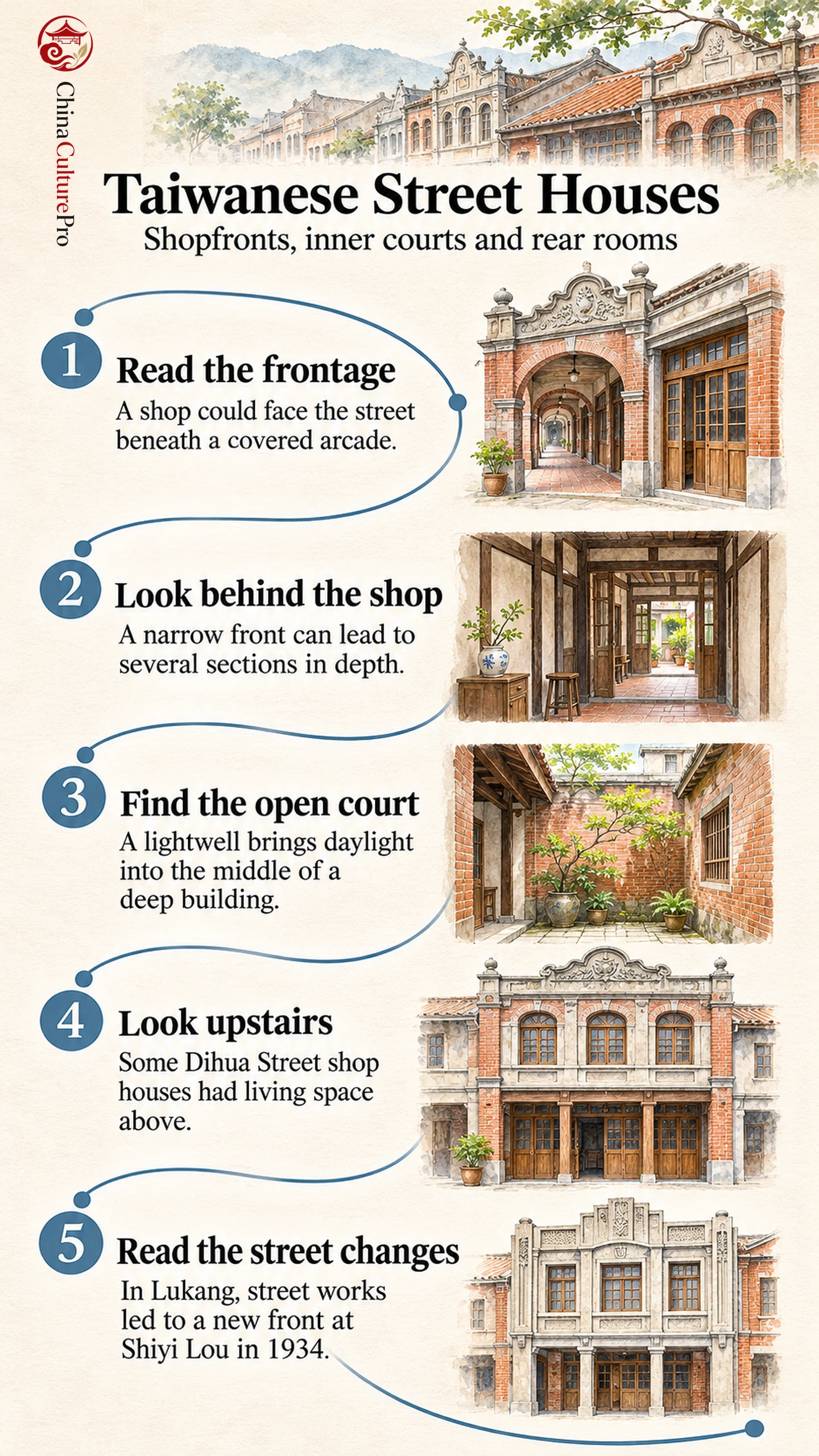
The width of the front door and windows tells you little about the full size of a street house. The business could occupy the visible frontage, while the household used the space beyond it. A stair or open court can help you see how the building continues behind the shop.
How a Narrow Front Opens Into a Deep House
In one documented pattern on Dihua Street (迪化街, Díhuà Jiē), the shop came first. A tianjing (天井, tiānjǐng), or small open court, interrupted the depth before the rear living rooms. The account also records rear sections used for storage in its account of later uses.[1] A rural Taiwanese sanheyuan organizes rooms around a wider front court.
Two Street Houses on Dihua Street
The heritage register describes No. 114 as a narrow two-storey building with two sections in depth, an arched arcade and a facade with molded ornament. The same record identifies it as an early completed restoration in the district and notes that timber stairs and doors survive.[2]
The record for No. 121 and its neighbors describes three linked shop bays at ground level and connected living space upstairs. The connected upper floor shows how several shop bays could share living space above.[3]
Lukang and Sanxia Show How Facades Changed
In Lukang (鹿港, Lùgǎng), the register describes Shiyi Lou (十宜樓, Shíyí Lóu) as a merchant residence with four sections in depth and an interior court. Road works in 1934 led to rebuilding the front section. Much of the underlying plan survived.[4] The new street face and the older parts behind it therefore record different phases.
Sanxia (三峽, Sānxiá) in New Taipei underwent its own street reconstruction in 1916. Its red-brick arcades offer a comparison with the sheltered walks of Lingnan qilou, while its facades reflect the local rebuilding history.[5]
FAQs About Taiwanese Street Houses
Does Every Street House Have an Arcade?
An arcade is one possible treatment of the street edge. Several historic examples have arched covered passages, while their depth and room layout vary.[2][5]
What Is the Opening in the Middle?
A tianjing is an open court or lightwell within a deep building. It can bring light and air to rooms farther from the street.[1][4]
Did People Live Behind the Shop or Above It?
Both arrangements are documented. Dihua Street accounts describe rear living rooms in some properties and upper-floor living space in others.[1][3]
Sumber
[1] Taiwan Ministry of Agriculture, Agricultural Knowledge Portal. Commerce and Everyday Life on Dihua Street
[2] Bureau of Cultural Heritage, National Cultural Heritage Database. Dihua Street No. 114 Shophouse
[3] Bureau of Cultural Heritage, National Cultural Heritage Database. Dihua Street No. 121 Shophouse
[4] Bureau of Cultural Heritage, National Cultural Heritage Database. Shiyi Lou in Lukang
[5] Sanxia District Office, New Taipei City. Sanxia Old Street