
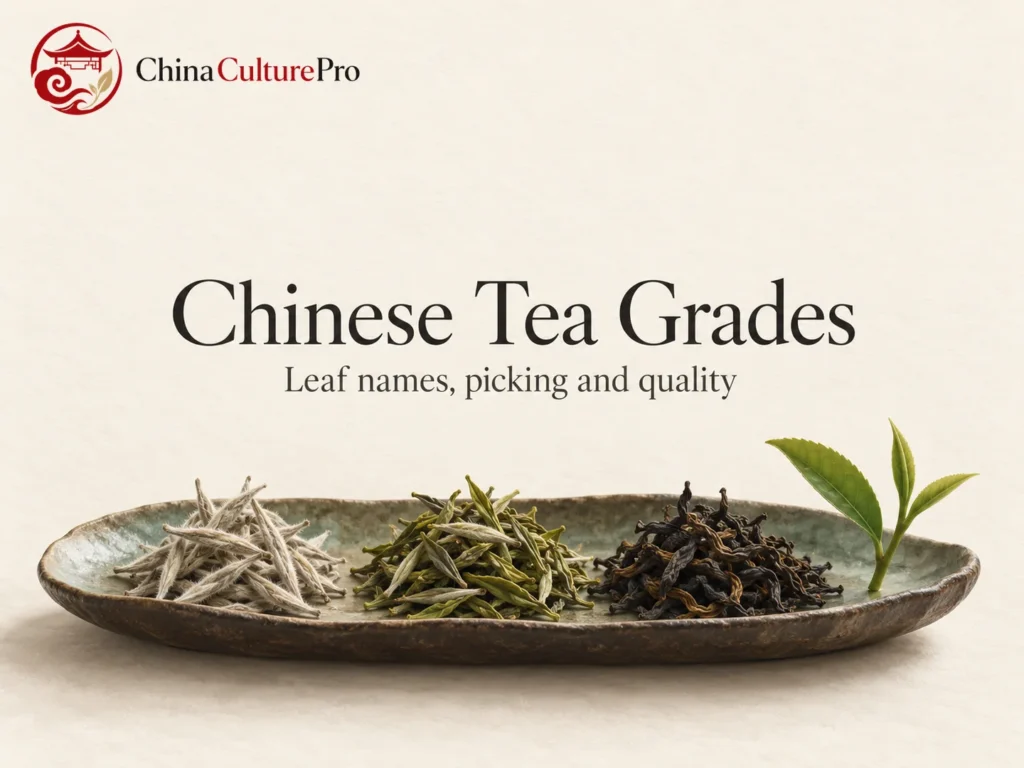

Quick Answer: What Do Chinese Tea Grades Tell You?
Chinese tea grades classify a particular product or material under a stated system. They do not create one ladder on which every tea can be ranked. A label becomes useful when you know the tea type, what was assessed and which criteria were applied.
- Grade: A position within a named product’s grading scheme.
- Picking: The bud-and-leaf material selected, which may help define a tea style.
- Context: Origin, season, processing, storage and brewed flavor remain separate information.
A higher stated grade within the same valid system can be meaningful. It does not automatically outrank a different tea whose style and grading criteria are unrelated.

A packet can name a grade, a picking standard and a harvest season without those words meaning the same thing. Reading them separately makes a comparison more useful than chasing the most impressive adjective. This guide explains the labels found across Chinese tea.
A Grade Needs a Named Product and Grading System
Teji (特级, tèjí) means special grade; yiji (一级, yījí) means first grade. Identify the tea and the grading system before comparing the words. Product standards and producer schemes may consider appearance and sensory qualities, with different criteria for different tea styles.
For a concrete example, a published 2008 pu-erh (普洱茶, pǔ’ěr chá) processing record divides the sun-dried input tea into eleven grades. That classification concerns a particular material at a particular production stage; it is not eleven universal quality levels for all finished cakes. The raw and ripe pu-erh distinction explains why the manufacturing stage matters.[1]
International letters are another system. The Sri Lankan trade nomenclature describes OP as a whole-leaf form and distinguishes it from broken-leaf grades. Such letters cannot be converted mechanically into Chinese special or first grade. Nor does an English marketing word such as premium reveal the assessment criteria by itself.[5]
Picking Standards, Leaf Names and White Tea Types
A picking description such as one bud with one leaf describes the shoot material. Bud-only, bud-and-leaf and more mature leaf suit different processing goals. The tenderest-looking material is not automatically the right material for every finished tea.
| Named tea | Material or appearance clue | What it illustrates |
|---|---|---|
| Silver Needle (白毫银针, báiháo yínzhēn) | A white-tea product associated with bud material and visible fine hairs. | Its product name does not replace a grade within that product. |
| White Peony (白牡丹, bái mǔdān) | A white-tea product with buds and attached leaves. | Leaves are an intentional part of this product style; evaluate its own criteria. |
| Taiping Houkui (太平猴魁, Tàipíng hóukuí) | A green tea recognized by two leaves embracing a bud. | A valued named tea need not consist of buds alone. |
The Fujian agricultural description discusses special-grade Silver Needle within its product account. That is a useful example of product type and grade coexisting, rather than four white-tea names forming one universal quality ladder.[4] The Taiping Houkui guide examines its distinctive leaf form separately.[7]
Whole, broken, rolled and needle-shaped describe condition or form. They should be read alongside the intended style. Fine hairs on buds and young leaf are also a physical feature, not a complete tasting score or a guarantee about an unidentified packet.
Harvest Terms Are a Different Axis
Mingqian (明前, míngqián) refers to tea picked and made before Qingming (清明, Qīngmíng). Yuqian (雨前, yǔqián) means before Grain Rain (谷雨, Gǔyǔ); in the familiar spring comparison it describes the window after Qingming and before that later solar term. These are seasonal labels rather than translations of special and first grade.[3]
Do not turn a regional spring calendar into a universal schedule for every tea. Official production guidance calls for harvesting according to local bud development, cultivar and garden conditions. A packet’s year and actual picking information still matter.[6] The tea harvest seasons guide explains the broader calendar.
Judge the Appearance and the Cup Together
The Taiwan TAGs method builds criteria for a particular assessment. Its four lenses examine both dry leaf and the brewed cup, rather than establishing one China-wide grade.[2]
- Penampilan: Look at dry-leaf color, shape and uniformity.
- Liquor color: Observe the infusion’s color and brightness.
- Aroma: Notice fragrance character and intensity.
- Rasa: Consider flavor balance, mouthfeel and aftertaste.
For your own comparison, use similar working water volumes and weighed doses, record the tea’s instructions and compare like with like. A glazed pot or gaiwan can make the leaves and liquor easy to inspect. Personal preference still matters: a technically higher grade can differ from the flavor you want.
Storage can also change the cup after grading. The tea storage guide explains why an impressive original label cannot protect an opened packet from dampness or odors.
How to Read a Grade on a Tea Label
- Identify the product: Find the actual tea name and processing style before comparing grade words.
- Locate the grade basis: Look for a stated grade and the product standard or producer scheme used. Ask what its criteria assess.
- Separate other labels: Record picking material, origin, harvest season and year as distinct fields. Do not treat any one as a substitute for grade.
- Check the condition: Consider packaging integrity and storage information alongside the dry leaf and any brewed sample.
- Compare within context: Compare similar teas under similar brewing conditions, then decide whether the flavor and price suit you.
These checks organize the information; they do not authenticate a product from its printed words alone. The tea authenticity guide addresses origin and product claims in more detail.
FAQs About Chinese Tea Grades
Does special grade always beat first grade?
Only compare them within the same applicable grading system and product. A special-grade label on one tea does not automatically outrank a first-grade label on a different style.
Are buds always better than leaves?
No. Buds and leaves serve different tea styles. White Peony and Taiping Houkui intentionally include leaves; their material should be judged against their own product requirements.
Do OP and BOP apply to every Chinese tea?
No. They belong to particular international trade grading conventions, often describing leaf form and size. They are not a universal conversion table for Chinese product grades.
Does Mingqian mean the tea was harvested this year?
No. It describes a seasonal window relative to Qingming, not the year. Check the harvest year and storage history separately.
Sumber
[1] Original national product-protection record. 普洱茶地理标志产品保护公告(2008年第60号)
[2] Taiwan Tea TAGs flavor platform, original method. TAGs鑑別方法
[3] Nanchang University food-science and Jiangxi testing experts, original consumer notice. 春茶知识知多少
[4] Fujian Provincial Department of Agriculture and Rural Affairs. 白茶种类都有哪些?
[5] Tea Exporters Association Sri Lanka, original nomenclature. Tea Grade Nomenclature
[6] Ministry of Agriculture and Rural Affairs, production guidance. 2022年春茶生产技术指导意见
[7] Huangshan Municipal Government, local production report. 太平猴魁开园