


Quick Answer: How Can You Assess Chinese Tea Authenticity?
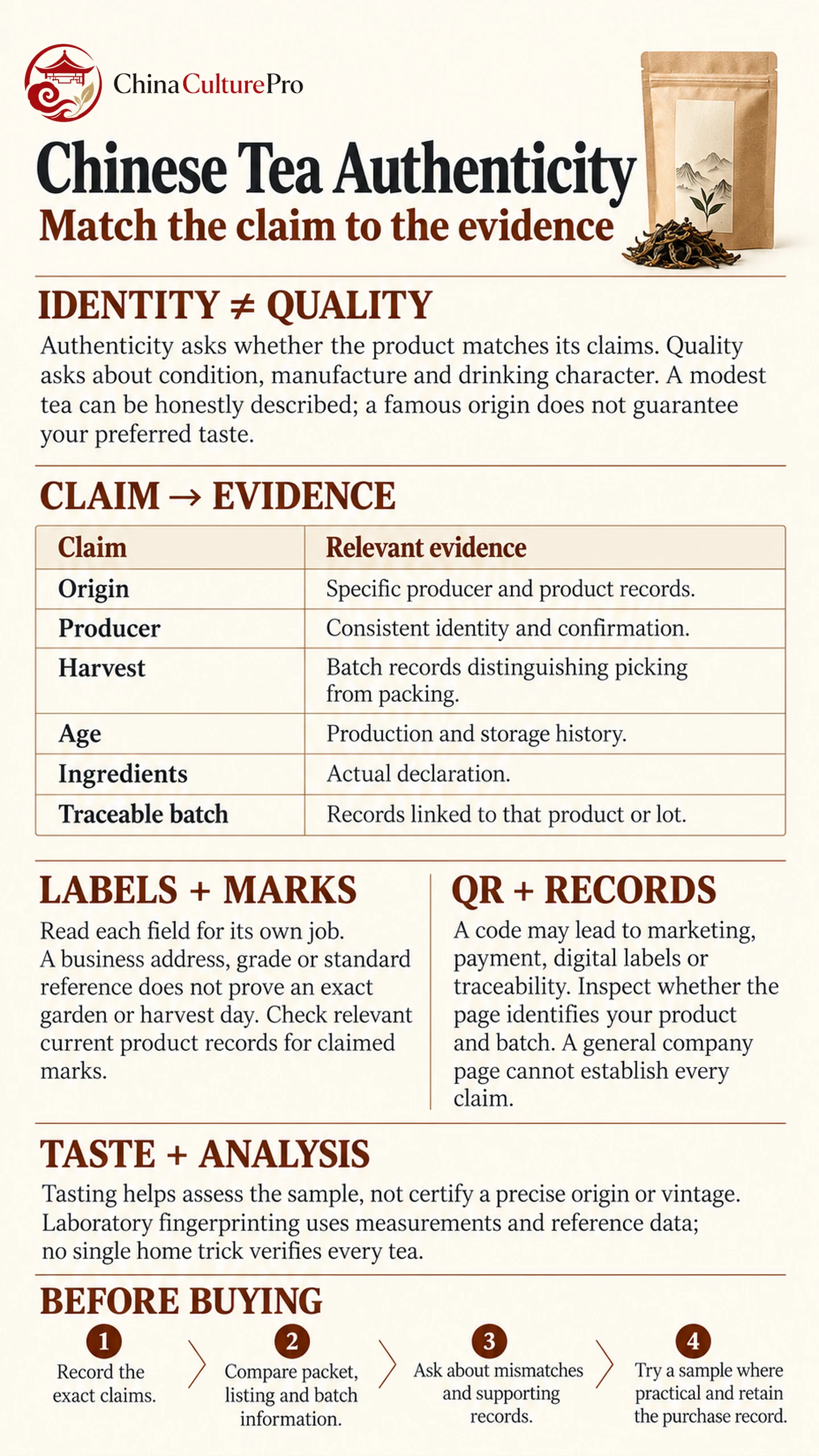
Assess Chinese tea authenticity by comparing a specific claim with evidence about the actual product. Traceability (溯源, sùyuán) connects a tea with records of its production and movement; it is more informative than an attractive wrapper alone.
- Identify the claim: Origin, producer, harvest, age and ingredients are different questions.
- Seek consistency: The label, batch information, seller’s explanation and relevant records should agree.
- Know the limits: Price, taste, a famous name or a QR code does not independently prove every claim.
Authentic identity and enjoyable quality overlap, but are not the same judgment.
“Is this tea real?” is often too broad a question. A product might contain genuine tea leaves yet be inaccurately described as coming from a particular garden, producer or year. Begin by deciding exactly what needs to be verified.
Authenticity and Quality Are Different Questions
Authenticity concerns whether the tea matches the claims made about it. Quality concerns its condition, manufacture and drinking character. A modest everyday tea can be honestly described and enjoyable; a famous origin does not guarantee that every batch suits your taste.
Likewise, disliking a tea does not establish fraud. Brewing, storage, picking and personal preference can explain differences between expectation and the cup. Keep those possibilities separate from evidence that a producer, ingredient or origin statement is false.
Chinese tea grades introduce another layer. A grade name belongs to a product-specific system or seller description; it is not a universal authentication result. Ask which definition the term follows before comparing impressive labels across unrelated teas.
Match Each Claim to the Right Evidence
A stronger claim needs evidence that addresses that claim, rather than a document that merely looks official.
| Klaim | More relevant evidence to seek |
|---|---|
| Named producing region | A specific origin statement supported by the producer and applicable product records. |
| Named producer or brand | Consistent producer identity and confirmation through the producer’s own channels where available. |
| Harvest season or date | Batch records that distinguish picking from later manufacture or packing. |
| An aged vintage | Production and storage history, rather than an old-looking wrapper. |
| A particular ingredient blend | The actual ingredient declaration and product description. |
| A traceable batch | Records linked to that product or lot, not only a general company page. |
Harvest-season claims and aged-tea claims require different context. A packing date is not automatically a harvest date, and a pressing date is not necessarily the age of all the leaf material.
The table is a way to organize questions, not a promise that every document is independently verified or that all small producers offer identical record systems.
What a Label or Mark Can Actually Establish
A geographical indication (地理标志, dìlǐ biāozhì) connects a named geographical scope with relevant product characteristics or reputation. It is different from a scenic place name used as decoration. Official explanations distinguish geographical-indication protection and associated collective or certification-mark arrangements.[1]
For a named regional tea such as Lushan Yunwu, ask what origin the seller claims and what supports that statement. Do not assume that an address near a famous mountain identifies the precise source of every leaf.
A producer’s address can identify a business or packing operation. A product standard reference describes a declared specification. A grade describes a classification within its relevant context. These fields should not be silently converted into proof of a particular garden, harvest day or top sensory quality.
Where a mark is claimed, check its identity and the relevant producer information through an appropriate official or rights-holder source. Current producer information and authorization should be checked against the relevant product record.
Traceability Is More Than a Printed QR Code
QR codes can serve different functions: marketing, payment, digital labeling or traceability. Official descriptions of commodity QR-code development explicitly distinguish these uses and describe the possibility of linking product identity and batch data.[2] The presence of a square code alone does not tell you which function it performs.
An actual tea traceability initiative in Chongqing records information such as the producing entity, raw-material source and inspection documentation, connecting the code with a wider record system.[3] Tea traceability also has a dedicated technical standard; it is a subject of record management rather than a decorative packaging feature.[4]
After scanning, look at what is shown. Does the page identify your product or lot, or merely describe a company? Are the producer, dates and product details consistent with the packet? A valid link can still answer a narrower question than the one you hoped to verify.
For compressed tea, a distinctive cake shape or attractive printing offers no substitute for those connections. Physical presentation is easy to notice, but the record needs to describe the tea inside it.
What Tasting and Laboratory Methods Can Tell You
Tasting helps evaluate the sample’s aroma, balance and condition. It can expose a mismatch with what you wanted, but cannot independently certify an exact garden, picking day or vintage. A seller’s confident tasting vocabulary is not a chain of custody.
Laboratory origin work uses analytical measurements and reference material. A university teaching account describes tea fingerprinting through trace elements and isotopes, illustrating the difference between an analytical comparison and a home tasting impression.[5] Such methods are useful within the questions and reference data for which they are developed; they do not turn every cup into a complete identity test.
Avoid internet shortcuts that promise to prove origin from one color, leaf shape or cold-water trick. Those observations may have several explanations. They should not become grounds for accusing a seller without more relevant evidence.
Storage conditions also affect a sample after manufacture. A genuine tea can be poorly kept, while a pleasant cup does not validate every statement on its label.
A Practical Check Before Buying
- Record the exact product name and the claims that matter to you, including origin, producer, harvest or age.
- Compare the packet, listing and available batch information, distinguishing picking, manufacture, pressing and packing dates.
- Ask the seller to explain any mismatch and provide relevant product-specific records or confirmation channels.
- Try a sample where practical, judge its present condition and flavor, and keep the purchase record with the product information.
If an important claim remains unsupported, treat it as unresolved rather than making the missing evidence disappear through a higher price or a romantic story. You can choose an honestly described everyday tea without needing the most prestigious origin name.
FAQs About Chinese Tea Authenticity
Does a high price prove that tea is genuine?
No. Price can reflect many factors and is not independent verification of origin, producer or age. Very cheap and very expensive teas both need claims read carefully.
Does a QR code guarantee the stated origin?
No. Check what the code links to and whether the records correspond to the actual product or batch. A general page cannot establish every origin claim.
Can you identify exact origin by tasting alone?
Not reliably. Tasting helps assess the sample, while precise identity claims need additional evidence and, in some contexts, appropriate analytical comparison.
Sumber
[1] National Intellectual Property Administration. Geographical Indications Registered as Collective or Certification Marks
[2] State Administration for Market Regulation. Revised Commodity QR-Code Standard Takes Effect
[3] Chongqing Market Regulation Administration. Tea Markets Adopt the Yusuyuan Traceability Code
[4] National Standard Information Platform. Agricultural Product Traceability Requirements: Tea
[5] University of Western Australia. Forgeries, Fakes and Fingerprinting