

Quick Answer: What Is Chinese Summer Cloth?
Chinese summer cloth (夏布, xiàbù) is a woven fabric traditionally made from ramie (苎麻, zhùmá). Makers separate fibers from the stem, prepare them into yarn and weave the yarn on a loom. The cloth is associated with warm-weather clothing and is also used for furnishing and decorative work.[1][2][3][4]
- Material: Ramie provides the long fibers used for traditional summer cloth.[1]
- Technique: Workers separate and join fibers, remove natural gums and weave the prepared yarn.[1]
- Regional traditions: Rongchang in Chongqing and Wanzai in Jiangxi have national heritage entries for summer cloth weaving.[3][4]
A label such as “grass linen” can refer to ramie. Read the fiber name separately from the name of the cloth.[1][5]
A length of summer cloth begins with the stem of a plant. Its feel depends on what happens between that stem and the loom. A pale, fine bolt and a coarse, visibly textured one can come from the same crop. Yarn preparation and the way threads are set on the loom account for much of that difference.
How Ramie Stems Become Woven Cloth
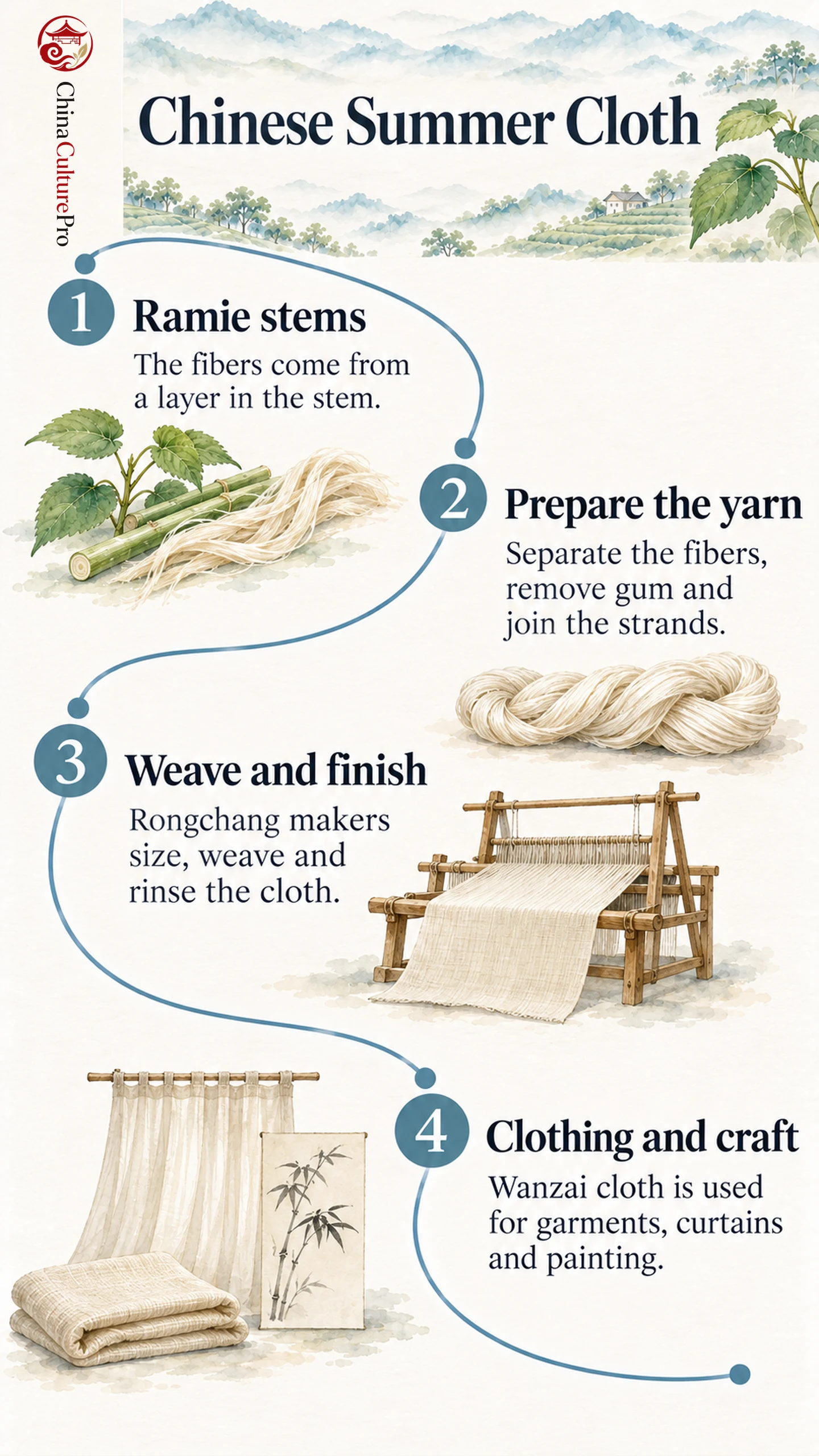
Ramie fibers come from a layer in the stem. After harvesting, workers strip or scrape the stems and separate usable fibers. The fibers contain natural gums. Removing them helps make the fibers easier to work into fine yarn. In some traditions, workers connect lengths of fiber by hand, then twist or spin them into yarn.[1]
Five albums of Qing export paintings by the Cantonese artist Sunqua show work from planting to clothing. The Science History Institute dates the set to about 1820–1870. The first album shows planting and harvesting. Later scenes show workers scraping stems, joining fiber ends and processing yarn. The paintings show several jobs that a finished bolt of cloth conceals.[1][2]
Gum removal can happen at different stages. The Yuan agricultural writer Wang Zhen describes steaming the plant before stripping it. A Ming account describes boiling the fibers before spinning. One Qing album shows yarn being heated before weaving, a step the accompanying notes describe as bleaching. The Science History Institute reads it alongside historical treatments for softening and removing gum. In Rongchang, preparing the loom includes arranging the lengthwise threads, threading them through the reed that spaces them, and applying sizing before weaving. The Rongchang heritage entry also records rinsing and shaping after weaving.[1][3]
Rongchang and Wanzai Summer Cloth
In Panlong, Rongchang, the heritage entry records fine cloth, coarse cloth and ribbed cloth. The categories tell you that the name identifies a local weaving tradition with more than one fabric weight or surface.[3]
Wanzai’s entry describes round-yarn summer cloth (圆纱夏布, yuánshā xiàbù), named for the form of its yarn. Wanzai makers have used the cloth for garments, curtains and other crafts, including a surface for painting and writing. Rongchang and Wanzai appear under the same national heritage project number, VIII-102, in the 2008 list, with separate local entries.[3][4]
Clothing, Trade and Other Uses
The name summer cloth points to its familiar use in warm weather. The Qing albums include scenes of cutting ramie cloth for clothing. The choice of cloth was only one part of making a garment. The guide to Chinese ramie clothing looks at how that material was used in dress.[1]
Rongchang summer cloth was exported to Japan during the Qing period. Modern reporting from the district shows that the textile is still used for clothing and has also been made into sheets and notebook covers. Its history includes both the movement of bolts of fabric and the making of finished goods.[3][5]
The fiber name matters when comparing warm-weather feel and weight across fabrics. Chinese hemp textiles use a different plant fiber. A smooth, light fabric might also be silk. The guide to Chinese silk clothing shows why a description needs both a fiber and a weave.
FAQs About Chinese Summer Cloth
Is Chinese grass linen made of flax?
In accounts of traditional xiabu, grass linen usually means ramie cloth. Flax linen comes from a different plant. Check the actual fiber identification when reading a label.[1][5]
Can a modern xiabu product use a fiber blend?
Yes. The Rongchang heritage profile for Li Jiankang describes his work with cotton and ramie together. A specific item’s fiber label is the best guide to its composition.[6]
Is all summer cloth loose and sheer?
No. Rongchang’s tradition includes closely woven fine cloth as well as coarser varieties. The yarn and the spacing of the weave affect the look and feel of the finished fabric.[3]
Sumber
[1] Science History Institute. Weaving History
[2] Science History Institute Digital Collections. The Story of Ramie From Seed to Finished Garment, Book 1
[3] China Intangible Cultural Heritage Digital Museum. Summer Cloth Weaving in Rongchang
[4] China Intangible Cultural Heritage Digital Museum. Summer Cloth Weaving in Wanzai
[5] Xinhua via ChinaCulture.org. A Stalk of Chinese Grass Weaves Its Way to the World
[6] China Intangible Cultural Heritage Digital Museum. Li Jiankang